Quote of the day: In an age dominated by endless notifications, crowded schedules and constant noise, a decades-old quote from Hans Hofmann is once again striking a nerve online.
The quote may sound simple at first glance, but its message carries unusual emotional weight in modern life. Whether applied to relationships, careers, creativity or mental health, Hofmann’s words continue resonating because they challenge a culture obsessed with excess.
At a time when people are trying to declutter their homes, reduce stress and disconnect from digital overload, the quote feels less like artistic advice and more like a survival strategy.
Quote of the day
“The ability to simplify means to eliminate the unnecessary so that the necessary may speak.”Why Hans Hofmann’s Quote Still Matters Today
The appeal of Hofmann’s quote lies in its universality. It can apply to almost anything. For some people, it reflects the need to remove distractions in order to focus on meaningful goals.
For others, it serves as a reminder that clarity often comes from subtraction, not addition.
Modern productivity culture frequently encourages people to do more, consume more and achieve more. Hofmann’s perspective moves in the opposite direction. Instead of piling things on, his philosophy asks what can be removed.
That idea has become increasingly relevant as conversations around burnout, anxiety and overstimulation continue growing worldwide.
Minimalist lifestyles, “quiet luxury,” digital detox trends and simplified living movements all echo the same underlying principle Hofmann expressed decades ago: what truly matters becomes visible only when unnecessary noise disappears.
Who Was Hans Hofmann?
Though many people recognize the quote, fewer know the remarkable story behind the artist who said it.
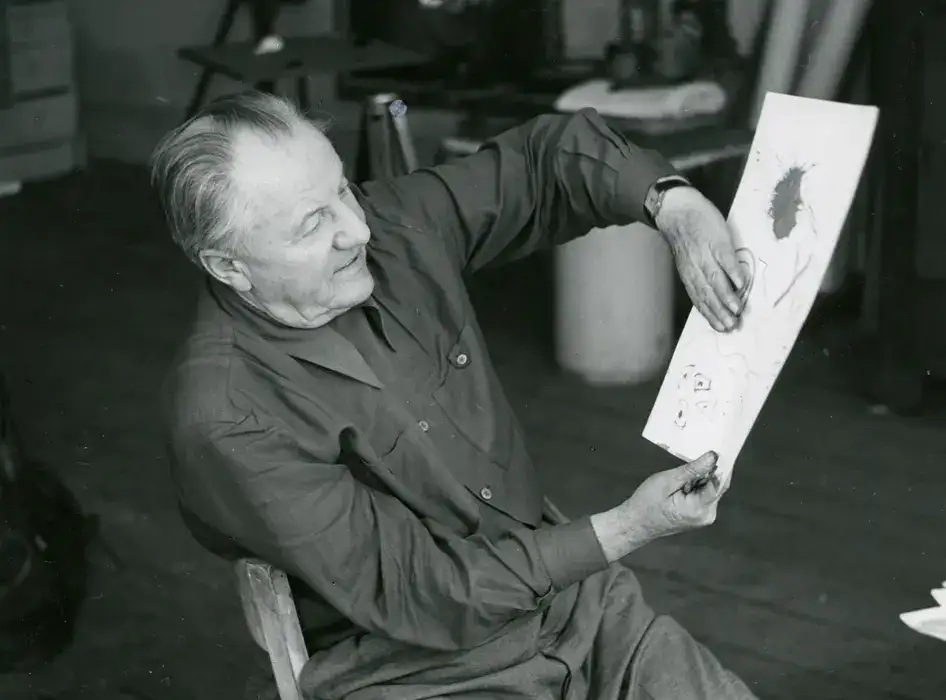
Hans Hofmann was born in Germany in 1880 and eventually became one of the most influential art teachers and painters of the 20th century. His career helped shape the future of modern American art.
After studying in Munich, Hofmann moved to Paris in the early 1900s, where he became deeply inspired by groundbreaking artists such as Henri Matisse and Robert Delaunay.
Their bold use of color and experimentation transformed his understanding of painting.
Years later, Hofmann relocated to the United States, where he became a legendary teacher in New York City. His Hans Hofmann School of Fine Art quickly gained prestige and helped influence a new generation of painters.
Many historians credit Hofmann with helping pave the way for the rise of Abstract Expressionism after World War II.
The Hidden Meaning Behind the Quote
While Hofmann spoke primarily as an artist, the deeper meaning behind the quote extends far beyond painting. At its core, the statement is about intentionality.
Simplifying does not mean removing beauty, emotion or ambition. Instead, it means stripping away distractions that weaken the message.
In art, that could mean reducing unnecessary details so the strongest shapes and colors stand out. In life, it might mean letting go of toxic relationships, overcommitment or endless comparison.
The quote also challenges the idea that complexity automatically equals intelligence or value. Sometimes the clearest message is also the simplest.
That philosophy has influenced not only artists but also architects, designers, writers and entrepreneurs for generations.
Why Simplicity Feels So Difficult Now
Ironically, simplicity has become harder to achieve in modern society. Social media constantly pushes people toward overconsumption, overstimulation and comparison. Attention spans are shrinking while digital platforms compete aggressively for every second of focus.
That is partly why Hofmann’s quote continues resurfacing online. Many people feel mentally exhausted by constant noise and are searching for ways to reclaim clarity.
Experts in psychology and wellness often note that simplifying environments and routines can reduce stress and improve focus. Whether through decluttering physical spaces or limiting digital distractions, the principle remains remarkably similar to Hofmann’s artistic philosophy.
The unnecessary must go so the necessary can finally be heard.
Hans Hofmann’s Influence on Modern Art
Beyond his famous words, Hofmann’s legacy in the art world remains enormous. His experimental approach to color, movement and abstraction influenced artists connected to the Abstract Expressionist movement, including figures associated with postwar American modernism.
One of his notable works, “Spring” (1940), is often cited for its early experimentation with paint-dripping techniques later associated with Jackson Pollock.
Hofmann eventually closed his influential art school in 1958 to focus entirely on his own work. Before his death in 1966, he also established a gallery dedicated to exhibiting his art in Berkeley.
Today, his quote continues reaching audiences far beyond galleries and museums because its message speaks directly to modern anxieties about focus, meaning and balance.
FAQs
Who was Hans Hofmann?
Hans Hofmann was a German-American painter and influential art teacher known for helping shape Abstract Expressionism in the United States.
Why is Hans Hofmann important in modern art?
Hofmann influenced generations of artists through both his teaching and experimental abstract paintings, helping pave the way for postwar American art movements.