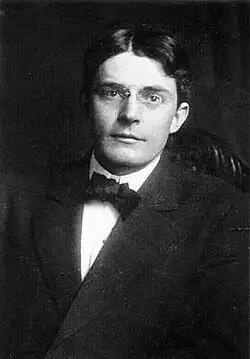
Quote of the Day by American psychologist John B. Watson : In psychology, few ideas have sparked as much debate as the question of whether people are born a certain way or shaped by the world around them. Long before modern discussions about mindset, habits, and self-improvement became popular, American psychologist John B. Watson was challenging traditional beliefs about human nature.
Quote of the Day by American psychologist John B. Watson
Today's quote of the day from Watson remains one of the most thought-provoking statements in psychology:
"There are... for us no instincts. We no longer need the term in psychology. Everything we have been in the habit of calling an 'instinct' today is a result largely of training, belonging to man's learned behavior."
The statement captures the core philosophy behind behaviorism, the psychological movement Watson helped establish. His message was simple but revolutionary: much of what we become is learned, not predetermined.
Quote of the Day by John B. Watson: Psychological Context
John B. Watson is widely regarded as the founder of behaviorism, one of the most influential schools of psychology in the twentieth century. At a time when psychologists focused heavily on thoughts, emotions, and consciousness, Watson argued that psychology should concentrate on observable behavior.
He believed that human actions are shaped primarily through experience, conditioning, and environmental influences. Rather than viewing personality, fears, talents, and habits as fixed traits, Watson argued that people learn behaviors through interactions with the world around them.
His famous quote reflects this belief. Watson challenged the notion that instincts govern most human behavior. Instead, he suggested that what we often label as natural tendencies are largely the result of learning, repetition, and training over time.
This idea became a cornerstone of behaviorist psychology and influenced decades of research on learning, education, parenting, and human development.
John b. Watson Quote of the Day: deeper meaning and modern relevance
The deeper meaning behind Watson's quote is both empowering and unsettling. If behavior is primarily learned, then many of our strengths, weaknesses, fears, and habits are not permanent parts of who we are. They can be modified, improved, or replaced through new experiences and deliberate practice.
This perspective shifts responsibility away from destiny and toward action. Instead of saying, "That's just how I am," Watson's philosophy encourages us to ask, "What have I learned, and what can I learn differently?"
The relevance of this idea is especially powerful in today's world. People frequently define themselves by labels, past failures, personality tests, or limiting beliefs. Many assume they are naturally bad at public speaking, mathematics, leadership, communication, or relationships.
Watson's work offers a different perspective. It suggests that many behaviors are learned patterns rather than fixed realities. Confidence can be developed. Discipline can be practiced. Communication skills can be improved. Resilience can be strengthened.
While modern psychology recognizes that both biology and environment influence human behavior, Watson's central lesson remains valuable: our surroundings, experiences, and daily habits have tremendous power to shape who we become.
In an age focused on personal development and lifelong learning, his message continues to challenge people to look beyond limitations and embrace the possibility of change.
John B. Watson's Early Life and Career
John Broadus Watson was born on January 9, 1878, near Greenville, South Carolina. His early life was marked by hardship after his father left the family when Watson was a teenager. Raised in a strict household, he eventually developed a strong interest in understanding human behavior and motivation.
Watson attended Furman University before earning his Ph.D. in psychology from the University of Chicago in 1903. His academic career flourished rapidly, and in 1908 he joined Johns Hopkins University, where he established a groundbreaking laboratory for comparative and animal psychology.
In 1913, Watson published his influential paper "Psychology as the Behaviorist Views It," a work often regarded as the manifesto of behaviorism. In it, he argued that psychology should focus exclusively on observable actions rather than subjective mental experiences.
His books, including Behavior: An Introduction to Comparative Psychology (1914), Psychology from the Standpoint of a Behaviorist (1919), and Behaviorism (1925), helped popularize the movement and brought behavioral science into mainstream discussion.
Watson is also remembered for the controversial "Little Albert" experiment, which attempted to demonstrate that emotional responses such as fear could be conditioned through experience.
After leaving academia in 1920, Watson entered the advertising industry, where he applied psychological principles to marketing and consumer behavior. His work helped shape modern advertising strategies and demonstrated how psychological insights could influence everyday decision-making.
Though behaviorism later evolved and expanded through the work of other psychologists, Watson's influence remains undeniable. His emphasis on learning, conditioning, and environmental influence transformed psychology and laid the foundation for many modern approaches to behavior change.
Today, John B. Watson is remembered as a pioneering thinker whose ideas challenged assumptions about human nature and opened new ways of understanding how people learn, adapt, and grow.