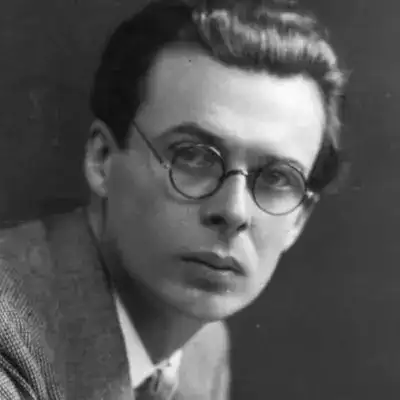
Quote of the day by Aldous Huxley : Human thought is rarely stable for long periods of time. The way people interpret life, make decisions, and understand their place in the world often changes depending on mood, energy levels, and even the time of day. What feels absolutely certain in the morning can seem questionable by the afternoon. This shifting nature of belief is part of everyday human experience, yet it often goes unnoticed. A quote by English writer Aldous Huxley captures this subtle contradiction in human psychology, showing how quickly the mind can move between opposing viewpoints without any major change in circumstances.
Aldous Huxley’s Quote on Changing Perspectives
Today's quote by Aldous Huxley is, “ A man may be a pessimistic determinist before lunch and an optimistic believer in the will's freedom after it ,” as per BrainyQuote report.
Why Human Opinions and Decisions Change So Quickly
Huxley’s observation highlights the flexible and sometimes contradictory nature of human belief systems. At one moment, a person may lean toward determinism, the idea that life is governed by forces beyond individual control, where outcomes feel pre-decided. This mindset often carries a sense of limitation or pessimism.
Quote of the Day May 20: The Psychology Behind Mood-Based Thinking
Yet, within the same day, the same individual may shift toward a belief in free will, feeling that personal choices and effort can actively shape outcomes. This sudden transition from pessimism to optimism does not necessarily come from new information, but from an internal change in mood, reflection, or emotional state.
The quote suggests that human beings are not strictly logical machines with fixed philosophies. Instead, they are influenced by subtle psychological and emotional shifts that can completely alter how reality is interpreted. What seems like a firm belief system is often more fluid than it appears.
What Does Aldous Huxley's Quote Reveal About Modern Life and Decision-Making
People constantly move between confidence and uncertainty. Decisions about careers, relationships, finances, and personal identity are rarely made with complete emotional consistency. Social pressures, fatigue, hope, and anxiety all play a role in shaping how situations are viewed at different times.
Huxley’s quote reflects this lived reality. It suggests that changing one’s mind is not unusual or irrational, but rather a natural part of how human consciousness works. Recognizing this can help reduce self-judgment when opinions shift or when certainty fades unexpectedly.
Understanding the Fluid Nature of Human Belief Systems
The quote serves as a reminder that belief is not fixed but fluid. Human perspective is shaped continuously by internal states and external experiences. Understanding this can lead to greater self-awareness, patience, and acceptance of the fact that even strong convictions may change with time, reflection, or something as simple as the passing of a day.
Who Was Aldous Huxley
Aldous Huxley (1894–1963) was an English novelist and critic known for his sharp intellect, wit, and pessimistic satire. Born in Godalming, Surrey, he came from a prominent intellectual family, including biologist Thomas Henry Huxley as his grandfather and writer Leonard Huxley as his father, as per a Britannica report.
He studied at Eton and Balliol College, Oxford, graduating in 1916. After developing partial blindness from keratitis, he continued reading and writing with difficulty. He began publishing in 1916 and later worked for The Athenaeum before focusing fully on writing, spending time in Italy and eventually settling in California.
Huxley gained early recognition with Crome Yellow (1921) and Antic Hay (1923), which satirized English intellectual society. His most famous work, Brave New World (1932), presented a dystopian future shaped by technology, conditioning, and state control, as per the Britannica report.
His later works, including Eyeless in Gaza, The Devils of Loudun, The Doors of Perception, and Island (1962), explored philosophy, mysticism, and human consciousness. Huxley died in 1963 in Los Angeles, leaving a lasting legacy in modern literature and social critique.