The recent increase in undocumented Cuban emigration _ more than 44,000 reached the United States in the past eight months alone _ is complicating the Obama administration's drive to normalize relations with Havana and cut the migrant flow through Central America.
Trying to halt the huge and almost permanent flow of Cubans traveling toward the Mexico-U.S. border, Washington appears to be supporting large-scale deportations of undocumented migrants.
The Cuban migration crisis exploded late last year when Costa Rica cracked down on a people-smuggling network, unleashing a chain reaction during which Nicaragua and then Panama closed their southern borders to undocumented Cubans. From the start, the U.S. government has referred to the Cubans as "undocumented immigrants" and urged governments in the region to tighten their migration controls as part of the fight against people-smuggling.
A State Department spokesperson in November said "all countries have the duty to put in place documentation requirements and border control mechanisms. This ensures that no travelers will arrive without documents, as well as the return of undocumented immigrants to their starting point, in accordance with the law and international practice."
In July, a senior State Department official said the issue of emigration had been discussed with the governments of Cuba and Central and Latin American countries affected by the migrants.
The governments of Cuba and several Central American countries have blamed U.S. immigration policies for the increase in Cuban migration and the humanitarian crises it has sparked. In the U.S. Congress, Reps. Ileana Ros-Lehtinen and Carlos Curbelo, both Florida Republicans, have blamed the increased migration on President Barack Obama's decision to resume diplomatic relations with Cuba, and on the absence of positive changes on the island.
Behind the scenes, however, the U.S. government has been seeking ways to contain migration from Cuba exodus without changing U.S. policy, documents and official statements indicate.
Cubans without U.S. visas who reach the United States are allowed to stay under the wet foot, dry foot policy, and the Cuban Adjustment Act then allows them to obtain permanent residence after 366 days. Efforts by Curbelo and Sen. Marco Rubio, R-Fla., to change the policy have failed.
In January 2015, when about 8,000 Cubans were stranded in Costa Rica, the U.S. government gave $1 million to the International Organization for Migration to provide food, water and medicine to them. The donation did not become public until March. That crisis was resolved when the migrants were flown to Mexico and then continued to the U.S. border. Later flights carried nearly 3,000 Cubans stranded in Panama to Mexico.
Thousands more remain stranded in Colombia and Ecuador, however.
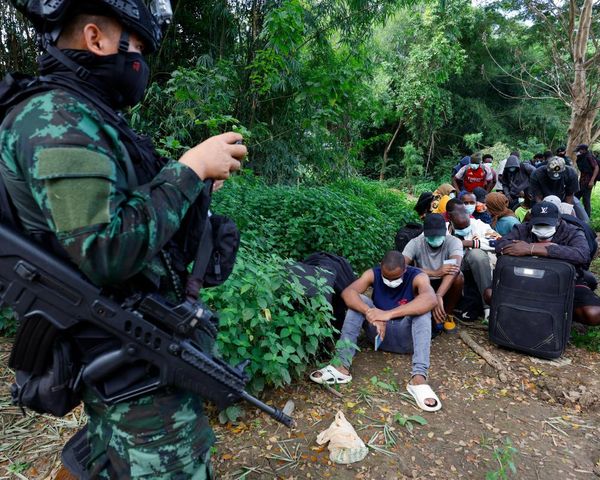
In the Colombian town of Turbo, more than 1,000 stranded Cuban migrants are seeing their dreams of reaching the United States fade after President Juan Manuel Santos announced they would be expelled.
The flights to Mexico from other Latin American nations have been costly, and the increase in Cuban migration has put pressure on the infrastructure and public assistance agencies in towns not prepared to deal with such large groups. In Turbo, the mayor recently declared a "state of public calamity" because of the overcrowding and unsanitary conditions faced by the Cubans, who want to cross into neighboring Panama to the north.
A senior State Department official has said that Washington views the airlifts to Mexico "useful to alleviate temporary humanitarian issues at the time, but we don't see that as a viable medium and long-term approach. We may need to engage with both the Central Americans and the Mexicans in terms of promoting the idea of safe, orderly, legal migration and restricting or repatriating irregular migrants."
Ecuador's decision last year to start requiring entry visas for Cubans appeared to be the result of negotiations between the different governments affected by the crisis, judging from the official's comments.
"The impact of some of the discussions that have been held was (that) many of the Cuban migrants were moving through Ecuador, where there is not a visa requirement for Cubans. A visa requirement has been imposed by the Ecuadoran government, which has reduced the flow to some extent there," the State Department official said. "In fact, the Ecuadoran government deported, I think, over 200 Cubans back to Cuba, who clearly were migrants."
The Ecuadoran government was criticized by from human rights activists after it evicted hundreds of Cuban protesters from a Quito park, and then deported 122 to Cuba within one week.
The Inter-American Commission on Human Rights, a branch of the Organization of American States, said it has received information that the Cubans deported were not migrants but people who were "seeking asylum and refuge."
Several countries in the region are tightening their immigration policies.
Colombian Foreign Minister Maria Angela Holguin announced in mid-July that her country had deported 2,841 Cubans to Ecuador since Jan. 1. Santos said last week that Colombia must reform its laws "to more effectively control this type of immigrants, who cause problems for the mayors of the towns where they gather."