Afternoon summary
-
David Cameron has said that the legislative programme unveiled by the Queen at the state opening of parliament is designed to stop Britain being a “two-speed country”. In an introduction to the government’s 103-page briefing document (pdf) on the plans, reproduced on Facebook, he claimed it was a “one nation Queen’s speech from a one nation government”. In his speech in the Commons he said he wanted to “increase the pace of reform in education” and he brushed aside calls for ministers to be allowed a free vote in the forthcoming EU referendum. He also challenged Labour to prove it backed aspiration by voting for the government’s proposed tax cuts.
In recent days, I have noticed some of the candidates for the Labour leadership seem to have discovered a new word: the word being aspiration. Apparently it has upset John Prescott, he went on television to explain he doesn’t know what it means. I am happy we should spend the next five years explaining what it means and how vital it is to everyone in our country. If the party opposite truly believe in aspiration, they will vote with us to cut people’s taxes so people can spend more of their own money as they choose. If they believe in aspiration, they will be voting with us to cap welfare and use the savings to fund more apprenticeships.
Some may question Cameron’s commitment to one nation politics (see 11.34am) and it is probably best to interpret Cameron’s constant use of the phrase partly as a sign of how worried Cameron is about the standing of the Conservatives outside England. There is a telling passage on this in the House of Commons’s excellent briefing note on the results of the 2015 election (pdf).
318 (96%) of the Conservative’s 330 MPs have seats in England, where the party won 40.9% of the vote. The government elected in May 2015 holds the lowest number of Scottish seats of any government. It also won the lowest share of the vote in both Wales (27.2%) and Scotland (14.9%) of any government since 1945.
-
Labour and union leaders have criticised plans in the Queen’s speech that could lead to the chief source of funding for the Labour party – the trade union political funds – facing big cuts. As Patrick Wintour reports, the trade union bill, put forward by the frontbench Conservative MP Sajid Javid, will create a shift from a current system whereby union members have to contract out from paying the political levy to one in which they have to contract in. The change, from a system of inertia to one in which members actively choose to pay, is likely to lead to a big dropoff in income to the unions. Paul Kenny, the GMB general secretary, said this was anti-democratic.
It’s one rule for the Tory slush fund, hedge funds and another for trade union members.
This will not deter or silence the voices of millions of working people who already give their approval for political funds through democratic ballots governed by statute.
It will bring state funding for political parties a step nearer. It is not sustainable to allow the elite and companies unfettered and unlimited rights to fund the Tory Party while shackling the bodies that have funded the political opposition to them for more than a century.
-
Harriet Harman, the acting Labour leader, has told MPs that the reality of the Queen’s speech does not match its rhetoric. In her speech she said:
The Queen’s speech talks of “one nation”– yet he sets the nations of the country against each other.
The Queen’s speech talks of ‘working people’ – yet he threatens basic rights at work.
At a time when our economy, our constitution and our public services are all fragile, we fear this Tory government will make things worse.
So as the dust settles, the real question for this Queen’s speech is – will it improve our country, our communities and people’s lives?
-
Nick Clegg, the outgoing Lib Dem leader, has said Cameron should spell out what he wants to achieve from his EU renegotiation. In his speech he told MPs:
This must be the first time in living memory that a country’s citizens are being asked to support the outcome of a renegotiation on a matter of such importance to its place in the world without the government of the day setting out in this house what it wants to achieve.
And because we do not know what the government considers a successful negotiation, we do not know for sure which side the prime minister will take in a referendum ...
So my advice to the government is this:
Pursue your renegotiation with the EU, but spell out exactly what you hope to achieve, so that people understand the choice that’s in front of them.
Clegg also said that, although the government was acting now as if it expected to win the referendum easily, it should be careful, because circumstances could change. “Having witnessed two referenda spin off in entirely unpredicted directions in recent years, I would strongly counsel against any complacency,” he said.
-
John Bercow, the Commons speaker, has reprimanded SNP MPs for clapping their Westminster leader, Angus Robertson. Bercow told them:
Can I say at the start of the parliament that the convention that we don’t clap in this chamber is very, very, very long-established and widely respected? And it would be appreciated if members would show some respect for that convention. They will get their speaking rights from this chair – of that they can be assured. They will be respected but I would invite them to show some respect for the traditions of this chamber of the House of Commons.
-
Lord Wallace of Tankerness, the Lib Dem leader in the Lords, has told peers that the Lords has the right to block government legislation – even if it was in the government’s manifesto. Under the Salisbury convention, peers are supposed to refrain from voting down measures that were in the manifesto of the governing party. In a speech, Wallace acknowledged that. But he implied that the Lords could ignore this in some circumstances.
It is of course right and proper that we uphold the measures which allow our revising chamber to remain a self-regulating house. I do not question the right of the House of Commons and a government who command the confidence of it to have its legislation dealt with in a constructive manner by this House.
But we may wish to reflect on the strength of the mandate of a government, which secured less than 37% of the popular vote on a turnout of 66%, should it seek to drive through ill-thought through and reactionary legislation without the robust scrutiny and the proper checks and balances, provided by this house. The government would do well to remember that the Cunningham report on the conventions of the UK parliament, which recognised the right of this house, in extreme and exceptional circumstances, to say no. The importance of the House of Lords retaining the right to say no is that it is that power which brings the government to the table in a constructive frame of mind ...
This house has demonstrated time and time again that it is the last bastion of defence of civil liberties and human rights. On these issues in particular, this house has a legitimate right to question the excesses of any government. It has the right to vigorously scrutinise and revise legislation.
That’s all from us for today. Thanks for the comments.
Updated
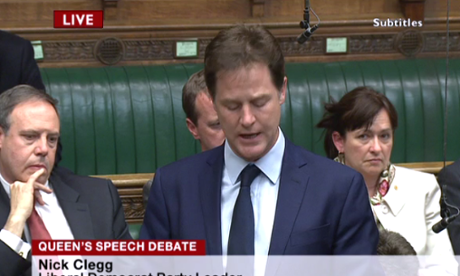
Nick Clegg is speaking now. The chamber is largely empty. When he last spoke in the Commons, he used to encounter a wall of noise, he says. Now, in what he says will be his last speech in the chamber as Lib Dem leader, he says it is a relief to be heard in silence.
Boris Johnson, the mayor of London, has just made his first intervention in the new Commons. Cheryl Gillan, the Conservative former Welsh secretary, is speaking, and she said her constituents had a hard time getting Transport for London to provide step-free access at Amersham station. Johnson stood up to defend TfL, saying it did a great job.
Getting pretty empty in the house now for #QueensSpeech debate - but Nick Clegg's still there http://t.co/5X7fbx3UhR pic.twitter.com/kUqtobprQs
— #SunNation (@SunNation) May 27, 2015
Emily Thornberry has finished speaking. Alex Salmond, the former SNP leader, rises to make a point of order. Would it be appropriate for the government to change the standing orders of the Commons to reduce the rights of some MPs (Scottish MPs) without taking proper constitutional advice from a committee, or some other body, he asks.
John Bercow says Salmond has raised a serious point. He says he will reflect on it, and respond to Salmond in due course.
After Angus Robertson’s speech, John Redwood was called next. We thought Nick Clegg might follow Redwood (speakers are always called in order – government, opposition, etc), but Labour’s Emily Thornberry was called next, and is speaking now. That means Clegg will have to wait a bit longer before he gets to deliver his speech, some of which was briefed overnight.
Updated
If you haven’t already seen it, the Comment is free panel verdict on the Queens speech from Hugh Muir, Deborah Orr, Michael White and Martin Kettle is well worth a read.
Here is an extract from Michael White’s piece.
What unifies this evidence-lite package is the yawning gap between pious aspiration (not-so-pious stuff, too) and the realities it is likely to confront, including the forces – English peers as well as Scottish Nats – determined to block it. Can we really confiscate the modest pay of illegal immigrants? Where will the extra doctors and their pay come from to provide all-hours GP services? How does the greater energy security the Queen promised us square with a Nimbys’ charter on planning consent for unpopular wind farms?
When Cameron talks in his introduction to the official text (big-footing Her Majesty, some may feel) of a “two-speed society” – and bigs up the very welcome “northern powerhouse” rhetoric emanating from Tatton’s George Osborne – we applaud the sentiment, but note that he is also committed to welfare cuts that will hurt many of the most vulnerable.
Updated
The SNP MP Gavin Newlands has taken to Twitter to effectively criticise John Bercow for trying to stop SNP MPs clapping Angus Robertson. He is accusing Bercow of being old-fashioned.
The speaker has asked us to respect convention & not applaud agreeable comments. Apparently we must bray 'hear hear' like it's 18th century!
— Gavin Newlands MP (@GavNewlandsSNP) May 27, 2015
Updated
Angus Robertson's speech
Angus Robertson, the SNP’s leader at Westminster, has been speaking for more than five minutes now.
Twice his comments prompted SNP MPs to clap. On the second occasion, John Bercow interrupted and told them - well, that this was not on. He did not have a good reason why clapping was not allowed; he just said that for many years it had not been the practice in the Commons.
Here are some other highlights.
SNP MPs clap as Angus Robertson declares that the SNP are the third party in the House of Commons
— James Forsyth (@JGForsyth) May 27, 2015
Angus Robertson congratulates David Cameron on his election success...in England #QueensSpeech
— Libby Brooks (@libby_brooks) May 27, 2015
SNPs Robertson criticises PMs "one nation" rhetoric which should recognise there are four nations with four different leading parties
— Faisal Islam (@faisalislam) May 27, 2015
The SNP will work across the house to protect the Human Rights Act, says Angus Robertson http://t.co/EBmydH6iXQ
— Nick Eardley (@nickeardley) May 27, 2015
Speaker tells off SNP MPs for clapping Robertson repeatedly, specifically after Labours Iain Austin urged the SNP to join government benches
— Faisal Islam (@faisalislam) May 27, 2015
Labour's Ian Austin's naked disgust at new SNP members reminds us how unlikely any genuine 'progressive alliance' is for now #QueensSpeech
— Libby Brooks (@libby_brooks) May 27, 2015
David Cameron's speech - summary and verdict
David Cameron’s speech - Verdict: Cameron’s speech was also a bit below-par too, although he did manage to produce some of the best jokes of the session so far. And there were a few points of substance worth noting.
- Cameron insisted that the government would legislate to get rid of the Human Rights Act.
- He brushed aside calls for ministers to be allowed a free vote in the EU referendum. That does not mean that he won’t end up allowing a free vote - Harold Wilson did in 1975, and conceivably Cameron may decide to follow that approach - but at the moment that does not seem to be his intention.
-
He singled out Andy Burnham for criticism. As Paul Waugh suggests, this may raise suspicions that he is trying to boost Burnham’s standing in the Labour party.
Interesting Cameron singles out @andyburnhammp for criticism on Free Schools. A double bluff bid to boost Burnham support?
— Paul Waugh (@paulwaugh) May 27, 2015
-
Cameron said Labour would be failing the “aspiration” tests if it opposed measures in the Queen’s Speech like extending the right to buy.

Updated
Labour’s Kevin Brennan asks how many Tory MPs told Cameron they would not back repeal of the Human Rights Act.
Cameron says Brennan should not think the government is dropping its plans to get rid of the HRA. There will be legislation, he says. He says he wants these decisions taken in the UK.
And that’s it.
Cameron says the party in the Commons that claims to represent Scotland advocates something that would amount to the worst deal for Scotland (full fiscal autonomy).
This is quite damning, if it’s true. It is from the SNP MP Carol Monaghan.
Stood next to Boris Johnson at Queen's speech. Boris "Why are there all these schoolgirls here?" Response from 2nd Tory "Those are our MPs".
— Carol Monaghan MP (@CMonaghanMP) May 27, 2015
Cameron turns to the EU referendum bill.
Labour’s Toby Perkins asks if cabinet ministers opposed to the EU will be able to vote against.
Cameron says Perkins has got it the wrong way round. All ministers back the referendum, and the renegotiation, he says.
Gareth Thomas, the Labour MP, asks Cameron to confirm that the Metropolitan police face cuts equivalent to 5,000 to 10,000 officers.
Cameron says in the last parliament the police cut crime while their numbers were being cut.
If Labour do not back welfare cuts, police cuts would have to be even deeper, he says.
Sir Gerald Howarth, a Conservative, asks Cameron if he support Lord Baker’s call for more university technical colleges.
Cameron says he does. He says the Tories launched their manifesto in one.
Cameron says Andy Burnham has supported some free schools, like the Everton free school. But he does not support them in principle. If free schools are good enough for his constituents, why are they not good enough for everyone else?
Cameron says some people have urged him to slow the pace of educational reform. He disagrees. He wants to go faster.
He wants to create 500 more free schools. It is the fastest growing and most successful schools programme in history.
Labour’s Emily Thornberry says two-thirds of children in poverty have one parent in work.
Cameron says he wants to improve wages for those in work. And he says he wants to take people on low pay out of tax.
Updated
Keith Vaz, the Labour MP, asks if Cameron agrees that a quota for Mediterranean migrants is not the answer. Does Cameron agree that it would be better to deal with the problems at source, the situation in the Maghreb countries?
Cameron does agree. We should be using our aid budget to stabilise these countries, he says.
Updated
Cameron is now running through the measures in the Queen’s speech.
Some candidates in the Labour leadership have discovered the word “aspiration”, he says.
John Prescott says he does not understand the term aspiration, Cameron goes on.
Cameron says the government will be happy to spend the next five years explaining aspiration.
If Labour backs aspiration, it should support the plans to cap welfare to fund new jobs.
Labour’s David Winnick intervenes. How can Cameron claim to support all communities when the £12bn welfare cuts will have a devastating effect?
Cameron says the government achieved larger welfare cuts in the last parliament.
Cameron says, in an age when people complain politicians all sound the same, Sheryll Murray is very different. She came into the Commons to speak up for Cornish fishermen, and impressed all MPs with the courage she showed after her husband died, Cameron says.
Updated
Cameron pays tribute to Simon Burns. Noting that Burns wears a Hillary Clinton watch, he says he has met Clinton many times but never plucked up the courage to ask her if she wears a Simon Burns watch.
When Burns leaves the Commons, there will be a permanent memorial to him, Cameron says: the Commons smoking shelter.
Updated
David Cameron's speech
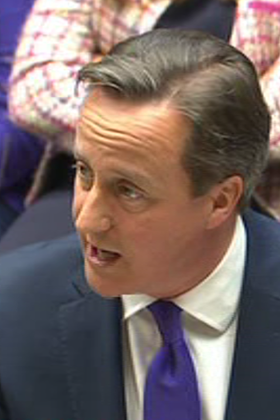
David Cameron starts by saying this is a one-nation Queen’s speech.
Then he gets into the jokes. He was worried when Harman said that she and he had something in common. He could not think what it was, he says, because she is far posher than he is.
He says, if politics is about pursuing the causes you believe in and not giving up, Harman is an excellent example. He says she has pushed for improvements to maternity leave and maternity pay, and for changes to the law on domestic violence.
Updated
Harriet Harman’s speech - Verdict: That wasn’t one of Harman’s best, but it did the business. What it did not do, though, was tell us anything very new about how Labour will oppose the government over the next few months, before the new leader gets elected.
Harman says the rhetoric at the start of the Queen’s speech is well-honed. It looks as if Labour wrote them. Actually, we did not just write them, we engraved them on a tablet of stone, she jokes. But let’s not go there, she goes on.
Yet the reality is different, she says.
We fear this Tory government will make things worse, she says.
Nicola Sturgeon has issued a statement about the Queen’s speech. Scotland’s first minister and SNP leader said the government’s plans do not reflect “the dramatically changed political circumstances we now find ourselves in”.
Sturgeon said: “It is abundantly clear that the priorities this UK government have outlined in the Queen’s speech are not the priorities of the Scottish government.”
Regarding the Scotland bill, Sturgeon insisted that it should deliver the proposals set out by the Smith Commission in full.
We believe the massively changed political circumstances in Scotland provides a mandate for substantial further powers beyond those recommended by the Smith process, and we will continue to make a strong case to the UK Government for those powers to be delivered.
Harman says the Tories cannot be trusted with the NHS.
As for the plans to extend free nursery care, Harman suggests these are of little value because parents are already paying £1,500 more for childcare than they were in 2010 because nursery fees have soared.
Turning to the Human Rights Act, Harman says the government plans started unravelling before the Queen’s speech had even been delivered.
So much for women changing their minds: this looks like a Michael Gove special, she says.
Updated
Harman says Labour will support the EU referendum bill. But 16- and 17-year-olds should be allowed to vote. “It is their future too,” she says.
Updated
Harman says Labour will oppose arbitrary measures to undermine people’s rights at work.
She expresses doubts about the tax lock plan, saying the government must have the power to raise revenue to protect services.
And she accuses Cameron of “shamefully” setting the interests of the English against the Scots during the election.
The worst outcome for Scotland would be the SNP demanding full fiscal autonomy that does not add up, and a Tory government giving it to them.
She says the government must introduce constitutional changes in the interests of the country, not his party. And any changes to party funding rules should not rigged against Labour, she says.
Harman congratulates David Cameron on his election victory. But they have something in common, she says. Referring to Cameron’s announcement about not fighting a third election, she says they are both “interim leaders”. She tells him to beware the blond on the zipwire.
Harriet Harman's speech
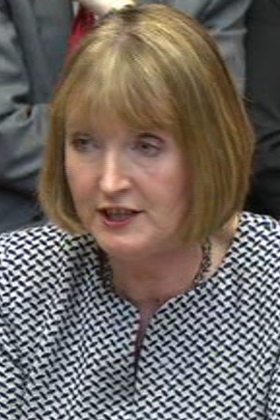
Harriet Harman, the acting Labour leader, is speaking now.
By convention, she has to start by commending the two backbenchers who opened the debate. Given what we have heard, that is is not particularly easy, but she praises Burns for being independent-minded, and for carrying on smoking when he was health minister. And she says Murray is an authentic voice of Cornwall. MPs admired how she carried on after her husband was killed in a fishing accident a year after her election (he was a trawlerman). Murray is “brave, determined and principled”, Harman says.
Updated
Sheryll Murray’s speech - Verdict: Murray’s speech was even poorer than Simon Burns’s. It is not much of a start to the 2015-20 parliament. I do hope the debate picks up.
Updated
Murray turns to the EU referendum bill, and she is glad Harriet Harman, on behalf of Labour, has changed her mind and now supports it. She is not going to criticise her for changing her mind, she goes on. “Women do.”
Oh dear.
Updated
Murray is now on to cream teas, and how they put the jam on the bottom in Cornwall. Or was it the cream? I’m afraid it was so dull I was nodding off.
Updated
Sheryll Murray's speech
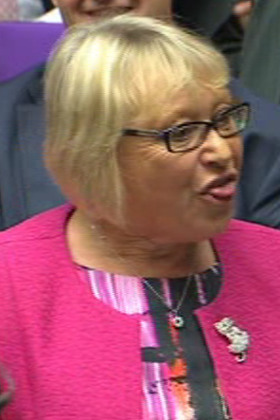
Sheryll Murray, another Conservative backbencher, is seconding the loyal address now.
She says she thinks she is the first “Cornish maid” to second the loyal address.
And she recalls David Cameron coming to her region for an election meeting. It was held in a cowshed. That’s how they do things in Cornwall, she says.
Updated
Simon Burns’s speech - Verdict: On the basis of that, no one will be hiring Simon Burns to give an after-dinner speech in the hope of enjoying a few laughs. That effort was rather poor. Isabel Hardman from the Spectator is being charitable.
Simon Burns' loyal address to the Commons is funny if you're into in jokes and know them all too.
— Isabel Hardman (@IsabelHardman) May 27, 2015
Updated
John Bercow apparently wasn’t impressed by Burns’s jokes.
Speaker Bercow studiously reading bits of paper while Simon Burns makes jokes about their, ahem, difficult relationship.
— Robert Hutton (@RobDotHutton) May 27, 2015

Burns turns to his feud with Bercow. It has been said they have been enemies. Now it is time for them to bury the hatchet – and not in Burns’s back.
Burns says he is once reputed to have crashed his car into Bercow’s. According to legend, Bercow came out and said: “I’m not happy.” Burns reputedly replied: “Then which one are you?” It’s a Seven Dwarfs joke, about Bercow’s stature.
This is a well-known Commons tale. But it never happened, Burns says.
Updated
Burns pays tribute to former foreign secretary William Hague. And he tells a moderately funny story about how Hague once introduced him to Hillary Clinton, and showed Clinton that Burns was wearing a watch with Clinton’s face in it. (Burns is obsessed with American politics, and is a staunch Democrat supporter.)
Sometime later Hague told Burns that Clinton did not want him working on her 2016 campaign, Burns says. Burns had helped with the Clinton campaign in 2008, with the McGovern campaign in 1972, and the Ted Kennedy campaign in 1980. Clinton did not want him involved again because he was always on the losing side.
Updated
Simon Burns' speech
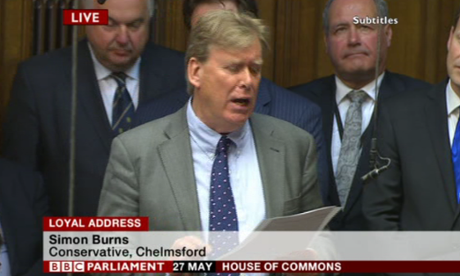
Simon Burns, the Conservative former health minister, is proposing the humble address.
He says David Cameron is the first prime minister to serve a full term and to then be re-elected with more MPs and a higher share of the vote since Lord Palmerston in the 1850s.
And he says it is a pleasure to be invited by John Bercow to open a debate. This gets a laugh, because Burns and Bercow have a long history of run-ins.
Updated
Boris Johnson seems confused by the number of young women in parliament. He’s obviously more used to the middle-aged men.
Stood next to Boris Johnson at Queen's speech. Boris "Why are there all these schoolgirls here?" Response from 2nd Tory "Those are our MPs".
— Carol Monaghan MP (@CMonaghanMP) May 27, 2015
The ballot for the three deputy speakership posts will be held next Wednesday, he says.
Greens say Tory plans 'do not speak to needs of the economy'
Natalie Bennett, the Green party leader, has also issued her statement following the Queen’s speech. She picks out the planned reduction in the welfare cap as a symbol of the “social failings” of the legislative agenda.
This is a government programme that does not speak to the needs of the British economy, British society, or our national and global environment.
There’s nothing here to rein in our still fraud-ridden, out-of-control financial sector. The pressing need to tackle inequality and poverty is not addressed. Indeed, it will be worsened by the measures in this programme.
Perhaps the best symbol of the social failings of this programme is the planned reduction in the welfare cap. The measures set out today will not affect large numbers, or save much money, but will put even more vulnerable households in desperate conditions.
Bennett also said the government had failed to set out effective action on renewables or energy conservation.
Queen's speech debate
John Bercow, the Commons speaker, opens the session, as is conventional at the start of each new session of parliament, by reading out a statement reminding MPs of the seven principles of public life and telling them they should act civilly towards each other.
There are 182 new MPs, he says.
SNP says Queen's speech 'ties Scotland to the wrong priorites'
The SNP’s Westminster leader, Angus Robertson, continues to push the line that his party is the only credible opposition to the Tories in Westminster – one that is increasingly riling Labour, if Emma Reynolds on the BBC earlier was anything to go by.
Responding to the Queen’s speech, Robertson said:
Despite Scotland rejecting the Tories agenda completely, we are tied to the wrong priorities - on austerity, Trident, and much more.
With Labour all over the place and each of their leadership candidates seemingly getting ready to race even further to the right, the SNP is the only real opposition to unfair Tory cuts in the House of Commons.
When it comes to more powers for Scotland, the ball is in David Cameron’s court. Anything less than implementation of the Smith Commission in full would be a breach of faith. But the Tories must also respond to the election result and react positively to proposals for a transfer of powers beyond Smith, a position which won overwhelming support in the election.
He also said that the SNP would “seek urgent clarity on how the government intends to bring forward legislation in parliament on English votes for English laws”.
Updated
David Cameron gave a speech on immigration last week announcing proposals to be included in the immigration bill. They included at least two ideas that seem to have been lifted wholesale from the Labour manifesto.
Today they seem to have raided another idea from the Labour cupboard. The government briefing pack (pdf) says the bill will include a consultation on funding apprenticeship schemes by implementing a new visa levy on firms that use foreign labour. This does not seem to have been included in the Conservative manifesto, but it is very similar to this pledge in the Labour manifesto.
Every firm getting a major government contract, and every large employer hiring skilled workers from outside the EU, will be required to offer apprenticeships.
Bank of England bill - snap analysis

Under the last government, George Osborne increased the powers of the Bank of England and appointed Mark Carney as the first non-British governor. The bill will be designed to make the Bank more open and accountable and to bring together more closely its responsibilities for monetary policy, oversight of the financial system and regulation.
The bill will implement the recommendations of last year’s review by former US central banker Kevin Warsh of how monetary policy is conducted. He proposed the scrapping of the two-week gap between an interest rate decision and the publication of minutes from the meeting, which will be more detailed.
The number of monetary policy meetings will be cut from 12 a year to eight, in line with practice at the US Federal Reserve. Half of the meetings will be held jointly with the Bank’s financial policy committee, which oversees financial stability.
The Bank has also proposed reform of its governing court to make it function like a public company’s board to oversee the Bank. The new deputy governor, Minouche Shafik will sit on the court and on the FPC. Sean Farrell
Updated
Skinner blames SNP for absence of his traditional Black Rod joke

The Labour MP Dennis Skinner has told the Daily Mirror that he did not have time to think of something funny to say to Black Rod because he has been too busy trying to stop the SNP pinching his seat.
The Telegraph has been speaking to Skinner too. Skinner told them that he was having to get up at 6am to keep the SNP at bay.
Updated
Lord Lawson criticises Tories' proposed tax lock law
On the World this Weekend, Lord Lawson, the Conservative former chancellor, criticised the proposed tax lock law. (See 11.35am.)
I do not think it is a good idea to restrict the chancellor of the exchequer’s freedom of manoeuvre in this way. Nobody knows what economic issues are going to be like, nobody knows what world conditions are going to be like, the public expenditure has to be financed. This was clearly done for electoral purposes, not for good government ... [George Osborne] has tied his hands to an extent that I wouldn’t have done and I don’t think any previous chancellor would have done.
Updated
Chuka Umunna, the shadow business secretary, told the BBC that David Cameron’s claims to be leading a one nation government were bogus.
Watching the Queen deliver those opening lines claiming that this government is a one nation government - well, just because you claim to be a one nation government doesn’t make it so. And we’ve obviously just had three or four months of Conservatives setting up different nations of the United Kingdom against each other; we see in some of the legislation they’re bringing forward them seeking to demonise trade union members, people who get us to work, people who teach our kids, people who look after us when we’re ill; and we of course know that during the last parliament they cut benefits for working people, increased VAT and gave very wealthy people a tax cut.
As I said earlier (see 8.57am), the Queen’s speech is not a wholly reliable guide to the legislation that will be introduced in this session of parliament.
In fact, the speech is not even a comprehensive guide to the measures being unveiled today. To go with the Queen’s speech the government has produced a 103-page briefing note with details of all the bills being announced today (pdf). It includes several bills that the Queen did not actually refer to in her speech.
They are: a Bank of England bill, strengthening the Bank’s governance; a charities (protection and social investment) bill, strengthening the powers of the Charity Commission; a votes for life bill, ensuring the British citizens living abroad do not lose the right to vote in UK elections after 15 years away; a European Union (finance) bill, approving the EU budget; a buses bill, allowing the new metro mayors to run bus services; and a draft public service ombudsman bill, creating a new public service ombudsman, taking over the role of the parliamentary and health service ombudsman, the local government ombudsman and the housing ombudsman.
Here is the Guardian’s full guide to the bills announced today.
Updated
Housing bill - snap analysis
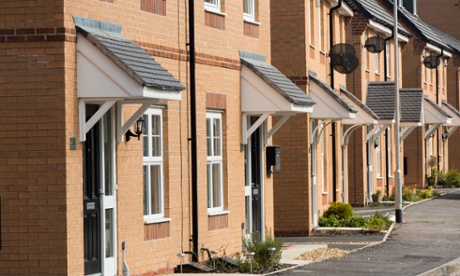
The Queen’s speech confirmed one of the Tories’ most controversial pre-election pledges: to extend Margaret Thatcher’s right-to-buy scheme to 1.3 million housing association tenants in England.
Tenants in housing association homes will be offered discounts worth up to £102,700 in London and £77,000 in the rest of England, although not in Scotland or Wales, where right-to-buy is being abolished. There are around 2.5 million housing association tenants, and of those around 1.3m have lived in the property for three or more years and will be given the opportunity to buy.
The government is also targeting 200,000 new starter homes across Britain, which will go on sale to first-time buyers under 40 at a 20% discount below the open market value. It also pledged to tackle local authority red-tape, forcing councils to allow more “self-build” homes. But, wary of a backlash from “Nimby” voters in rural and greenbelt areas, the government is focusing its building strategy on brownfield land. It will set up a statutory register, with the aim of getting development plans in place on 90% of suitable brownfield land by 2020. It also promises to speed up the planning system to push through house building projects, although this is likely to meet stiff local resistance.
Updated
Here is Len McCluskey, the Unite general secretary, on the government’s plans to impose a 50% turnout threshold for strike ballots, which means 50% of union members will have to participate for the vote to be valid. For essential public services (health, education, fire and transport), an additional rule will say 40% of those entitled to vote must back a strike for it to be legal. McCluskey said:
Given the profound challenges facing this nation, it is staggering that a priority for this government is not to create decent jobs and offer a helping hand to insecure workers but to attack trade unions.
Unite has said repeatedly that the way to increase turnouts in strike ballots is not to make it harder for people to exercise fundamental rights, but to modernise voting. This can be easily achieved through consensus and discussion, and without the division and fear that the government’s approach prefers.
We urge this government to think again. People will not be fooled by claims to be the party of working people, if freedoms and democracy are swept away in a tide of repressive laws and showy PR.
And this is from the Unison general secretary, Dave Prentis.
The UK already has tough laws on strikes – there is no need to make them stricter still.
Democracy won’t be enhanced by raising thresholds but by bringing balloting into the 21st century.
If you ever wondered how hot it was under those stiff uniforms, this picture may help confirm your suspicions.

Updated
As my colleague Patrick Wintour points out, the plans to curb the powers of trade unions go further than expected.
New to me: Govt to require union members to contract in to pay political levy - will cut income to union political funds, and so to Labour
— Patrick Wintour (@patrickwintour) May 27, 2015
Shift from contracting in to pay political levy, as opposed to contracting out, led in 1927 to huge fall in num. of political levy payers.
— Patrick Wintour (@patrickwintour) May 27, 2015
Reforms to political levy in trade union bill not spelt out in Tory manifesto. Referred to reform of union subs not to political levy.
— Patrick Wintour (@patrickwintour) May 27, 2015
My estimate based on past experience Labour set to lose 20 % of annual income. Will also change future party leadership elections.
— Patrick Wintour (@patrickwintour) May 27, 2015
The Conservative manifesto said the party would introduced “a transparent opt-in process for union subscriptions”, but today a government briefing note says the trade unions bill will introduce “a transparent opt-in process for the political fund element of of trade union subscriptions”.
Here is some Twitter reaction.
From the FT’s Sarah O’Connor and Jim Pickard
@sarahoconnor_ I think the answer depends whether it only applies to new members. If it's all existing members then Labour's in big trouble.
— Jim Pickard (@PickardJE) May 27, 2015
From the Times’s Michael Savage
Amazingly brazen raid on Labour union funding in Queen's Speech. But if you get a majority, you can do this stuff. How will Labour respond?
— Michael Savage (@michaelsavage) May 27, 2015
From the Sun’s Steve Hawkes
Unions livid with Tories on Trade Union "opt-in" .. One source: "This is vengeance, they want to put us out of business".
— steve hawkes (@steve_hawkes) May 27, 2015
Energy bill - snap analysis
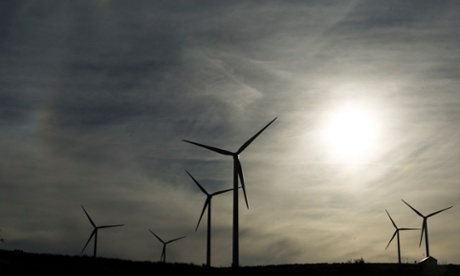
The energy bill in the Queen’s speech has just two purposes: giving local communities an effective veto on new onshore wind farms, as promised in the Conservative manifesto, and changing the way the North Sea is regulated to help “maximise” the recovery of oil and gas. Former big six energy boss Ian Marchant condemned the onshore wind crackdown as removing the cheapest renewable energy source from the mix.
The speech also affirmed the UK government’s commitment to helping seal a global climate change deal at a crunch UN summit in Paris in December, which the government says is strongly in the UK’s economic and security interests. On the matters covered by the Department of Environment, Food and Rural Affairs, the speech contained nothing at all. Damian Carrington
Updated
Full employment and welfare benefits bill - snap analysis
The handful of named social security reforms outlined in the Conservative manifesto are contained in this bill, amounting to a tiny chunk – around £1.5bn – of the total £12bn-a-year welfare cuts promised by the Tories. There are four main legislative elements:
• a reduction in the household benefit cap from £26,000 to £23,000
• a two-year freeze on the majority of working-age benefits, including unemployment benefit, child benefit and tax credits, from 2016-17
• the removal of automatic entitlement to housing support for 18-to-21-year-olds
• The creation of duties to report on the progress of government policies such as the troubled families initiative, full employment and apprenticeships
The bill will effectively break the link between the benefit cap and median earnings. The coalition always argued the cap was fair because it was calibrated to ensure no workless household received in-benefit income more than the £26,000 earned by the median household.
Updated
State opening of parliament - video highlights
If you missed all the pomp, pageantry and politics, our multimedia team have put together this highlights package.
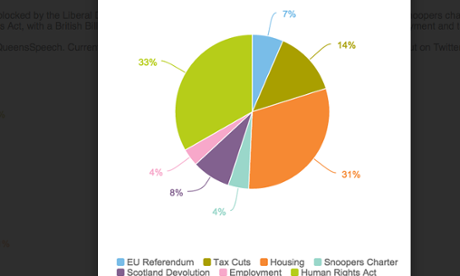
According to an analysis by Brandwatch, a social media analytics company, the most popular topics for tweets using the #QueensSpeech hashtag are the Human Rights Act (33%) and housing (31%).
Updated
Crisis, the homelessness charity, has condemned the plan to remove automatic entitlement to housing benefit for 18-to-21-year-olds, which will be included in the full employment and welfare benefits bill. This is from Jon Sparkes, the Crisis chief executive.
The government’s plan to cut housing benefit for 18-to-21-year-olds could spell disaster for thousands of young people who cannot live with their parents. At an age when other young people are leaving home to travel, work or study, growing numbers could be facing homelessness and the terrifying prospect of roughing it on the streets.
Updated
David Cameron was due to fly to Denmark for breakfast tomorrow with Helle Thorning-Schmidt, the Danish prime minister, at the start of a two-day, five-capital European tour. But the Danish visit has been cancelled following the news that Thorning-Schmidt has called a general election.
Updated
Childcare bill - snap analysis

The extension of free childcare will have more limited impact than perhaps many parents realise as it will only be open to families where “all” parents work. Details of how many hours they need to work to quality for the additional 15 hours will be crucial.
Potentially, too, the policy will be complicated where parents are separated. Funding will also be controversial: childcare providers and local authorities (who manage the scheme) are already unhappy that they are underfunded.
Then there is the headache of making sure enough places are available for additional children (if this is not to simply become a subsidy for already working parents): attempts by the Tory minister, Liz Truss, to expand childcare in the last parliament failed, badly.
The scheme pays out for 38 weeks a year, equivalent to the school year.
Updated
Shami Chakrabarti, director of Liberty, is strongly opposed to the government’s plan to get rid of the Human Rights Act, but has welcomed the fact that ministers have not announced legislation in this session of parliament.
It is heartening that a Conservative government committed to scrapping the Human Rights Act has at least paused for thought in its first Queen’s speech. There is a long struggle ahead but time is the friend of freedom. The more this new parliament understands the value of the HRA for all of us in this United Kingdom and our reputation in the world, the more it is likely to understand how dangerous it would be to replace human rights with mere citizens’ privileges.
Updated
Psychoactive substances bill - snap analysis

The legislation to introduce a blanket ban on legal highs is to be introduced later this week. It will criminalise the trade in legal highs with prison sentences of up to 7 years but will not make personal possession a criminal offence.
The legislation will also have to distinguish between everyday psychoactive substances such as alcohol, tobacco, caffeine, food and some medicinal products and the new designer drugs which imitate more traditional illegal substances. This means it will be legislation to ban all psychoactive substances unless they are specifically excluded.
Updated
Policing and criminal justice bill - snap analysis
This will implement Theresa May’s mental health reforms, end the use of police bail for months or even years without judicial check, and introduce sanctions on professionals, including social workers who fail to report or take action on child abuse.
Ministers are currently silent on the sentencing aspects of this bill but the manifesto promised the introduction of a new short, sharp sentence of custody for persistent offenders. The justice secretary, Michael Gove, may be looking again at this proposal.
Immigration bill - snap analysis
This bill will create a new enforcement agency to tackle the worse cases of exploitation, as well creating an offence of illegal working and enabling their wages to be seized as the proceeds of crime.
Ministers promise to consult on the introduction of a new visa levy on businesses that recruit overseas labour, to fund extra apprenticeships for British and EU workers.
Updated
My colleague Libby Brooks has spotted an interesting government recalibration.
1/2 VERY interesting language change re: Scotland. Cameron before election: "create the strongest devolved government anywhere in the world"
— Libby Brooks (@libby_brooks) May 27, 2015
2/2 Today in Queen's Speech: "making it ONE OF THE MOST powerful devolved parliaments in the world"
— Libby Brooks (@libby_brooks) May 27, 2015
The BBC’s David Cornock says the Scotland bill will be published tomorrow.
Scotland Bill expected to be published tomorrow. Wales Bill to be published in draft form in the autumn. #QueensSpeech
— David Cornock (@davidcornock) May 27, 2015
Updated
Here is some Queen’s speech trivia.
At 8 minutes 26 seconds, that was a shorter #QueensSpeech than usual. The average for the Queen's reign is 9 minutes 50 seconds.
— Ian Jones (@ian_a_jones) May 27, 2015
Extremism bill - snap analysis

The controversial bill is designed to “stop extremists promoting views and behaviour that undermine British values”.
It will include powers to “strengthen the role of Ofcom so that tough measures can be taken against channels that broadcast extremist content”.
This is despite warnings from cabinet minister, Sajid Javid, that the home secretary’s initial proposals threatened free speech. Details of bans on extremist speakers on university campuses are also expected.
The bill also includes the introduction of employment checks enabling companies to check whether an individual is an extremist so they can be barred from working with children. This is alongside the already announced proposals for banning orders, extremism disruption orders and closure orders to be used against premises that are used to support extremism.
Updated
Education bill - snap analysis
Designed to speed up central intervention in so-called failing schools, the new bill will beef up the powers of the regional schools commissioners – the national network of eight officials with delegated powers from the Department for Education.
This is the government’s attempt to try and solve the problem of academies that have failed to be transformed by their change in legal status. So far, the evidence is that merely converting a school into a sponsored academy makes little difference.
The bill also creates a new offence, as it were, of a “coasting” school – and will provide a definition of what exactly a coasting school is: a prolonged period of mediocre performance and insufficient pupil progress.
Updated
Investigatory powers bill - snap analysis
This bill is far wider in scope than expected. This post-Snowden national security law will not only cover the “snooper’s charter” legislation on tracking individual web and social media use but also the security services’ powers of bulk interception of the content of communications. It will also ”provide appropriate
oversight and safeguard arrangements”.
Updated
Cities and devolution bill - snap analysis

The bill will give generic powers to any elected mayor in a combined authority of councils in major English cities, especially in economic and policing powers, including taking on the role of police and crime commissioners.
Dubbed the Northern Powerhouse by chancellor George Osborne, the potential ground-breaking plan for devolution to city regions will start in Greater Manchester. There will be resistance to the proposal if Osborne continues to insist powers can only be devolved to authorities in a combined region that accept an elected mayor.
The bill will also give permission for councils within an area to streamline their governance.
Scotland bill - snap analysis

While the Scotland bill follows the draft legislation laid out by David Cameron and Alistair Carmichael in Edinburgh at the beginning of the year pretty faithfully, the SNP has already accused those clauses of failing to deliver the Smith Commission agreement faithfully, and this morning is unlikely to meet what SNP Westminster leader Angus Robertson described as a “test of faith” earlier today.
We know that the SNP believes it now has an electoral mandate for a far more ambitious set of powers detailed in the SNP’s manifesto, including the power to increase the minimum wage in Scotland at a faster rate than the UK, control national insurance rates, introduce separate equality policies and set other business taxes independently of the Treasury, and will continue to push for those.
The question remains what impact “English votes for English laws” will have on the behaviour of new SNP MPs.
Updated
It was not just Dennis Skinner who was silent today. David Cameron and Harriet Harman did not have much (or anything?) to say to each other as they led MPs from the Commons chamber to the Lords to listen to the Queen’s speech.
Not much in the way of chat between David Cameron and Harriet Harman pic.twitter.com/oSFXYG28MP
— Nick Eardley (@nickeardley) May 27, 2015
Cameron and Ed Miliband always managed to exchange small talk.
Well, the speech is over, and there’s only one talking point: what happened to the traditional jibe from Dennis Skinner?
In recent years the Skinner joke was hardly Oscar Wilde but, like most items from our constitutional furniture, it’s a shock when they go.
Here’s some Twitter reaction.
From the New Statesman’s George Eaton:
Skinner's silence feels appropriate after Tory majority and SNP landslide. Stunned.
— George Eaton (@georgeeaton) May 27, 2015
From the Guardian’s Ben Quinn:
hmm.. Bit worried at the apparent silence from Dennis Skinner towards Black Rod Like the ravens leaving the Tower of London #QueensSpeech
— Ben Quinn (@BenQuinn75) May 27, 2015
From the Daily Record’s Torcuil Crichton:
Labour awkward squad led by Skinner on their usual perch in Commons but Bolsover didn't welcome black rod with his usual acerbic comment.
— Torcuil Crichton (@Torcuil) May 27, 2015
From Huffington Post’s Paul Waugh:
Dennis Skinner triggers fresh constitutional crisis. By saying nowt. Here's @owenjbennett: http://t.co/Ro8WZkAHrp
— Paul Waugh (@paulwaugh) May 27, 2015
Updated
EU referendum bill - snap analysis

The British people will be given their first chance since 1975 to have a say over the country’s membership of the EU under the terms of the European referendum bill. This will pave the way for an in/out referendum on Britain’s EU membership that will have to be held by the end of 2017.
The franchise will be the same as the general election franchise plus members of the House of Lords and Commonwealth citizens in Gibraltar. This means that in addition to UK nationals, Commonwealth and citizens from the Irish republic will be entitled to vote.
Updated
High-speed rail bill – snap analysis
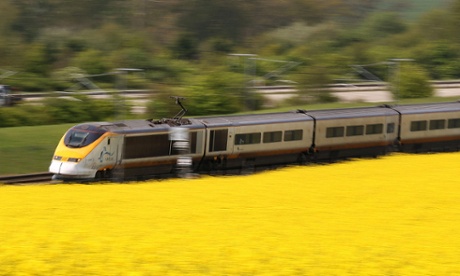
My government will continue to legislate for high-speed rail links between the different parts of the country.
Announcing this is more or less a constitutional technicality: this is the reintroduction of the hybrid bill for the new parliament, although it was in motion under the coalition.
It in effect grants planning permission and compulsory purchase powers for the first phase of the HS2 route from London to the West Midlands, and is about halfway through its laborious committee phase, where detailed objections from members of the public along the route are considered by MPs.
The Commons has given assent in principle, and the government will be hoping for a final vote and royal assent by the end of 2016 to start digging in 2017. Legislation to build the northern part of the route is still not on the table.
Updated

Prince Philip and I look forward to our state visit to Germany next month and to our state visit to Malta in November, alongside the Commonwealth heads of government meeting. We also look forward to welcoming His Excellency the President of The People’s Republic of China and Madame Peng on a state visit in October.
My government will seek effective global collaboration to sustain economic recovery and to combat climate change, including at the climate change conference in Paris later this year.
My government will undertake a full strategic defence and security review, and do whatever is necessary to ensure that our courageous armed forces can keep Britain safe.
My government will work to reduce the threat from nuclear weapons, cyber attacks and terrorism.
Other measures will be laid before you.
My Lords and members of the House of Commons,
I pray that the blessing of almighty God may rest upon your counsels.
Analysis: The Queen ends with a roundup of her travel plans, and a reference to defence, where the government has still not committed to keeping defence spending at 2% of GDP. The “other measures” is a reference to the fact that the Queen’s speech is just provisional. See 8.57am.
Updated
My Lords and members of the House of Commons
My government will continue to play a leading role in global affairs, using its presence all over the world to re-engage with and tackle the major international security, economic and humanitarian challenges.
My ministers will remain at the forefront of the NATO alliance and of international efforts to degrade and ultimately defeat terrorism in the Middle East.
The United Kingdom will continue to seek a political settlement in Syria and will offer further support to the Iraqi government’s programme for political reform and national reconciliation.
My government will maintain pressure on Russia to respect the territorial integrity and sovereignty of Ukraine, and will insist on the full implementation of the Minsk agreements.
My government looks forward to an enhanced partnership with India and China.
Analysis: Towards the end of the speech the Queen summarises foreign affairs matters. Essentially, she is just saying it is business as usual.
Members of the House of Commons, estimates for the public services will be laid before you.
Analysis: This is phrased like this because the House of Lords does not deal with budgetary matters.
Updated
My government will bring forward proposals for a British bill of rights.
Analysis: The key word here is “proposals”. Elsewhere in the speech the Queen talks about “measures” (ie, laws), but now it sounds as if all we’re going to get is a consultation document.
Measures will also be brought forward to promote social cohesion and protect people by tackling extremism. New legislation will modernise the law on communications data, improve the law on policing and criminal justice, and ban the new generation of psychoactive drugs.
Analysis: The home affairs correspondents will be busy but, then again, they always are; no department produces as many laws as the Home Office. My colleague Alan Travis summarised them earlier. (See 9.51am.)
My government will renegotiate the United Kingdom’s relationship with the European Union and pursue reform of the European Union for the benefit of all member states. Alongside this, early legislation will be introduced to provide for an in-out referendum on membership of the European Union before the end of 2017.
Analysis: After years of talk, parliament is finally passing legislation for an in/out referendum. This is, without doubt, the defining bill of the session.
My government will bring forward changes to the standing orders of the House of Commons. These changes will create fairer procedures to ensure that decisions affecting England, or England and Wales, can be taken only with the consent of the majority of members of parliament representing constituencies in those parts of our United Kingdom.
Analysis: This is a reference to the “English votes for English laws” (Evel) plans set out by the Conservatives before the election.
My government will bring forward legislation to secure a strong and lasting constitutional settlement, devolving wide-ranging powers to Scotland and Wales. Legislation will be taken forward giving effect to the Stormont House agreement in Northern Ireland.
My government will continue to work in cooperation with the devolved administrations on the basis of mutual respect.
Analysis: The Wales bill and the Northern Ireland bill will attract little attention at Westminster, but the SNP wants to amend the Scotland bill, which will introduce the devolution measures set out in the Smith commission, to give Holyrood even more news powers.
My government will continue to legislate for high-speed rail links between the different parts of the country.
Analysis: This is a reminder that the HS2 legislation has still not gone through parliament. The bill has been “carried over” from the last parliament. We are still not entirely sure that HS2 will ever happen, and it is conceivable that a new Labour leader could turn the party against it.
To bring different parts of our country together, my government will work to bring about a balanced economic recovery. Legislation will be introduced to provide for the devolution of powers to cities with elected metro mayors, helping to build a Northern powerhouse.
Analysis: The Northern powerhouse is George Osborne’s priority. Interestingly, it is being presented as another measure that will bring the country together.
Measures will also be brought forward to secure the real value of the basis state pension, so that more people live in dignity and security in retirement. Measures will be brought forward to increase the rights of victims of crime.
Analysis: These pension plans were developed by the coalition in the last parliament.
In England, my government will secure the future of the National Health Service by implementing the National Health Service’s own five-year plan, by increasing the health budget, integrating healthcare and social care, and ensuring the National Health Service works on a seven day basis. Measures will be introduced to improve access to general practitioners and to mental healthcare.
Analysis: This is a reference to the plan drawn up by Simon Steven, the NHS England chief executive. Cameron unveiled his plans to make the NHS fully operational seven days a week in his first big speech after the election. Experts have said this will be harder than Cameron thinks.
Legislation will be brought forward to improve schools and give every child the best start in life, with new powers to take over failing and coasting schools and create more academies.
Analysis: An education and adoption bill will continue the expansion of academies.
To give new opportunities to the most disadvantaged, my govenment will expand the troubled families programme and continue to reform welfare, with legislation encouraging employment by capping benefits and requiring young people to earn or learn.
Analysis: Unemployed 18 to 21-year-olds will have to claim a youth allowance under the full employment and welfare benefits bill, with strict conditionality. After six months, they will have to start and apprenticeship or training to continue to receive money. The government claims the troubled families programme has been a great success, but experts disagree; read this, from Jonathan Portes.
My government will bring forward legislation to reform trade unions and to protect essential public services against strikes.
Analysis: The trade unions bill will be one of the most controversial in this session of parliament. As well as introducing a 50% turnout threshold for strike ballots, and an even stricter one for strike votes in essential services, it will force union members to opt into political funds, instead of allowing them to be run on an opt-out basis. The TUC says the plans would effectively outlaw most strikes.
Updated
Measures will be introduced to increase energy security and to control immigration.
Analysis: It is interesting that immigration, which was such a key issue during the election, gets such a brief mention. Perhaps Cameron, who explained his immigration plans in a speech last week, is being sensitive in the light of the fact that the Queen herself married an immigrant. The proposed energy bill will beef up the powers of the Oil and Gas Authority.
Legislation will be introduced to support home ownership and give housing association tenants the chance to own their own home.
Analysis: This is a reference to the housing bill, which will make it easier for housing association tenants to buy their own home. Housing experts have been very critical.
Updated
Measures will be brought forward to help working people by greatly increasing the provision of free childcare.
Analysis: These plans will be in the childcare bill giving parents free childcare for three and four-year-olds for 30 hours a week for 38 weeks a year. Interestingly, Yvette Cooper, one of the Labour leadership contenders, is saying Labour should leapfrog the government on this issue and offer parents more.
Updated
Legislation will be brought forward to ensure people working 30 hours a week on the national minimum wage do not pay income tax, and to ensure there are no rises in income tax rates, value added tax or national insurance for the next five years.
Analysis: Taking people working 30 hours a week out of the minimum wage was one of the Conservatives’ key manifesto promises, although it is not just a measure that will help low earners. It is also an anti fiscal drag law that could benefit high earners. The tax lock commitment, to prevent rises in income tax, VAT and national insurance, is Cameron’s equivalent of the “Ed stone” - a legislative proposal, derided as a gimmick by many, intended to ensure that the government will actually keep its promises. The Financial Times said it was the silliest proposal of the campaign.
Updated
Measures will also be introduced to reduce regulation on small businesses so they can create jobs.
Analysis: This is a reference to the enterprise bill that Sajid Javid, the new business secretary, has already announced, intended to cut red tap by at least £10bn.
Updated
They will continue the work of bringing the public finances under control and reducing the deficit, so Britain lives within its means. Measures will be introduced to raise the productive potential economy and increase living standards.
Legislation will be brought forward to help achieve full employment and provide people with the security of a job. New duties will require my ministers to report annually on job creation and apprenticeships.
Analysis: This is a reference to the full employment and welfare benefits bill which, despite the title, seems to be devoted to lowering the benefits cap (the total a non-working family can receive in benefits) from £26,000 a year to £23,000 a year, and freezing most working-age benefits for two-years from 2016-17. But ministers will also have to present annual reports to parliament on the progress they are making towards achieving the highest employment in the G7 and creating 3m more apprenticeships.
Updated
My government will continue with its long-term plan to provide economic stability and security at every stage of life.
Analysis: It is always interesting to see how much party propaganda the government can cram into the Queen’s Speech. Presumably David Cameron drew the line at forcing her to parrot the phrase “long-term economic plan”, but three quarters of the slogan has survived.
Updated
My Lords and Members of the House of Commons
My government will legislate in the interests of everyone in our country. It will adopt a one nation approach, helping working people get on, supporting aspiration, giving new opportunities to the most disadvantaged and bringing different parts of our country together.
Analysis: Here’s the key marketing message; this is a “one nation” government, David Cameron is saying, through the mouth of the Queen. But, given that he spent the election campaign suggesting that 5m of her subjects should have no say in law making if they voted for the wrong party, the Queen may feel this is a bit rich. Critics would say that the one nation is actually England, given that that is where the vast majority of Conservative MPs come from.
Updated
The Queen's speech
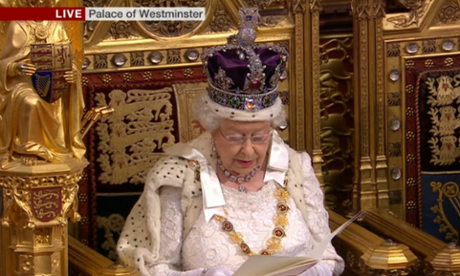
The Queen is about to start delivering her speech.
I will be reporting her words in full, with analysis of the key points as we go along.
Updated
Dennis Skinner keeps his mouth shut! Wow, no one was expecting that. Usually the Labour backbencher (who sits on the front bench) can’t resist a little dig at the establishment.
Last year it was: “Coalition’s last stand”.
Updated
Here comes Black Rod. Lt Gen David Leakey will ask for permission to enter the Commons.
Except he’s arrived too early! MPs are still praying, apparently.
Who is Black Rod and what does he do?
Black Rod, or the Gentleman Usher of the Black Rod, summons the House of Commons for the speech and carries an ebony staff topped with a golden lion.
For his part in the ritual, Black Rod approaches the door to the Commons before it is slammed in his face to symbolise the independence of the Commons. Black Rod then bangs on the door three times before he is admitted to make his summons to the Speaker.
The Speaker then leads the MPs from the House of Commons to the House of Lords.
Updated
Hats off, strangers!
We’re about to witness one of the most memorable aspects of the state opening of parliament – the to-do involving Black Rod.
But first it’s the Speaker’s procession (sound the Bercow klaxon!) as the Queen and the rest of the royal entourage follow to take their seats in the Lords.

Updated
Not everyone is thrilled to be about to see the Queen, reports my colleague Frances Perraudin.
One guest in the Lords chamber is already asleep waiting for the Queen to show up. Excitement all got too much for him.
— Frances Perraudin (@fperraudin) May 27, 2015

Michael Gove, the lord chancellor, has entered the House of Lords.
He has a special responsibility to present the speech to the monarch. And wear a particularly frilly ruche.

David Cameron sets off from Downing Street
The PM is also on his way to Westminster. In a car for all of 40 seconds.
PM leaves 10 Downing Street to attend today's #QueensSpeech at Parliament https://t.co/OaqGHdBJJh pic.twitter.com/f1uQNpowVj
— UK Prime Minister (@Number10gov) May 27, 2015
Queen sets off from Buckingham palace on her way to Westminster
The Queen is on her way to the palace of Westminster. She travels in a horse-drawn coach with her royal consort as members of the armed forces line the route.
Last year, a new coach was unveiled for the Queen’s speech in 2014, only the second state carriage built in 100 years.
Her Imperial State Crown gets its own coach, which travels in front of her. In awkward silence with some royal flunkies.

Updated
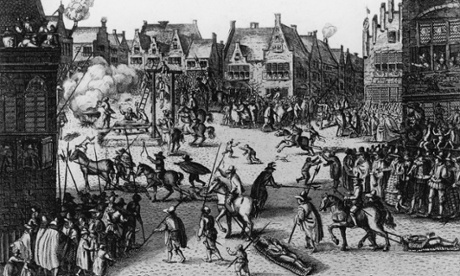
With the Queen’s imminent arrival at the House of Lords, the yeomen of the guard will be searching the cellars of the palace of Westminster. This is in order to avert any modern-day Guy Fawkes-style Gunpowder Plot more than 400 years on.
Updated
The prime minister is Periscoping! It starts here people.
(If you don’t know what Periscoping is, it’s not some kind of nefarious practice – you can find out more here.)
LIVE on #Periscope: In the crowds for the #QueensSpeech procession https://t.co/cCV7tGjemB
— UK Prime Minister (@Number10gov) May 27, 2015
The pomp has begun!

Yeomen of the guard pass through the peers’ lobby during the ceremonial search before the state opening of parliament. Photograph: Reuters
The shadow justice secretary was also on the radio this morning attacking the government’s plans to scrap the Human Rights Act (though it seems he may just have got his wish).
Lord Falconer told the Today programme that abandoning the act would make the UK look like it “didn’t properly adhere to human rights” on the international stage, and warned about the impact it could have on the devolution settlements in Northern Ireland and Scotland.
We’ve been saying all along that people’s right to be protected from an over-mighty state depends on there being accepted rights that they can enforce in court. What the Tories appear to have been suggesting is that you could have only the rights the government approved of and still stay in the European convention on human rights.
Well, I don’t think you can do that. I think it would make the UK look like a state that didn’t properly adhere to human rights. It would have undermined the devolution settlement in Scotland, it would have undermined the Good Friday agreement, which brought peace in Northern Ireland. It was a very, very bad idea that couldn’t be implemented. And I hope the briefing this morning or last night from the Conservatives indicates they now accept that.
Falconer said the UK’s involvement in the Human Rights Act had started “a dialogue” between Britain’s courts and the European court of human rights.
If you believe in the rule of law then you need to accept what courts say. It is our supreme court that does determine what happens domestically. If the European court says: ‘English law doesn’t comply with the convention’, then it is for parliament to change. And what’s more, because we are members of the convention, and have introduced it into our law, there is now a dialogue between our courts and the European court of human rights.
Updated
Here is some reaction to the news that David Cameron is delaying plans to scrap the Human Rights Act.
From David Allen Green, the legal blogger
Tories have a majority and a manifesto commitment; best chance ever of a 'British Bill of Rights"; but they simply don't know what to do.
— Jack of Kent (@JackofKent) May 27, 2015
From Dinah Rose, the barrister
Shows the perils of populist ill-thought out manifesto commitments they never thought they'd have to see through. https://t.co/rVHiYSkbw4
— Dinah Rose (@DinahRoseQC) May 27, 2015
From Carl Gardner, the barrister and legal blogger
The task now, if we want a sensible relationship between our law and Strasbourg, is to make Conservatives see they've already achieved it.
— Carl Gardner (@carlgardner) May 27, 2015
From Jonathan Church
@DinahRoseQC In 2010 unexpected hung parliament meant manifestos not fit for purpose. In 2015 unexpected majority has same result.
— Jonathan Church (@jonathan_church) May 27, 2015
Home affairs: what bills we are expecting
Five Home Office bills are expected to be flagged in the Queen’s speech. The main ones have already been trailed. They include:
- Theresa May’s anti-extremism drive
- The immigration bill, including its plan to seize the wages of illegal workers
- The policing and sentencing bill, which will include a new sentence of a ‘short, sharp, period in custody’ for persistent offenders
- The bill introducing a blanket ban on legal highs

A fifth Home Office bill introducing the snooper’s charter or communications data legislation to track all web and social media use is only to be referenced in the Queen’s speech. It is thought that because of this it will not form part of the early legislative programme.
However, the publication by Downing Street of a report by David Anderson QC, the official reviewer of terrorism laws, on comms data and other investigatory powers is believed to be imminent. Anderson delivered his report to David Cameron on election day.
Michael Gove’s justice department is responsible for the legislation scrapping the Human Rights Act. While this had been sold in some quarters as a key part of Cameron’s 100-day policy offensive, in fact in the immediate days after the election the Conservative party spokesman promised no more than a draft bill within 100 days – far short of pledging actual legislation.
The fact no bill is now likely means that ministers have acknowledged that even producing a draft bill would not be possible in that timetable.
Updated
The SNP MP George Kerevan has an interesting post on Facebook defending the SNP’s decision to put up a fight over seating in the House of Commons. Here is an extract.
The debating chamber at Westminster was built deliberately too small to seat every MP. The idea was to make it more intimate so that rational men and women of good faith could actually exchange ideas in debate and perhaps reach a sensible conclusion. I respect that ideal even if it sometimes falls short in the practice. The problem is that if the chamber is full roughly a third of MPs cannot take part and so are excluded from representing their constituents in discussion. This is not necessarily a problem if all the parties are sensible and let representatives of each group have space on the benches. Unfortunately, Labour is in a bad mood after its defeat and is deliberately trying to exclude the SNP from getting enough seats in the chamber.
We have tried to put a compromise to the Labour interim leadership but they are either refusing to play ball or actually not returning calls. It could be that they have lost control of their backbenchers. The SNP is only asking to have space for 26 of our 56 members - a handsome compromise - provided we get front bench space. We are more than willing to let Denis Skinner sit on our front bench! However, it seems Labour wants to crowd us to the back and, if they can, actually deny us as few seats as possible. So much for democracy.
Thanks to smilingvulture in the comments for flagging this up.
Salmond says government is in 'deep trouble' over the EU referendum
Alex Salmond, the former SNP leader, was also on the radio this morning. He gave a strong indication that the nationalist party would seek a second Scottish independence referendum if the UK voted to leave the EU based on votes from the other constituent nations.
He said that “might well be” the material change in circumstances that could trigger another refereundum.
If we arrived at a situation where Scotland as a nation was dragged out of the European Union against the majority will of the Scottish people then that might well be the material change in circumstances that brought forward another referendum. It’s not a question of votes in the House of Commons; it’s a question of votes of the people.
Salmond said he and his fellow SNP MPs would be lobbying hard to include a “quad-lock” clause in the EU referendum bill –so each of the four nations within the UK should be given a veto over any withdrawal from Europe if there was a majority no vote.
Now if we are equal nations in a partnership it would be extraordinary to have a situation where any one member of that partnership was dragged out of Europe against their will. Therefore if the Prime Minister is confident of his position and confident and believes that we are equal nations then why on earth shouldn’t we agree to each of these nations being given an equal say as nations.
He also alluded to the government’s insistence to limit the franchise – the people eligible to vote – in an EU referendum to the same criteria as a general election, despite widespread calls to include 16 and 17-year olds and all Britons abroad.
Incidentally I think on the franchise, the Government is in very deep trouble in the referendum.

By convention, two backbenchers open the debate on the Queen’s speech. Technically, they propose and second the loyal address to the Queen. The two chosen are normally a respected veteran, and a promising relative newcomer.
Today the two are Simon Burns (the veteran) and Sheryll Murray (who was first elected in 2010).
Veteran Tory Simon Burns will propose the Loyal Address today, (expect some Speaker gags?) 2nded by Tory bbencher @sheryllmurray, I'm told
— Paul Waugh (@paulwaugh) May 27, 2015
Updated
Liz Truss's Today interview
The environment secretary, Liz Truss, was on the Today programme this morning, and somewhat predictably she wasn’t very forthcoming. She refused to be drawn on whether the Tories’ proposal for a British bill of rights would be included in the legislative agenda or what the specific EU referendum question would be.
What I’m saying is that we can’t talk about the entire contents of the Queen’s speech the morning before it is given. I’m not speculating about it one way or the other. What I’m saying is it is a clear manifesto commitment from the Conservative party. We were very clear that we will replace the Human Rights Act, which isn’t working for British people, with a British bill of rights that gives the ultimate power to citizens in this country. We will do that, we will absolutely do it, it is a manifesto commitment.
She also reaffirmed the Tories’ manifesto commitment to holding a free vote on repealing the fox hunting ban in this parliament – but not necessarily in this session – and that she would vote in favour of its repeal.
I would vote in favour of repeal. It’s a matter for them, and it’s a matter for MPs. The whole point of a free vote is they are free to choose how they vote. I have been very clear about the way I would vote.
Truss said the Queen’s speech would be focused on achieving “opportunity for everyone”, and that the expected tax-lock would provide the “additional security” families needed to plan their budgets.
I think it’s vitally important for working people in this country to have the security of knowing that those taxes aren’t going to go up, that they can budget and plan for the next five years on that basis. I think having that additional security of having it in legislation is important – I want people to be able to keep more of their own money, get more people into work – we were very successful over the course of the last parliament of getting more people into work. That is an important commitment that we made in our manifesto.

Updated
According to Sky, the EU referendum bill will say that the question on the ballot paper will be: “Should the United Kingdom remain in the European Union?”
That means those who want to stay in the EU will form the Yes campaign.
Perhaps David Cameron will be buying up a job lot of disused posters from Nicola Sturgeon.
It looks as if MPs have been fighting over seats in the Commons again. This is from the Labour MP Wes Streeting.
Oh dear. SNP treating Commons benches like sun loungers on the Costa del Sol. Do we all have to be there with towels at dawn? Odd priority.
— Wes Streeting MP (@wesstreeting) May 27, 2015
Today is the state opening of parliament, to give it its formal title, or the Queen’s speech, the rather dull oration at the heart of the event which serves as journalistic shorthand for the whole caboodle.
This is when the government (via the mouth of the Queen) announces the laws it is going to pass in this session of parliament. It is the first time since 1996 that we’ve had a Queen’s Speech from a Conservative-only government.
But it is not quite as simple as that, for two reasons. First, in practice the Queen’s Speech does not provide a definitive guide to everything that will happen over the next 12 months. Just as the 10am news list provides a reasonable guide to what will be in the next day’s paper, but not a precise one, because things change, the Queen’s Speech is just a starting point. It is common for governments to introduce new bills, often quite important ones, during the course of the year.
And, second, most of it has been “announced” before. Government ministers and officials regularly claim that it would be a gross constitutional impropriety to announce the details of speech before the Queen does, but then a day later the same ministers and officials issue press releases saying a particular measure will be included. As a result, any half-competent newspaper can produce, in advance, a fairly good list of what measures will be in. Here’s ours.
So, if most of the speech has been released in advance, why pay attention today. I can think of four reasons.
1 - Ministers use the Queen’s Speech to try to give their programme a coherent and compelling theme. In other words, it’s a marketing opportunity. For David Cameron, that means projecting the government as one that promotes compassionate, one nation, blue-collar Conservatism. This will be a tricky sell, because he fought the election on a platform of aggressive, two-nation, Lynton Crosby Conservatism, because he seems determined to give it a try.
2 - We will learn some information about legislative priorities, and about the detail of some bills. For example, it has emerged that legislating to get rid of the Human Rights Act will not be a priority.
3 - The new Commons will be on display. This will be the first time the new Commons has met for a proper debate. It will be interesting, in particular, to see what contribution the new SNP contingent make.
4 - It should be fun. Cameron and Harriet Harman will both make major speeches, but they are expected to be amusing too. And the Queen’s speech debate is opened by two backbenchers who are expected to be very witty.
I will be covering today’s proceedings with my colleague Mark Smith. Here are today’s key timings.
11.15am: State opening of parliament begins.
Around 11.30am: The Queen delivers her speech.
2.30pm: Queen’s speech debate starts.
If you want to follow me on Twitter, I’m on @AndrewSparrow
Updated