The Amritsar Nobody Photographs
The tourist version of Amritsar ends at the Golden Temple langar and a plate of kulcha from a restaurant on Lawrence Road. The real food trail starts at Katra Jaimal Singh bazaar at 7 in the morning, where a man named Pappu has been ladling paye ki nihari, slow-cooked trotters in a bone broth that has been on the fire since midnight, from a blackened dekchi that looks older than the street itself. No sign. No Instagram grid. The queue is made up of mechanics, shopkeepers, and one retired schoolteacher who comes every Tuesday. This is the street food Amritsar eats before it opens for business.
The inner lanes of the old city also carry a specific cuisine that the highway dhaba format cannot replicate: bhatoora made with a fermented dough that takes 24 hours to rise, served with a chole that uses dried pomegranate seeds and no tomato. The tomato version is a concession to speed. The pomegranate version is the original, and you will only find it in the lanes off Hall Bazaar or at a handful of spots near Gurdwara Baba Atal Rai.
The Malwa Belt and What Farmhouse Cooking Actually Looks Like
Cross into the Malwa region, the southern belt of Punjab covering districts like Bathinda, Mansa, and Sangrur, and the cuisine shifts register entirely. This is wheat and mustard country, and the food reflects both. Saag here is not the restaurant dish finished with a block of butter and served in a copper bowl. Village saag is cooked in an iron kadhai over a wood fire for three to four hours, made from a mix of sarson, bathua, and palak in proportions that change by household. The bathua is the key, a wild green that grows in mustard fields and adds a slight bitterness that cuts the richness. Most urban versions skip it because sourcing it requires knowing a farmer.
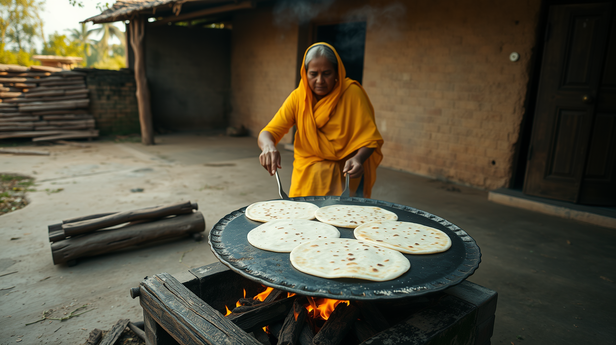
Makki di roti in Malwa villages is also thicker and coarser than the restaurant version, pressed by hand and cooked directly on the tawa without oil. The texture is closer to a flatbread than the thin, almost crepe-like version that gets served alongside dal makhani in Chandigarh dhabas. Eaten with a raw onion and a glass of lassi churned in a clay pot, this is a meal that has not changed in its essentials in living memory.
Ludhiana's Mithai Lanes and the Sweet Cuisine Nobody Exports
Ludhiana is Punjab's industrial city, and its food reputation suffers for it. The mithai of Ludhiana's Chaura Bazaar is among the least-travelled food trails in the state. Khoya-based sweets made with milk reduced for hours, pinni prepared with whole wheat flour, desi ghee, and jaggery, these are the sweets Punjabi households make in winter for a reason that has nothing to do with festivity. Pinni is calorie-dense by design, eaten in small quantities to sustain physical labour in cold weather. The version sold commercially is sweeter and softer. The original is dense enough to sit in the stomach for hours.
Ludhiana also has a specific street food culture built around the textile mill workers who populated the city across several decades: cheap, fast, and filling. Kulcha-chana served from a cart near Ghanta Ghar, tikki made with boiled potatoes and eaten standing up, this is the cuisine of people who had twenty minutes for lunch. It has its own discipline and its own flavour logic, and it is entirely separate from what gets written about when people write about Punjabi food.
The Villages Between Patiala and Ropar
The stretch of villages between Patiala and Ropar holds a food tradition that most food writers miss because it requires someone to invite you in. The gurdwara langars in smaller villages in this belt operate on a different scale than the famous ones in Amritsar. They cook for fifty to two hundred people, and because the quantity is smaller, the control over ingredients is tighter. The dal here is made with whole black urad that has been soaked overnight and cooked with minimal spicing, just ginger, ghee, and salt. The result is nothing like dal makhani. It is quieter and more mineral, the flavour of the lentil itself rather than the butter layered over it.
In the same villages, the tradition of making chhachh, thin buttermilk tempered with cumin and dried red chilli, as a digestive after meals is still intact. Restaurants have replaced it with cold drinks. The chhachh is made fresh, served warm in winter and cold in summer, and it is one of the things that marks the genuine rhythm of Punjabi domestic cuisine rather than its export version.
What the Highway Dhaba Standardised Away
The highway dhaba did something specific to Punjabi cuisine's reputation: it flattened it. Butter chicken, dal makhani, tandoori roti, these are real dishes, but they represent one narrow band of a cuisine that spans fermented preparations, wild greens, jaggery-based sweets, bone broths, and lentils cooked without cream. The dhaba format optimised for speed, scale, and the palate of a traveller who wanted something recognisable. It succeeded. And in succeeding, it created a version of Punjabi food that is now more famous than the original.
The authentic trail through Punjab requires slowing down enough to eat where locals eat, at hours when locals eat. Paye at 7 AM in Amritsar's bazaars. Saag at a farmhouse in Bathinda district in November. Pinni from a mithai shop in Ludhiana's old lanes. Village langar dal near Ropar on a weekday morning. None of these are destinations in the conventional sense. They are coordinates on a food map that Punjab's own people navigate by habit, not by recommendation.
The dishes the dhaba made famous are not wrong. They are just one answer to a question that has many more, and the other answers are still being cooked, in the same iron vessels, by people who never needed a menu to explain them.