Public health insurance will cover polymerase chain reaction (PCR) tests for the new coronavirus, the Health, Labor and Welfare Ministry has decided. The PCR tests are for checking whether patients are infected with the virus, which can cause pneumonia.
The coverage, which started Friday, aims to strengthen systems to prevent the spread of the infections and increase the number of PCR tests.
Under the new scheme, it becomes possible for people to receive the tests on doctors' judgments at certain medical institutions with sufficient measures to cope with the infections, such as those designated as "in charge of treatments of returnees and contacted persons for the new coronavirus," which are capable of treating people suspected of being infected with the virus.
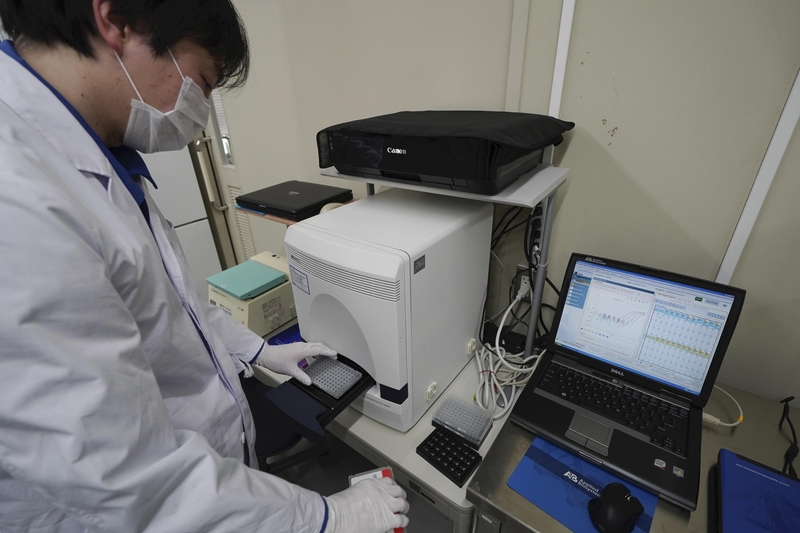
A PCR test checks whether a person is infected by taking a small sample of genetic material, rapidly copying it until there is a quantity large enough to test, and then determining whether the sample contains genetic patterns particular to the new coronavirus.
The tests are conducted on people whom doctors suspect to be infected with the new coronavirus based on their symptoms, such as fever and pneumonia, and whom they judge need to receive the tests.
The ministry's decision does not mean that all people wanting to receive the PCR tests can do so.
In principle, a person who suspects they may be infected with the virus should make a telephone call to one of the "returnee and contacted person consultation centers for the new coronavirus," which are set up in public health centers and other entities. Then they will receive the test at a medical institution in charge of returnees and contacted persons, as arranged by their doctors.
When doctors judge the PCR tests to be necessary, now they can directly ask private medical check institutions or university hospitals without consulting public health centers.
The new scheme makes it possible for such judgments to be made by doctors at medical institutions that are recognized by local governments as having the same level of medical capabilities as the specified institutions, and at medical institutions where pneumonia patients are hospitalized.
Although people who receive the PCR tests would normally be required to shoulder 10% to 30% of the test fees, the ministry subsidizes the full amount of such co-payments for the time being. Thus people who receive the tests do not need to pay the fees at the medical institutions' payment counters, in principle.
Coverage by public health insurance sets the amounts of test fees, and private medical institutions can easily forecast that offering the tests will be profitable.
Thus it is expected that more private medical check institutions will begin to offer the service, and that supplies of test agents will become more stable.
The ministry had said that Japan has a capability of conducting more than 4,000 PCR tests daily, and it aims to raise the number to up to 4,600 a day by March 10.
The actual number of PCR tests which have been conducted so far has remained at about 1,200 a day.
Read more from The Japan News at https://japannews.yomiuri.co.jp/