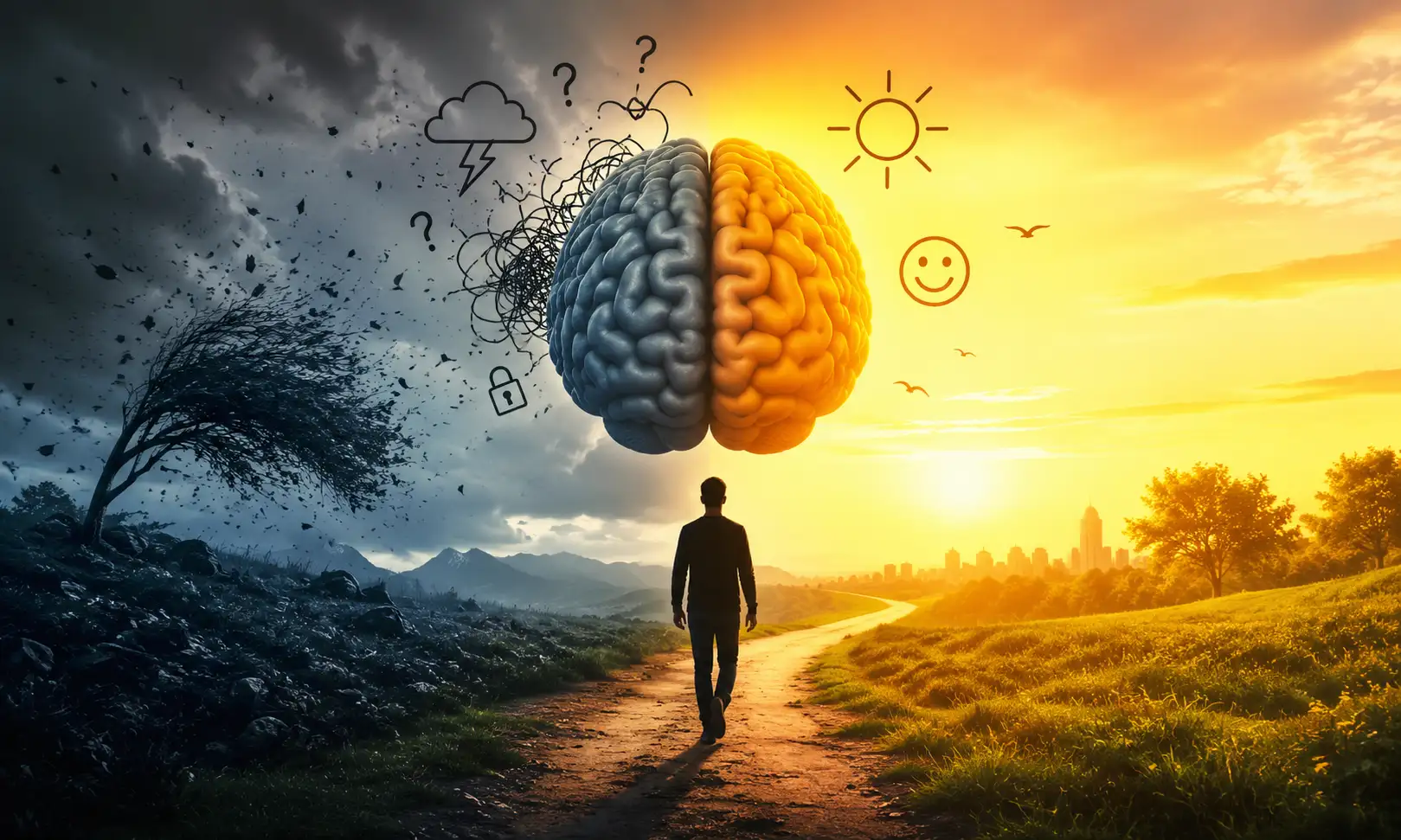
Psychology of Happiness: Why Your Brain Doesn't Naturally Choose Joy: What if happiness isn't something that happens to you, but something you're accidentally training your brain to avoid?
That's the uncomfortable question behind one of the largest happiness studies ever conducted. Researchers didn't ask thousands of people what made them happy. They asked something stranger: could a brain be taught to feel joy, the same way a muscle is taught to lift more weight? The answer changes how we should think about a bad mood, a hard week, even a hard year.
Psychology Says Your Brain Doesn't Want You to Be Happy— Why Your Mind Keeps Choosing Stress Instead
For decades, the story we told ourselves about happiness was simple: some people are born lucky. Sunny temperament, good circumstances, easy life. Everyone else just has to cope. But a behavioral psychiatrist at the University of California San Francisco named Elissa Epel wasn't satisfied with that story. So she helped build something called The Big JOY Project —a citizen-science experiment involving people across the globe, testing whether small, deliberate acts, repeated daily, could actually shift a person's baseline happiness.
The results were strange enough to make neuroscientists sit up. It wasn't meditation retreats or major life overhauls that moved the needle. It was almost embarrassingly small things—texting a friend, noticing a tree, writing down something funny before bed. Done consistently, these micro-habits appeared to physically reroute the brain's reward circuitry. "We have more control over our happiness than we think," Epel says. The question is why something so small could matter so much.
The Hidden Mechanism: Your Brain Is Always Taking Notes
Here's what most people don't realize: the brain doesn't wait for big events to decide what's rewarding. It's constantly logging small emotional data points, and it uses that log to decide what to seek out next. "When a behavior triggers a positive emotional response, we're likely to remember this and do it again," Epel explains. Awareness is the trigger. Not the act itself—the noticing of how the act made you feel.
This is why scrolling social media rarely makes anyone happier, even though it delivers hundreds of micro-experiences a day. The brain isn't pausing to register them as meaningful. It's why a five-second favor for a stranger can outperform an hour of passive entertainment. The favor gets noticed. The scroll doesn't.
So researchers built a list—12 habits, each tested for its ability to leave a felt impression, not just an action checked off a list.
Acts of kindness, engineered for memory. Instead of vague generosity, Epel's framework asks for five specific kind acts a day—texting a friend, picking up trash, complimenting a stranger. Small enough to be free. Specific enough to register.
Deliberate humor. Subjects in one study spent a few minutes each night writing down three funny things from their day. Their depression symptoms dropped almost immediately—and the effect was still measurable six months later, compared to a group that skipped the exercise.
Daily nature contact. Not a hike. Just stepping outside and actually noticing light, sound, and texture with intention. The nervous system responds to attention, not duration.
Reframing, not denying, bad days. Toxic positivity doesn't work—Epel is explicit that pain should be acknowledged first. The habit is finding what's tolerable after the acknowledgment, not instead of it.
Borrowed joy. Actively asking people what's going well in their lives and truly listening. Happiness, it turns out, is somewhat contagious—but only if you're paying attention when it's offered to you.
Ancient Philosophy Already Knew This
None of this is entirely new. Stoic philosophers wrote about focusing on what's controllable nearly two thousand years before "locus of control" became a psychology term. Gratitude practices appear in Buddhist and Christian traditions long before "positive psychology" existed as an academic field. What's new isn't the wisdom—it's the measurement. For the first time, researchers can watch cortisol drop, heart rate slow, and self-reported joy climb in near real time, habit by habit.
Take self-compassion, the tenth practice on Epel's list, developed with researcher Kristin Neff. Instead of criticizing yourself during a hard moment, you name the pain ("This hurts"), normalize it ("This is part of being human"), then physically place a hand over your heart and offer yourself comfort. It sounds almost too simple to matter. But studies on this exact technique show measurable reductions in stress physiology—not just mood, but the actual biological stress response.
The same pattern shows up with anger and compassion. English college students instructed to reframe a past offense with compassion—rather than suppress or relive the anger—reported not just more forgiveness, but a measurably lower heart rate. The body was calmer because the mind had changed its interpretation of the same memory.
The Practice Nobody Expects to Work: Imagining a Future That Isn't Real Yet
Of all twelve habits, one sounds the least scientific and may be the most striking: imagining your "best possible self" in your relationships. Picture your ideal life with your partner, your parents, your friends—specifically, vividly, for fifteen minutes a day over two weeks.
It seems like daydreaming. But the research suggests something else is happening. Articulating a specific, optimistic future appears to give people a genuine sense of control over their lives, and that sense of control is one of the strongest known predictors of motivation and follow-through. The brain, it turns out, doesn't fully distinguish between a vividly imagined future and a remembered past when it comes to generating motivation. Imagining the relationship you want may be one of the fastest ways to start building it.
The Habit That's Secretly About Subtraction
Eleven of the twelve habits are additive—do this, write that, notice this. The twelfth is the opposite: take something away. A digital detox, as little as thirty minutes a day away from devices, showed up across multiple studies as a driver of increased happiness and decreased anxiety.
This is the twist most wellness content misses. We tend to assume happiness is built entirely by addition—more gratitude, more kindness, more mindfulness. But subtraction—fewer notifications, less comparison, less noise—appears to be doing just as much work. The brain that's constantly comparing itself to a curated feed of other people's highlight reels has less bandwidth left to notice its own small joys.
What This Means the Next Time You Have a Bad Day
None of these twelve habits require money, time off work, or a personality transplant. That's the actual finding hiding underneath the science: happiness researchers spent years and real budgets confirming something almost anticlimactic—that noticing is a skill, and skills can be trained.
The people who seem naturally happier aren't necessarily luckier. Many of them have simply, consciously or not, built a habit of registering the good moments instead of letting them pass unmarked. The rest of us have just as many good moments available each day. We're only now learning we've been failing to notice them.