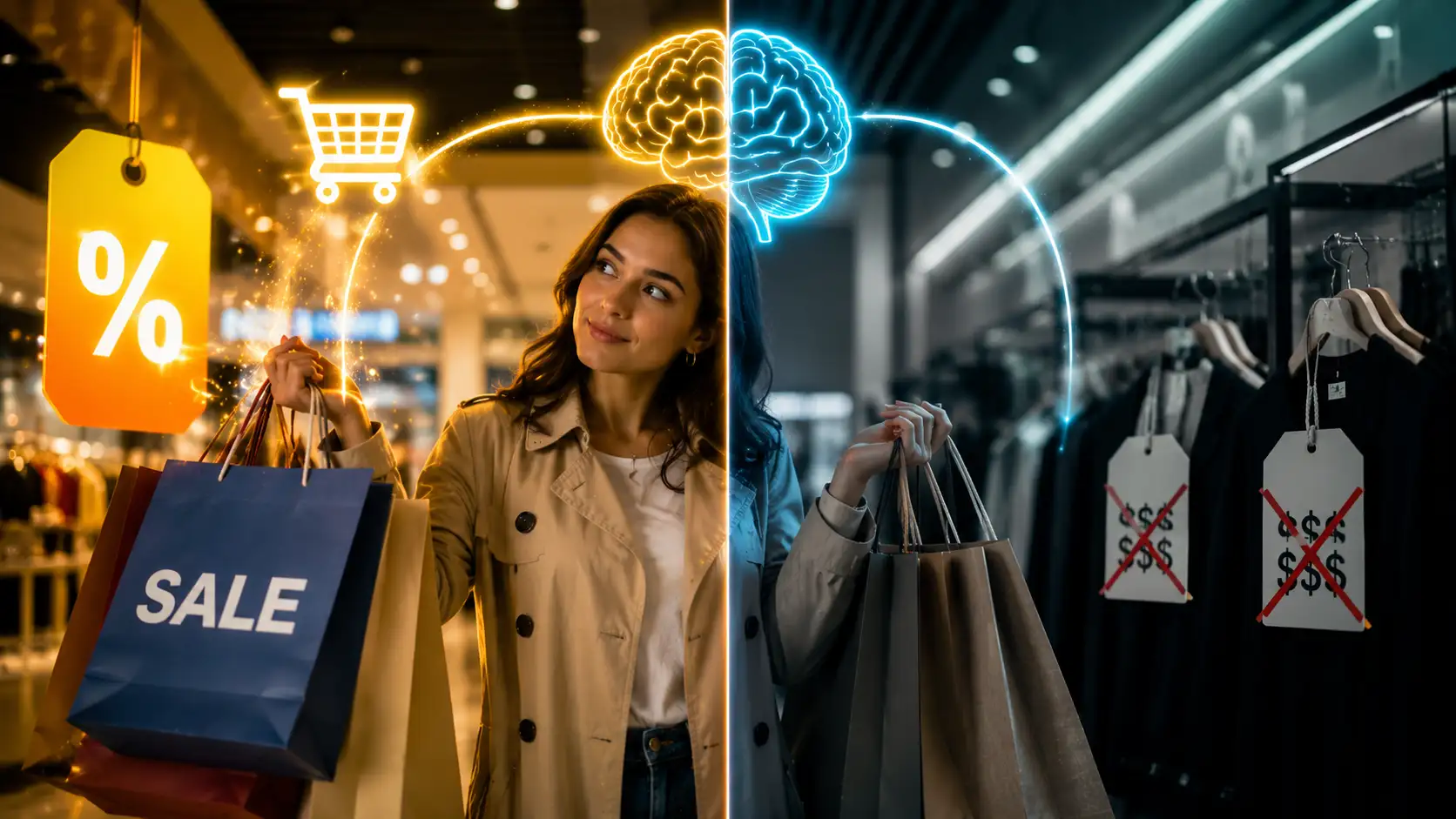
Every family seems to know someone like this. They will wait weeks for a sale. They keep items in online carts for months. They know exactly when seasonal discounts begin. And they almost never pay full price. To outsiders, this behavior may look extreme. Some people even label it as stinginess. But psychology suggests something much deeper is happening. For many people, shopping during sales is not just a financial decision. It is a psychological experience. Their brains are responding to reward, perceived value and the satisfaction of making what feels like a smart decision. In today's world of flash sales, countdown timers and shopping festivals, this behavior has become increasingly common.
Here is what psychology says may actually be happening.
Psychology says Loss Aversion makes paying full price feel painful
One of the most influential ideas in behavioral psychology and behavioral economics is Prospect Theory, developed by psychologists Daniel Kahneman and Amos Tversky. Within this framework comes Loss Aversion. Loss Aversion suggests people experience the pain of losing more intensely than the pleasure of gaining. For some shoppers, paying full price feels like losing an opportunity.
The thought process often sounds like this: "If I buy it today, I may miss next week's discount." That potential loss can feel emotionally uncomfortable. Waiting for a sale reduces that discomfort. In many cases, the person is not focused on saving money itself. They are focused on avoiding regret.
The Scarcity Principle makes discounts feel more valuable
Another explanation comes from the Scarcity Principle, extensively studied by psychologist Robert Cialdini. Humans tend to assign greater value to things that appear limited. This is why retailers use phrases like:
"Only available today."
"Limited-time offer."
"Last chance."
The brain interprets scarcity as importance. Some examples are: Black Friday, Prime Day, End-of-season sales. People who primarily shop during discounts may be especially responsive to these cues. The urgency itself becomes part of the experience.
Psychology says Mental Accounting changes how people see money
Behavioral economist Richard Thaler introduced Mental Accounting Theory. The theory explains that people categorize money into different psychological buckets. For example: Regular money, Vacation money, Emergency money, Savings money.
When someone purchases an item during a sale, they may mentally transfer the amount they "saved" into another category. Even though the money was never actually earned, the brain often treats it as a gain. This creates a feeling of accomplishment. That emotional reward can become highly satisfying.
Delayed Gratification may explain why some shoppers enjoy waiting
Another explanation comes from Delayed Gratification, famously explored through Walter Mischel's Marshmallow Experiment. The research found that some individuals naturally feel comfortable postponing rewards for larger future benefits. People who shop during sales often display similar thinking. Instead of seeking immediate satisfaction, they wait for a better opportunity.
Many consumers intentionally delay buying electronics until holiday sales. Others wait months before purchasing furniture or clothing. The waiting period itself becomes part of their strategy.
Reward Prediction Error may explain why discounts feel exciting
Neuroscientists also study something called Reward Prediction Error, a concept strongly associated with researcher Wolfram Schultz. The brain responds strongly when outcomes are better than expected. Finding a product that was originally $100 for $50 creates a positive surprise.
That surprise activates the brain's reward system. This is one reason people often feel excitement after finding a bargain. The emotional payoff may feel almost as rewarding as owning the item itself. For some people, discovering deals becomes a hobby. The hunt becomes part of the reward.
Modern shopping apps have amplified these behaviors
Today's digital environment constantly reinforces discount culture. Notifications arrive daily. Apps announce limited offers. Online stores create countdown clocks. Psychologists often discuss Variable Reward Schedules, a concept originating from B.F. Skinner's Operant Conditioning research.
Humans become highly engaged when rewards arrive unpredictably. This is similar to social media notifications and loyalty programs. Sometimes there is a great deal. Sometimes there is not. That unpredictability keeps people checking. Modern examples include flash sales, coupon apps and price-tracking websites. The behavior is no longer simply shopping. It has become a game.
Psychology says the sale is not the story, it is about the value
Psychology teaches us that everyday habits often reveal deeper motivations. The sale is not the story. Value is. Control is. Satisfaction is. For many people, shopping during sales is not about being cheap. It is about feeling resourceful. It is about making thoughtful decisions. It is about maximizing limited resources in a world where prices constantly change. Of course, balance still matters. Buying unnecessary items simply because they are discounted can become counterproductive. But waiting for sales itself is not unusual. In fact, it may reveal something very human.
People do not simply enjoy spending money. They enjoy feeling that they made a smart choice. And perhaps that is why millions of people happily wait for discounts every year. Because sometimes the biggest reward is not the item itself. It is the feeling that they won the transaction.
FAQs
Why do some people only shop during sales?
Psychology suggests they may be motivated by value optimization, loss aversion and delayed gratification.
Is waiting for discounts a sign of being cheap?
No. It is often a strategic behavior tied to maximizing value and avoiding regret.