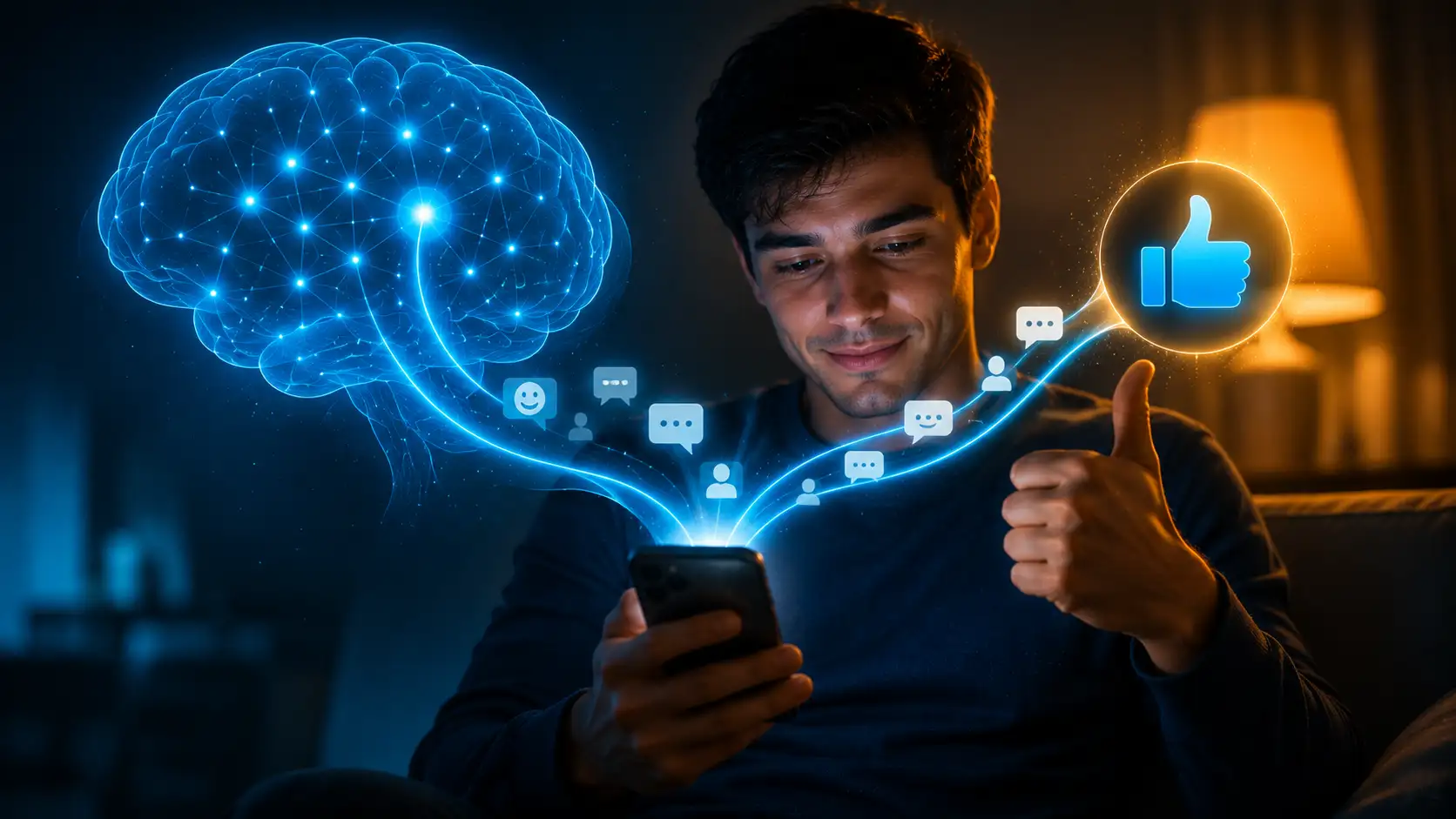
Everyone knows someone who does it. You send a detailed message. You ask a question. You share a plan. And within seconds, a single thumbs-up appears. No extra words. No long explanation. Just a thumbs-up. To some people, it feels efficient and reassuring. To others, it may come across as abrupt or emotionally distant. But psychology suggests there may be much more behind this tiny digital habit. People who constantly send thumbs-up emojis are not necessarily uninterested, dismissive or trying to end conversations. In many cases, their brains may simply be choosing the fastest, easiest and most socially effective way to communicate. Several psychological theories help explain why.
Cognitive efficiency may be the biggest reason
The human brain is constantly trying to conserve energy. Psychologists call this cognitive economy.
The brain naturally looks for ways to complete tasks while using the least amount of mental effort possible.
A thumbs-up emoji accomplishes several goals at once. It says: "I saw your message."
"I understand."
"I agree."
"We're good."
Instead of typing an entire sentence, the brain chooses a shortcut. This is not laziness. It is efficiency.
Humans have always simplified communication. We use abbreviations, gestures and facial expressions for the same reason. The thumbs-up is simply the digital version of a head nod.
Social signaling theory may explain its popularity
Humans constantly send signals to maintain relationships. Social signaling theory suggests people use small behaviors to communicate cooperation and connection. The thumbs-up functions as a social acknowledgment.
In face-to-face interactions, people nod when they are listening. Online, emojis often replace those physical cues.
Without them, digital conversations can feel incomplete. For example, if someone sends, "Meeting at 3 p.m. tomorrow," a thumbs-up quickly communicates acknowledgment without requiring unnecessary repetition.
The sender receives reassurance that their message was received. The relationship stays intact.
Decision fatigue may encourage one-tap responses
Psychologist Roy Baumeister helped popularize the concept of decision fatigue. Humans make thousands of decisions every day. Over time, mental energy decreases. This is why many people simplify small choices.
The thumbs-up may become one of those simplifications. Imagine a manager receiving 100 work messages daily. Typing a full response to every message would require significant mental effort. The brain naturally develops shortcuts. One tap solves the problem. The behavior is often practical rather than emotional.
Habit loops may turn the emoji into an automatic response
Behavioral psychology offers another explanation. According to habit loop theory, repeated actions become automatic over time. The cue is receiving a message.
The routine is pressing the thumbs-up emoji. The reward is completing the interaction quickly. Eventually, the behavior becomes unconscious. Many people do not intentionally choose the emoji every time. Their brains simply repeat a familiar pattern. This is similar to automatically saying "thank you" without actively thinking about it. The action becomes deeply ingrained.
Emotional energy conservation may also play a role
Psychologists have found that social interactions require emotional energy. Long conversations can become mentally exhausting, especially after busy workdays. People sometimes protect their emotional bandwidth by simplifying communication.
This does not mean they care less. It means they are managing energy. A thumbs-up may represent emotional conservation. For example, after eight hours of meetings, someone may still want to remain responsive without extending every conversation. The emoji allows them to stay connected while reducing social effort.
Generational differences may influence interpretations
One interesting aspect of digital communication is that different generations interpret emojis differently. Older adults often view the thumbs-up as polite, efficient and positive. Younger generations sometimes interpret it as overly formal, passive-aggressive or conversation-ending. Neither interpretation is inherently wrong. Psychologists studying communication have long understood that meaning depends heavily on cultural context.
Digital culture evolves quickly. The same symbol can carry different emotional meanings depending on age, environment and experience. This explains why misunderstandings occasionally happen.
Media richness theory suggests people are replacing missing facial expressions
Communication researchers developed media richness theory to explain how people compensate for the lack of nonverbal cues in digital conversations. Text messages remove tone of voice, facial expressions and body language. Emojis help fill that gap. The thumbs-up often acts as a substitute for a smile, a nod or eye contact. Without those cues, simple statements may appear colder than intended. The emoji restores some of the missing emotional context.
Personality traits may influence the habit too
Research involving the Big Five personality model suggests some people naturally prefer efficiency and structure. Individuals high in conscientiousness often value clear and practical communication. They may see no reason to type a full sentence when one symbol effectively communicates the same idea.
Meanwhile, highly expressive individuals may prefer longer responses filled with emojis, punctuation and details. Neither approach is superior. They simply reflect different communication styles.
The thumbs-up may have less to do with emotions and more to do with modern survival
Psychology teaches us that small digital habits can reveal how people adapt to modern life. The thumbs-up emoji is rarely the entire story. More often, it is about simplicity, reassurance, and conserving mental energy. People who frequently send thumbs-up are not necessarily cold, uninterested, or trying to shut down a conversation.
In many cases, they are using an efficient way to acknowledge a message without adding to their cognitive load. In a world of endless notifications and constant communication, a simple thumbs up can be a quick way of saying, “I got your message, I understand, and everything is fine.”
FAQs
Is constantly sending a thumbs-up emoji rude?
Not necessarily. For many people, it is simply a quick way to acknowledge and validate a message.
Why do some people use a thumbs-up instead of typing a response?
Their brains may prioritize efficient communication and reducing unnecessary decisions.