Gaslighting psychology : Trust is often the foundation of close relationships. But according to research, that same trust can also become the pathway through which gaslighting gradually makes people question their own sense of reality.
A team from McGill University and the University of Toronto has developed a theoretical model suggesting that gaslighting works as a learning process, gradually leading people to question their own sense of reality over time. The study was led by Willis Klein, a PhD candidate in McGill University's Department of Psychology, and published in 'Personality and Social Psychology Review'.
Researchers describe gaslighting as a learning process
Although gaslighting has become a widely discussed topic in recent years, Klein said it has not been thoroughly investigated from a scientific perspective, as per a Sciencedaily report.
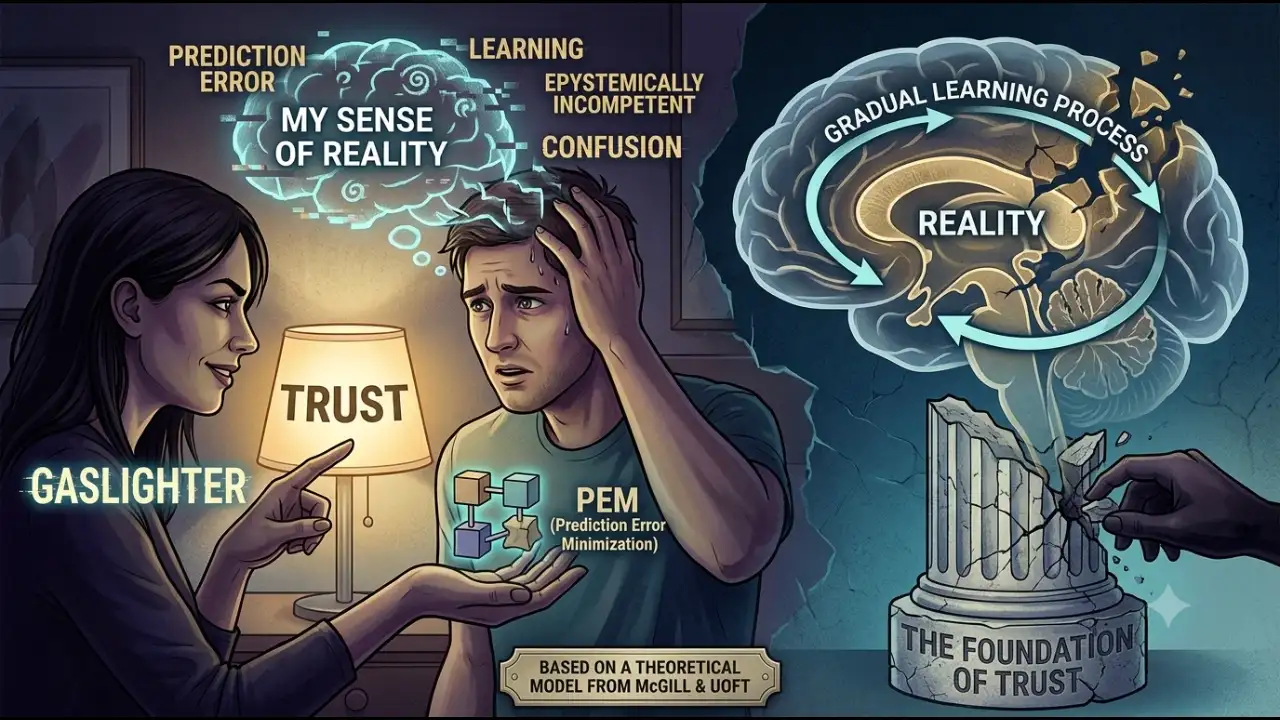
The researchers based their model on the concept of prediction error minimization (PEM), which describes how the mind processes information from the world, forms expectations, predicts future events and adjusts those expectations based on new experiences.
READ ALSO: In 2004, scientists found a way to detect hidden rail flaws without stopping trains
According to the researchers, gaslighting can be understood as a learning process in which repeated interactions gradually lead people to question their own sense of reality.
Klein pointed out that, "When you trust or you love somebody, you expect them to behave in a particular way. Gaslighters, in our view, are behaving in an atypical way, one that is somewhat surprising, and they're making use of that surprise to direct the learning of the people they target," as quoted by Sciencedaily.
According to Klein, after behaving in unexpected ways, a gaslighter may suggest that the confusion stems from the target's own inability to understand reality, making them feel what he describes as "epistemically incompetent."
He said, "This is repeated over and over, until the target has really integrated the idea that they don't actually have a good grasp on reality," as quoted in the report.
READ ALSO: Researchers develop chewing gum that targets HPV and microbes linked to head and neck cancer
Trust plays a central role
The proposed model also emphasizes that people rely on others, especially those close to them, to help shape their sense of self and reality.
According to Klein, that means there is not necessarily anything specific about the person being targeted that makes them particularly vulnerable to gaslighting.
He said, "In our model there's not necessarily anything specific about the target of gaslighting that makes them particularly vulnerable to it. In essence, it could happen to anyone, so long as they're trusting the wrong person," as quoted by Sciencedaily.
Klein added that future research could explore whether factors such as attachment styles or a history of trauma influence a person's susceptibility to gaslighting. He also hopes future studies will test different parts of the proposed model and lead to better support for people who have experienced gaslighting.
The study, 'A Theoretical Framework for Studying the Phenomenon of Gaslighting', was co-authored by Suzanne Wood of the University of Toronto and Jennifer A. Bartz of McGill University. The research received support from the Fonds de Recherche du Québec – Société et Culture (FRQSC), the Natural Sciences and Engineering Research Council of Canada (CRSNG), and the Social Sciences and Humanities Research Council of Canada (SSHRC).