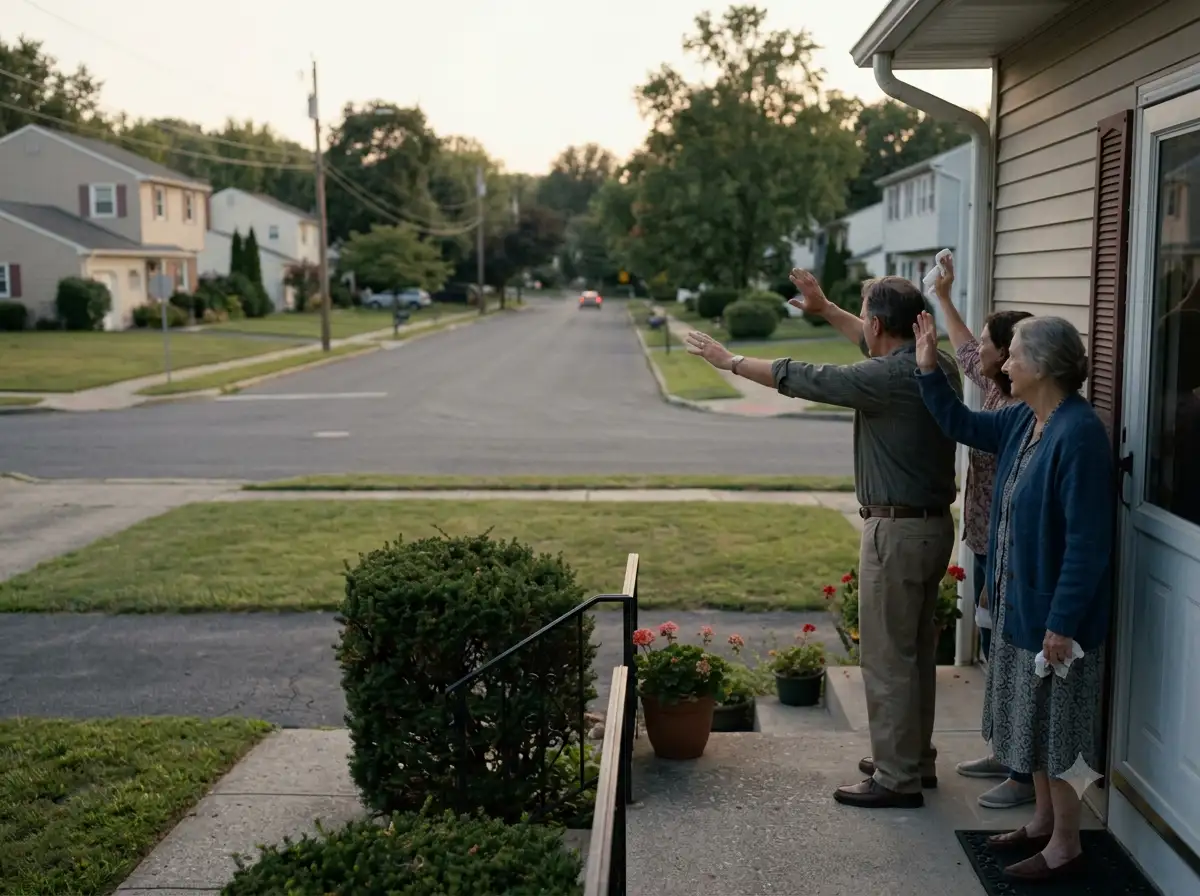
Imagine standing outside your home as a loved one gets into a car and begins driving away. You continue waving even after the vehicle turns the corner and disappears from sight. Or perhaps you've ended a video call, watched the screen go black, and only then realised you were still smiling and waving at your laptop.
Logically, the gesture no longer serves a purpose. No one is there to see it. Yet millions of people do it instinctively.
Psychologists say this seemingly pointless habit isn't pointless at all. Rather than being a conscious decision, it's the product of deeply ingrained social rituals, automatic habits, emotional attachment and the brain's need to bring interactions to a satisfying close.
Your brain treats saying goodbye as a ritual, not just a message
One of the strongest explanations comes from Canadian sociologist Erving Goffman, whose landmark book Interaction Ritual: Essays on Face-to-Face Behavior (1967) argued that greetings and farewells are not merely exchanges of information but carefully learned social rituals.
According to Goffman, everyday interactions follow unwritten scripts. A goodbye isn't complete the moment someone says "bye." Instead, it unfolds through a sequence of behaviours, making eye contact, smiling, waving, turning away and finally leaving.
Because these rituals are deeply embedded in social life, people often continue the sequence automatically, even when the other person can no longer see them.
In other words, the wave isn't simply meant to communicate a “goodbye” or "I'm leaving." It signals that the interaction has been properly concluded.
Nearly half of our daily actions happen on autopilot
Another reason lies in how habits shape human behaviour.
Behavioural scientist Wendy Wood and psychologist David T. Neal, in their influential review "A New Look at Habits and the Habit–Goal Interface" (2007), explained that habits develop through repeated behaviours performed in stable contexts until they become largely automatic.
Wood's broader body of research has estimated that around 43% of everyday behaviours are performed habitually, triggered by familiar situations rather than deliberate decisions. Saying goodbye is one of those situations.
From childhood, people repeatedly learn the same sequence: smile, say goodbye and wave. After thousands of repetitions, the brain no longer evaluates whether the other person is still watching. Instead, it simply completes the familiar behavioural routine.
This is why people often find themselves waving at a departing plane, a train disappearing around the bend or even a disconnected video call.
Waving goodbye also helps us deal with separation
The gesture isn't only about the other person, it also serves an emotional purpose.
British psychiatrist John Bowlby, who introduced Attachment Theory in his groundbreaking work Attachment and Loss, Volume I: Attachment (1969), proposed that humans are biologically wired to form close emotional bonds and to maintain those bonds during periods of separation.
His colleague, developmental psychologist Mary Ainsworth, later expanded the theory through her influential attachment research.
According to attachment theory, separation rituals, including hugs, kisses, handshakes and goodbye waves, help regulate emotions during parting. These small behaviours reassure both people that the relationship continues despite the temporary separation.
In this sense, waving after someone has disappeared from view isn't irrational. It allows the brain to extend the feeling of connection for just a few moments longer, making the transition emotionally smoother.
Your brain likes to finish social interactions properly
Research in Conversation Analysis also suggests that conversations rarely end abruptly.
Sociologists Harvey Sacks, Emanuel Schegloff and Gail Jefferson, pioneers of conversation analysis, demonstrated in their seminal paper "A Simplest Systematics for the Organization of Turn-Taking for Conversation" (1974) that conversations follow structured patterns rather than ending randomly.
Later work by Schegloff on conversational closings showed that endings typically involve multiple "closing signals," such as saying goodbye, expressing future intentions ("See you soon"), smiling, waving or taking one last glance.
These behaviours function like punctuation marks at the end of a sentence.
Because the brain expects this sequence to reach completion, many people instinctively continue waving until the interaction feels psychologically finished, even if the practical communication has already ended.
The takeaway
Social rituals encourage us to complete interactions properly. Habit makes the gesture automatic after years of repetition. Attachment helps soften the emotional impact of separation. And nonverbal communication gives us a way to express feelings that often linger after words have ended.
So the next time you find yourself waving at a person that's already disappeared, don't feel embarrassed. Your brain isn't forgetting that no one is watching, it may simply be doing what humans have evolved and learned to do for generations: making sure every goodbye feels complete.