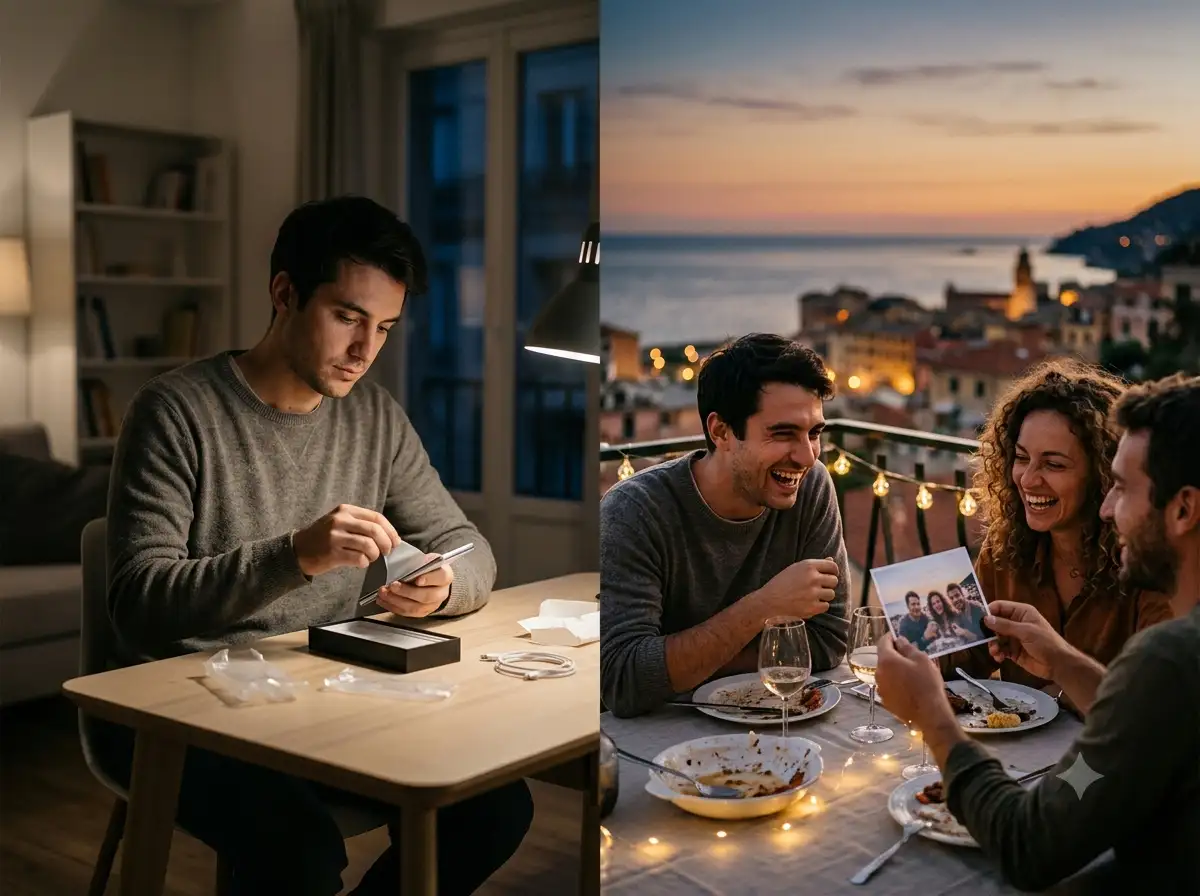
Imagine two people each receive the same bonus. One buys the latest smartphone, while the other books a weekend trip with friends. A few months later, the phone has become just another everyday object. But the holiday? It's still a favourite story, a collection of photos and memories that brings a smile every time it's recalled.
Why does one purchase seem to keep giving while the other quickly fades into the background?
According to decades of psychological research, the answer lies not in how much we spend, but in what we spend it on. Studies consistently suggest that, once our basic needs are met, experiential purchases, such as travel, concerts, dining out or learning a new skill, tend to bring greater and longer-lasting happiness than material possessions.
Why experiences make us happier than possessions
One of the most influential studies on the topic was published in 2003 by psychologists Leaf Van Boven of the University of Colorado Boulder and Thomas Gilovich of Cornell University in the Journal of Personality and Social Psychology .
After surveying hundreds of people about purchases that had made them happy, the researchers found that people consistently reported greater satisfaction from experiences than from material goods.
Their conclusion was simple: experiences become part of who we are, while possessions remain things we own.
As Gilovich later explained, "Our experiences are a bigger part of ourselves than our material goods." Unlike a new gadget or designer bag, experiences become woven into our identity and personal story.
The problem with buying things: We get used to them
Psychologists describe this as hedonic adaptation, our tendency to quickly become accustomed to positive changes. That excitement you feel after buying a new laptop, car or watch often fades within weeks or months because the item becomes part of everyday life. Once the novelty disappears, so does much of the emotional boost. Experiences work differently.
A holiday, live concert or family celebration cannot simply become another object sitting in the corner of a room. Instead, the experience continues to evolve every time we remember it, talk about it or look through old photographs.
The happiness starts before the experience even happens
One of the most surprising findings is that experiences often make us happier before they even take place.
A study by Amit Kumar and colleagues, titled “Waiting for Merlot: anticipatory consumption of experiential and material purchases,” found that people enjoyed anticipating experiential purchases, such as an upcoming holiday or concert, more than waiting for a material purchase to arrive.
Planning a trip, counting down the days and imagining what lies ahead all create positive emotions long before the experience begins. In contrast, waiting for a package to be delivered rarely produces the same sustained excitement.
Experiences strengthen relationships
Psychologists say another reason experiences create lasting happiness is that they are often shared with other people. Whether it's travelling with family, attending a wedding, trying a new restaurant or hiking with friends, these moments strengthen social bonds.
Strong relationships are among the biggest predictors of wellbeing. The famous “Harvard Study of Adult Development: Human Connection is Key to Health and Well-Being,” one of the world's longest-running studies on happiness spanning more than 85 years, has consistently found that good relationships are one of the strongest factors linked to long-term health and life satisfaction.
Experiences don't just create memories, they create shared memories, making them even more meaningful over time.
The research does not suggest that buying material possessions is a mistake. Many purchases improve comfort, health or daily life, and basic needs such as housing, clothing and transportation remain essential.
Instead, psychologists argue that once those needs are met, directing more discretionary spending towards meaningful experiences is often a better investment in long-term wellbeing.
What the research really tells us
The psychology behind spending is not really about money, it's about memory.
Experiences become part of our identity, strengthen our relationships and continue to bring joy long after they end. Material possessions certainly have value, but the excitement they generate often fades as we adapt to them.
The next time you're deciding between buying another gadget or creating a memorable experience, psychology offers an interesting perspective: years from now, you're far more likely to remember the sunset you watched on holiday, the laughter you shared with friends or the concert that gave you goosebumps than the object that once sat unopened in a box.