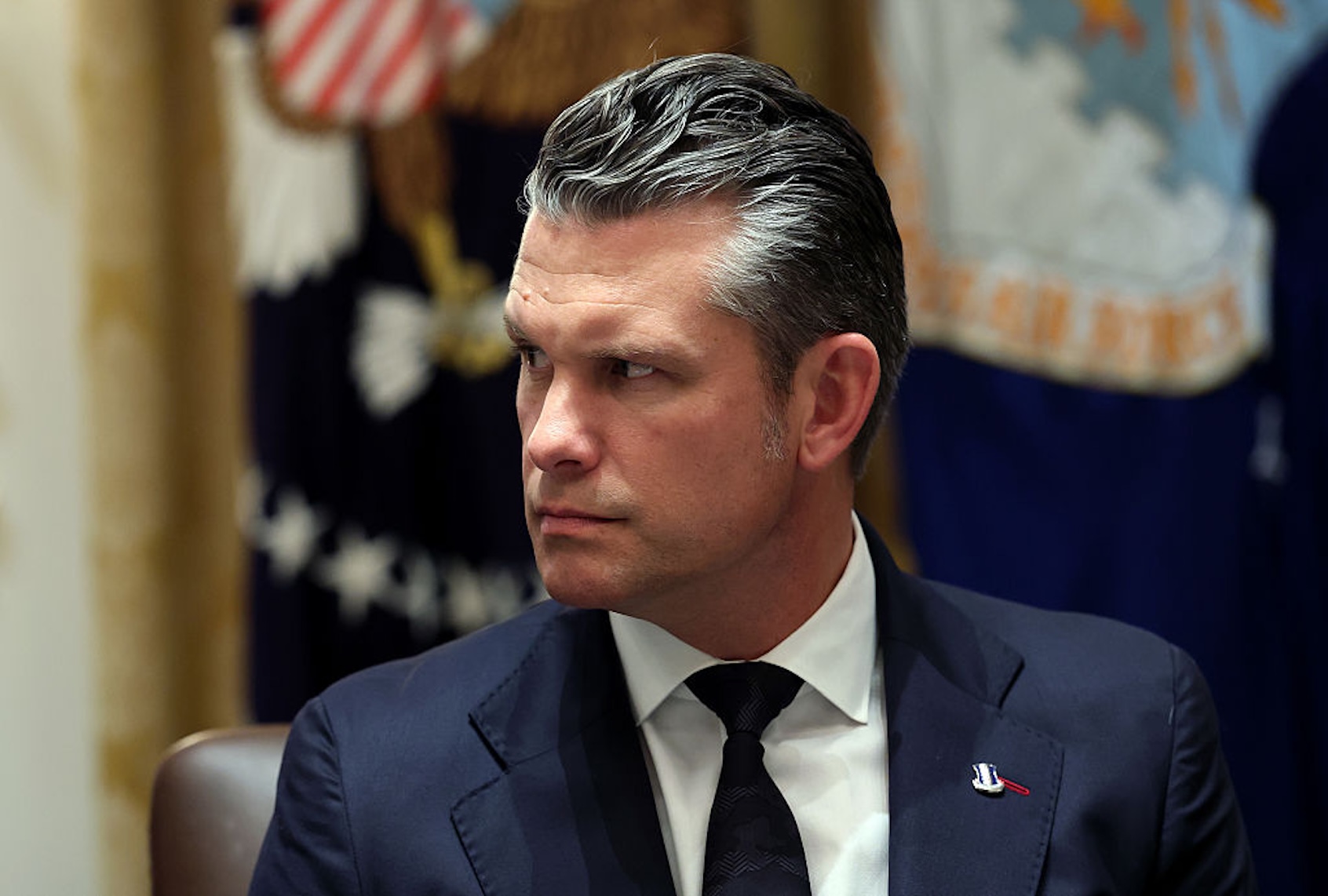
On Monday Secretary of Defense Pete Hegseth posted a video on X, the government’s de facto policy platform, explaining that the Pentagon and the Justice Department created a newfangled joint task force to identify and prosecute press leaks.
The “joint task force” model of all things law enforcement became increasingly popular in the wake of 9/11. Now, under Donald Trump’s administration, it appears press freedom is the new terrorism.
“George Washington himself battled leaks, insider threats and espionage,” Hegseth noted in the video. However, I’m fairly certain the secretary doesn’t know that a reason Washington disliked leaks was because of the “Conway Cabal” — one of the earliest American political leaks. It involved private letters between two senior Continental Army officers who wanted Washington replaced as commander-in-chief of the army during the Revolution.
If Hegseth dug a little deeper, he would also learn that the Founding Fathers, including Washington, frequently relied on stealth statecraft, planting press stories and other leaky behavior. Washington, Thomas Jefferson, Benjamin Franklin, Alexander Hamilton, John Adams and James Madison were colonial cyberpunks who used various encryption methods and strategically used information to influence politics, public opinion and the course of history. Jefferson was quite literally the nation’s OG cryptographer, a master of codes and ciphers that would make modern-day hackers blush. Benjamin Franklin, of course, was America’s first great newsman — a writer, publisher, editor and champion of an unbridled free press.
Hegseth’s “new” anti-leak task force is a dramatic escalatory reincarnation of older censorship efforts that even Washington would have scorned. The move also drips with hypocrisy, irony and mendacity in light of the secretary’s own leaky tenure and the Justice Department’s near-simultaneous subpoenas of five New York Times journalists who reported on Trump’s Qatari-gifted, inadequately secured designer airplane.
Government anti-leak campaigns have a long and ignominious history, from Richard Nixon’s illegal “Plumbers” (1971-72) and George W. Bush and Dick Cheney’s expansion of interagency leak investigations (2001-2008) to Barack Obama’s “National Insider Threat Task Force” (2011) and Donald Trump’s first term “DOJ Leak Task Force” (2017). Obama’s group famously pictured my clients Edward Snowden and Thomas Drake alongside actual spies and mass murderers on a “WANTED”-style poster of “Those that have done us harm.”
In once again teaming up, the Justice Department and the Pentagon can dust off the Defense Counterintelligence & Security Agency’s training courses, tool kits, templates and videos that discourage employees from choosing their conscience over their career. One McCarthyesque poster encouraged employees to rat on one another for “general suspicious behaviors,” including First Amendment activity like “making anti-U.S. comments.” Anti-leak posters featured cutesy slogans like “There’s no delete when you tweet!” and “Every leak makes us weak!” My personal favorite was “Free speech doesn’t mean careless talk,” when that’s exactly what it means. While you can’t shout “fire” in a crowded theater, there’s no Supreme Court ruling holding that “careless talk” is exempt from First Amendment protection; otherwise, Trump’s Truth Social posts and X feed would have been shut down long ago.
I am no stranger to government witchhunts for “leakers.” After blowing the whistle in America’s first terrorism prosecution after 9/11, the Justice Department investigated me as part of an over-the-top leak probe. Despite years of severe and grueling retaliation — including anonymous government officials publicly calling me a “turncoat,” referring me to the state bars where I’m licensed as a lawyer and putting me on the “No-Fly” list — I got lucky because the DOJ had not yet seized upon using the antiquated Espionage Act as its weapon of choice to go after whistleblowers. All I had to do was clear my name, pay enormous legal fees, miss a bunch of flights and rebuild my entire career.
The next batch of civil servants weren’t so lucky. U.S. Army whistleblower Chelsea Manning; Air Force whistleblower Reality Winner; CIA whistleblowers Jeffrey Sterling and John Kiriakou; and NSA whistleblowers Thomas Drake, Edward Snowden, and Daniel Hale faced prosecution under the draconian Espionage Act and stared down decades in prison for revealing serious government malfeasance including war crimes, secret mass surveillance, civilian drone strikes and Russia’s attempts at election interference. (Trump was also charged under the Espionage Act in the classified documents case, but U.S. District Judge Aileen Cannon dismissed the indictment. Special counsel Jack Smith appealed in an attempt to undo the dismissal, but once Trump returned to office, Smith dismissed its appeal.)
In full hair and makeup, Hegseth started his X video announcing the task force with a telling statement: “As you know, we live in a dynamic and dangerous threat environment where access to and accumulation of closely held information is key to understanding our world.” His words sounded shockingly similar to those of Wikileaks founder Julian Assange, who recently testified that secret military information helped “educate people about how the world works so that through understanding we might bring about something better.” I agree with both Hegseth and Assange that secret government information has, in fact, been key to understanding larger world dynamics, especially the global impact of war, mass surveillance, torture and other human rights violations.
When it comes to the deleterious effects of leaking, Hegseth knows this territory well. He’s led the leakiest Pentagon ever and was responsible for one of the biggest leaks in military history. Early in his tenure, he fired three senior Pentagon officials accused of leaking. Then we had Signalgate, in which the secretary and other principals discussed real-time U.S. airstrikes on Yemen in a Signal group chat to which a journalist was added inadvertently. In fact, the Pentagon’s own inspector general issued a scathing report that found Hegseth had endangered troops and violated department policy by using the commercially-available Signal app for official business. Yet the secretary’s indisputable gift is his ability to fail up in direct proportion to his fireable conduct.
So what will this new joint task force yield? It’s not meant to yield anything. It’s meant to chill the sharing of vital information. There will be a marked increase of federal reporter subpoenas and search warrants in national security leak cases. There will be an increase in FBI agents showing up on reporters’ doorsteps. There will be more armed raids of journalists’ homes, regardless of whether they are the subject or target of an investigation. There will be even more criminal probes and prosecutions of journalists and whistleblowers. The biggest losers of all, unfortunately, will be the public and its right to know what the government is doing, often under a Reflecting Pool-level film of algaescent secrecy.
While the Pentagon and Justice Department stand up their joint anti-leak task force, they should take a look into why leaks are on the rise despite ever more draconian measures like tracking employees’ computer downloads, restricting reporter access to government spaces and polygraphing ordinary civil servants. Such an inquiry would reveal that leaking is a time-honored practice and safety valve in a democracy, as Hegseth actually acknowledged without even realizing it. That’s something worthy of study by a joint task force of two of the largest departments in the U.S. government.