Welcome to the Monday, Aug. 3, 2026, Brew.
By: Briana Ryan
Here’s what’s in store for you as you start your day:
- Prediction markets approach $200 million in settled contracts
- Two states have veto-proof majorities opposite their governor's party — that could change this year
- Generation and ideology divide two of the candidates running in the Democratic primary for Hawaii's 1st Congressional District
Prediction markets approach $200 million in settled contracts
An NBC News analysis found that in this election cycle, approximately $200 million has been wagered in prediction markets, where users have bet on election outcomes across the country.
According to the Commodity Futures Trading Commission (CFTC), a prediction market is a platform where users buy and sell contracts tied to the outcome of future events. The price of a contract reflects the market-implied probability of an outcome.
For example, a contract trading at 55 cents implies the market estimates a 55% chance the event will occur. Trading volume reflects how actively a market is being traded. Prediction markets are speculative, which means market prices do not guarantee the outcome of an event.
According to economics professors Paul W. Rhode and Koleman Strumpf, prediction markets in elections date back centuries. The first modern version of a prediction market was the Iowa Presidential Stock Market, a program that three University of Iowa professors started in 1988 to test whether markets were more accurate than polls. Their research found prices outperformed the polls three-fourths of the time from 1988 to 2004. In 2023, the prediction market platform Kalshi began offering contracts on which party would control Congress following the 2024 elections. In the 2024 presidential election, users of Polymarket, another prediction market platform, spent $3.2 billion on contracts.
Polymarket data on 504 congressional and gubernatorial general elections as of July 27 shows that Democrats are favored in 264 races and Republicans in 236. There are no odds available for this year's general elections in California's 40th Congressional District and Maine's 2nd Congressional District.
In most of these general elections, one party is viewed as having an 81% or higher chance of winning. Seventy races are viewed as more competitive, with one party having a 51% to 80% chance of winning.
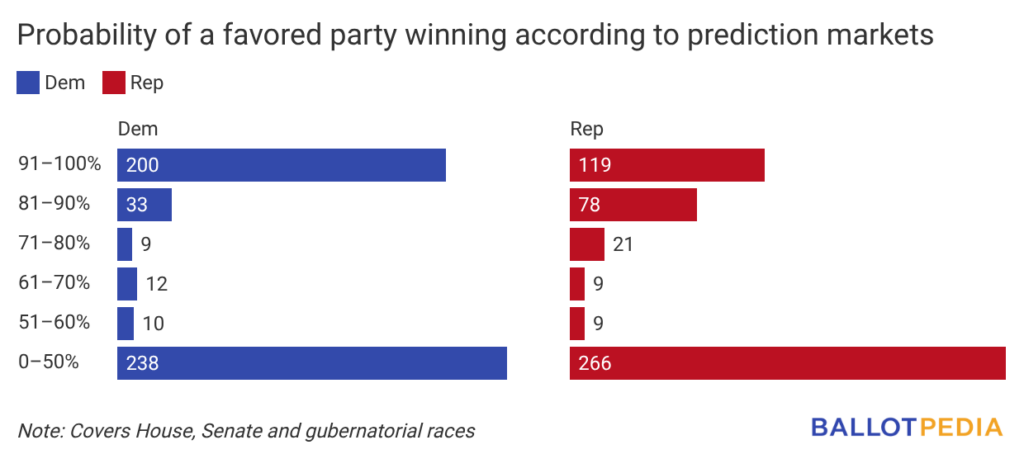
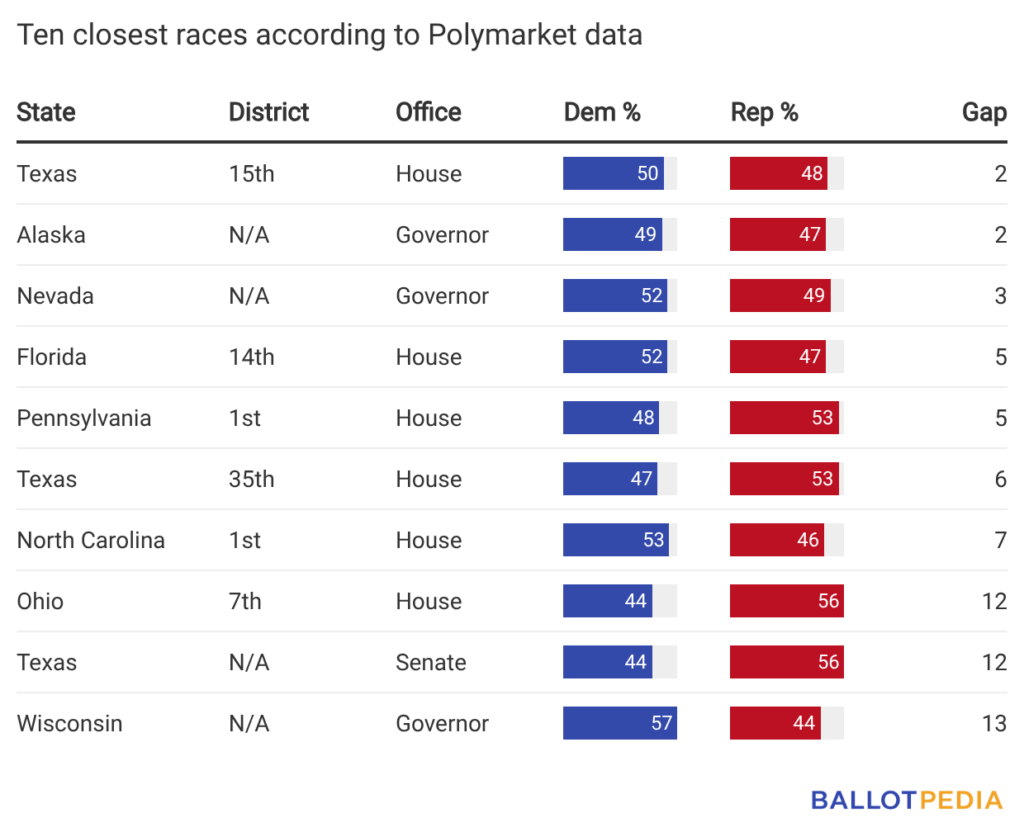
According to Polymarket, the following races are the closest congressional and gubernatorial general elections this year:
- The closest U.S. House race is between incumbent Rep. Monica De La Cruz (R) and Bobby Pulido (D) for Texas' 15th Congressional District . Pulido has a 50% chance of winning the race, compared to De La Cruz's 48%.
- The closest U.S. Senate race is between James Talarico (D) and Ken Paxton (R) in Texas . Paxton has a 56% chance of winning the race, compared to Talarico's 44%.
- The closest gubernatorial race is in Alaska. Four candidates will advance from the Aug. 18 primary to the general election . A Democratic candidate has a 49% chance of winning the race, compared to a Republican candidate's 47%. Among 2026 congressional and gubernatorial general elections, this is the only race in which neither party is favored by at least 50%.
Click here for more information about prediction markets, and here for more about this year's elections.
Two states have veto-proof majorities opposite their governor's party — that could change this year
This year, there are two states with a governor of one party and a veto-proof state legislative majority of the opposing party: Kansas and Kentucky. At least one legislative chamber is up for election this year in both states, meaning their veto-proof majority status could change.
Voters in Arizona, Nevada, North Carolina, Vermont, and Wisconsin could elect veto-proof legislative majorities this year opposite their current governors' parties. Four of those states — Arizona, Nevada, Vermont, and Wisconsin — are also holding gubernatorial elections.
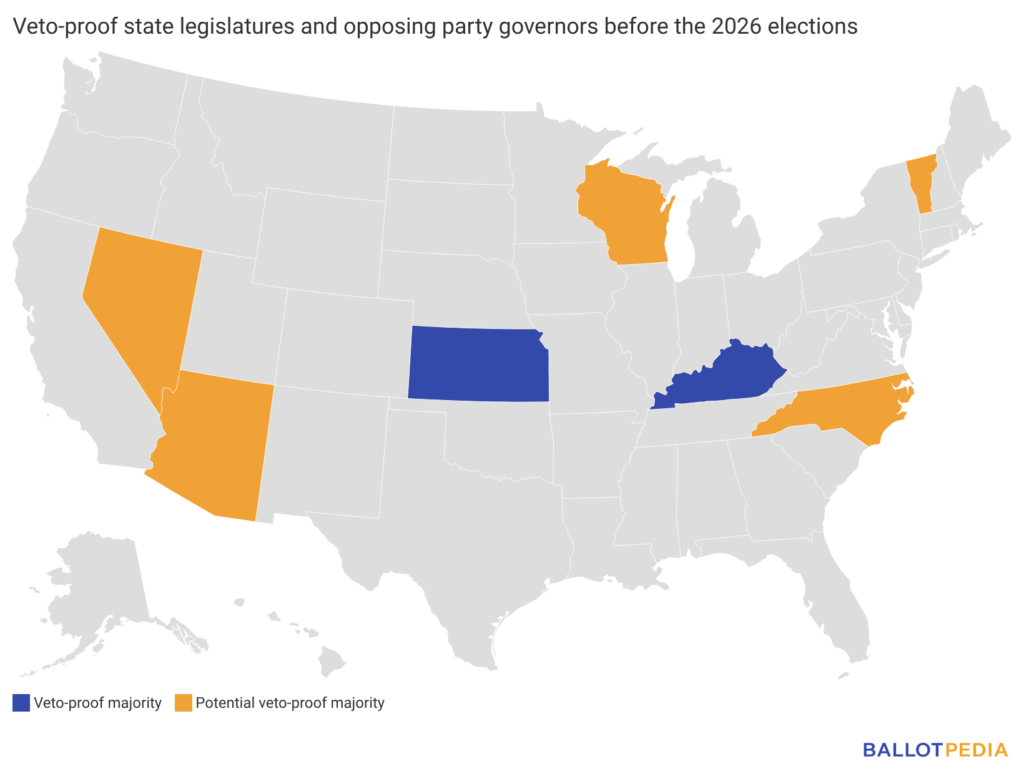
Governors have the power to veto legislation, and legislatures have the power to override those vetoes. In each state, the number of votes needed to override a gubernatorial veto ranges from one-half to two-thirds of the legislature. A veto-proof majority is when one party controls enough seats to overturn a gubernatorial veto without any support from the other party.
States with a veto-proof legislative majority and an opposing-party governor
In Kansas, Republicans have an 88-37 majority in the Kansas House of Representatives and a 31-9 majority in the Kansas Senate. That's more than the two-thirds of the Kansas Legislature that is needed to override a veto.
If Democrats win at least five seats in the state House, they will break Republicans' veto-proof majority. If Republicans lose fewer than five seats or gain seats, they will retain their veto-proof majority. No state Senate seats are up for election. Kansas is also holding a gubernatorial election this year. The state's incumbent Gov. Laura Kelly (D) is term-limited. As of July 28, The Cook Political Report and Sabato's Crystal Ball rated the gubernatorial general election as lean Republican. Inside Elections rated it as a toss-up.
In Kentucky, Republicans have an 80-20 majority in the Kentucky House of Representatives and a 32-6 majority in the Kentucky Senate. That's more than the simple majority in the Kentucky General Assembly that is needed to override a veto.
If Democrats win at least 30 seats in the state House or at least 13 seats in the state Senate, they will break Republicans' veto-proof majority. If Republicans lose fewer than 30 seats in the state House and fewer than 13 seats in the state Senate, or gain seats, they will retain their veto-proof majority. The governorship in Kentucky is not up for election until 2027, when incumbent Gov. Andy Beshear (D) will be term-limited.
States that could potentially elect a veto-proof legislative majority with an opposing-party governor
We consider a state to have a chance at electing a veto-proof majority with an opposing-party governor if a party would need to win fewer than 15% of the seats up for election in at least one legislative chamber to gain a veto-proof majority, and the opposing party controls the governorship.
There are 11 states with divided governments. In five of those states — Arizona, Nevada, North Carolina, Vermont, and Wisconsin — one party currently has majorities in both legislative chambers, and the other party holds the governorship.
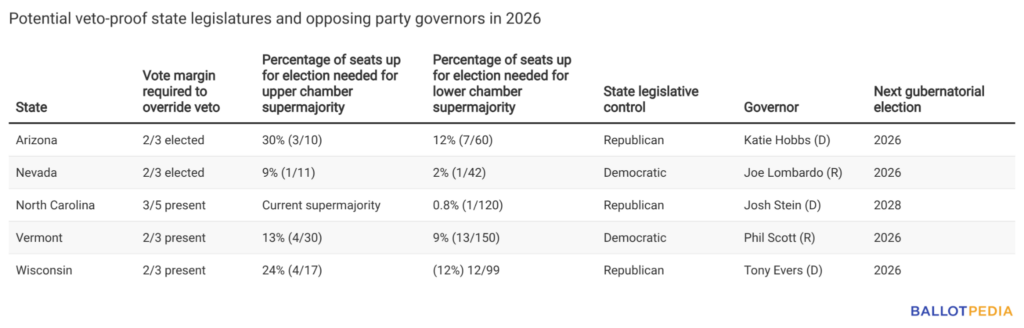
Click here to read more about veto-proof state legislatures and opposing party governors in this year's elections.
Generation and ideology divide two of the candidates running in the Democratic primary for Hawaii's 1st Congressional District
Five candidates are running in the Aug. 8 Democratic primary for Hawaii's 1st Congressional District. Incumbent Rep. Ed Case (D) and Jarrett Keohokalole (D) lead in fundraising and media attention.
Spectrum Local News' Michael Tsai said, "While it is relatively rare for an incumbent of Case's standing to face significant opposition in the primary, Case has drawn fire from within his own party for voting in support of Republican initiatives, including ... the so-called SAVE Act, which requires documented proof of citizenship to register to vote."
According to The New York Times' Tim Balk, aside from ideological differences, there is also a generational divide between the two candidates. Case is 73 years old, and Keohokalole is 42 years old.
Case has represented the district since 2019 and represented Hawaii's 2nd Congressional District from 2002 to 2007. He previously represented District 23 in the Hawaii House of Representatives from 1994 to 2002 and worked as a lawyer.
Case's campaign website says, "Our country and world face immense challenges that demand strong, smart leadership to defend our democracy and deliver real solutions. ... If re-elected, I will move to the top 25% of House seniority, continue on the powerful Appropriations Committee, and further expand my relationships and influence."
Keohokalole has represented District 24 in the Hawaii Senate since 2018. He previously represented District 48 in the state House from 2014 to 2018 and worked as a lawyer.
In a campaign advertisement, Keohokalole said, "The solutions we've been getting from Ed Case are not good enough. Families like mine are being priced out of our communities. Our kids have to leave to build a future and the help we need, the urgency we deserve, is missing."
Jennifer Booker (D), Ben Fatula (D), and Nicholas Kiswanto (D) are also running in the Democratic primary.
The Cook Political Report and Inside Elections rated the general election as solid Democratic. Sabato's Crystal Ball rated it safe Democratic.
Click here to learn more about the Democratic primary for Hawaii's 1st Congressional District. Also, if you're a Hawaii voter, check out our Sample Ballot Lookup here to prepare for Election Day.