The Metropolitan Police Department is strengthening its crackdown on counterfeit goods connected to the Tokyo Olympics and Paralympics, and plans to dispatch officials with expert knowledge who can conduct preliminary authentications in and around Games venues.
The MPD will also conduct cyber patrols to protect the Olympic and Paralympic brands.
"I thought Olympic goods would sell well," a 43-year-old self-employed man from Itabashi Ward, Tokyo, told police investigators. On June 30, the man was referred to prosecutors on suspicion of violating the Trademark Law.
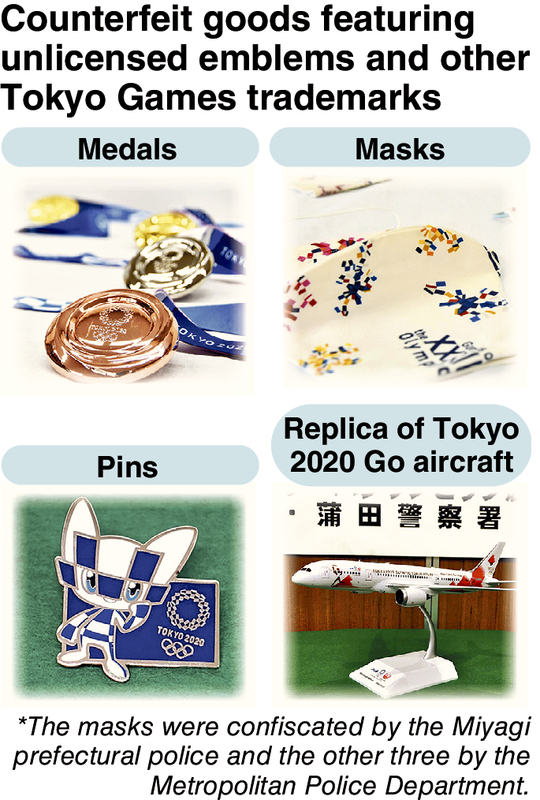
The man allegedly sold unlicensed replicas of Tokyo Olympic-brand medals via internet auctions. He later voluntarily submitted to questioning by the MPD.
The man purchased the counterfeit medals from a U.S. website. He bought a set of gold, silver and bronze medal replicas for about 11,000, yen and replicas of gold medals for about 7,500, yen and then offered them for sale through internet auctions at prices that were several thousands of yen higher.
The MPD said he sold a total of eight such medals to four people in February last year, before the decision to postpone the Games.
In May this year, a 39-year-old jobless man in Ota Ward, Tokyo, was arrested on the same charge. He allegedly sold unlicensed models of Tokyo 2020 Go, a special plane used for transporting the Olympic flame.
He imported about 30 models of the plane from China and sold them at 6,800 yen to 18,000 yen each via a flea market app.
According to the National Police Agency, 16 cases involving counterfeit Tokyo Olympic-brand goods nationwide have come to their attention since 2016. However, a large number of other counterfeit goods, such as cellphone straps and T-shirts, have been found at customs nationwide.
"There are a significant number of cases in which we demand that importers give up their ownership rights," a customs official says.
The MPD aims to further strengthen crackdowns ahead of the opening of the Tokyo Olympics, and its core personnel for this purpose are investigators in charge of preliminary authentications. These investigators have significant knowledge about counterfeit brand goods and experience looking into such cases.
They have also attended training sessions given by four famous companies -- Chanel, Louis Vuitton, Hermes and Rolex -- every year.
At investigation sites, they conduct preliminary authentications of goods in stores and elsewhere. If they judge goods to be counterfeit, they are authorized to arrest people concerned without waiting for the results of official authentications.
Currently, the MPD has about 80 investigators who can conduct preliminary authentications. Fifteen of them attended a training session on June 9 that was held by officials of the Olympic organizing committee.
The investigators learned the characteristics of tens of thousands of officially licensed goods.
During the Games, the investigators will tour places around venues to crack down on counterfeit goods.
Many goods featuring the Olympic emblem and mascots, such as pins, bags and towels, are offered for sale on flea market apps and elsewhere.
Though some of the goods are properly licensed secondhand items, a senior MPD official said, "There are lots of counterfeits among them."
The MPD aims to strengthen cyber patrols on the internet and begin official investigations into particularly serious cases.
-- Problems in the past
Counterfeit goods have been a problem at past Olympics and other international events.
During the 2016 Olympics in Rio de Janeiro, the MPD sent investigators to study the issue, and confirmed that Olympic goods deemed to be counterfeit were sold at outdoor stalls.
When the Rugby World Cup was held in Japan in 2019, the MPD arrested a man who had towels featuring unlicensed emblems of New Zealand's national team and intended to sell them near a match venue, on suspicion of violating the Trademark Law.
Under the Host City Contract, which the Tokyo metropolitan government, the International Olympic Committee and other concerned entities signed in 2013, the organizing committee and other authorities in Japan must monitor the unlicensed use of trademarks and take necessary measures to protect copyrights.
Prof. Ryo Shimanami of Kobe University, an expert in intellectual property said: "If goods that clearly infringe intellectual property rights are left unattended, Japan may lose its international credibility. Police, the organizing committee and other concerned entities need to collaborate and take firm measures."
Read more from The Japan News at https://japannews.yomiuri.co.jp/