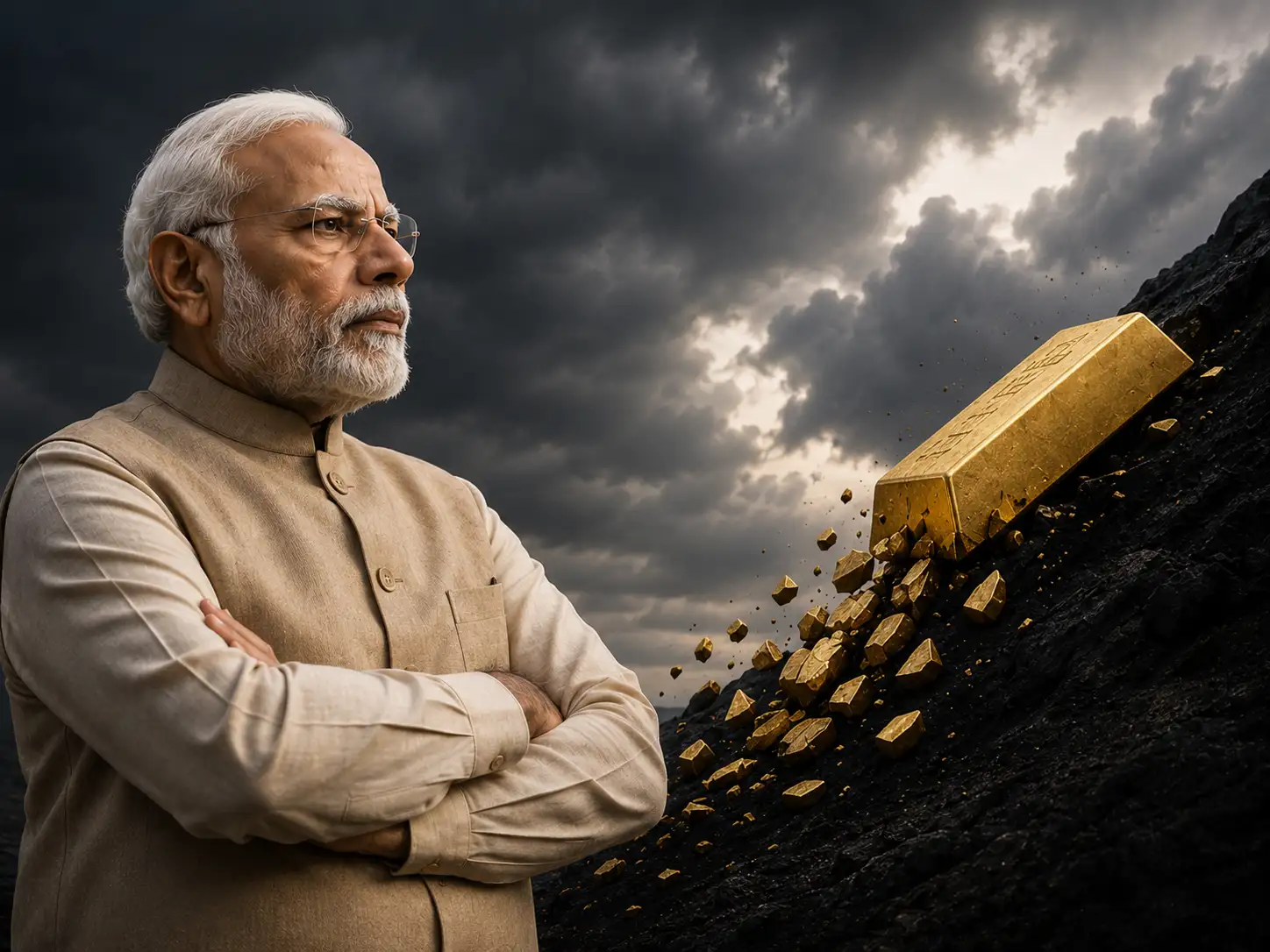
In a speech delivered in Hyderabad’s Secunderabad, Narendra Modi urged Indians to avoid buying gold for the next one year, an appeal that immediately grabbed attention in a country where gold is far more than a financial asset. For Indian households, the precious metal represents tradition, security, weddings, savings and generational wealth, making the Prime Minister’s remarks both unusual and significant.
Gold has historically been viewed as one of the safest long-term stores of value for Indian families, particularly during periods of uncertainty. Which is precisely why the comments triggered a sharp reaction across the market, with shares of jewellery companies plunging as much as 9% on Monday in a knee-jerk selloff.
But beyond the immediate market reaction, the Prime Minister’s appeal appears rooted in a larger macroeconomic concern: protecting India’s foreign exchange reserves at a time of elevated global uncertainty, rising crude oil prices and pressure on the rupee.
Short-term pain, long-term resilience?According to Ponmudi R, CEO of Enrich Money, jewellery stocks could witness near-term sentiment pressure following such comments, especially if investors begin pricing in temporary moderation in festive and wedding demand. However, he believes the possibility of a sharp structural decline in demand remains low.
Indian festive and wedding-related gold buying has historically remained emotionally driven and relatively resilient. Ponmudi added that organised jewellery players could continue gaining market share even during periods of temporary slowdown, as consumers increasingly gravitate towards trusted and transparent brands.
He also pointed out that the long-term structural outlook for organised jewellery companies in India remains strong. Investors are increasingly viewing gold not only as jewellery demand, but also as a strategic hedge against inflation, currency depreciation and geopolitical instability. According to him, this behavioural shift itself is emerging as one of the biggest long-term growth drivers for the broader gold ecosystem.
Suvankar Sen, Managing Director and CEO of Senco Gold & Diamonds, said that according to the prime minister’s commentary, there is also a possibility of an increase in gold import duty going forward. If these trends continue, India’s annual gold imports could potentially decline to nearly 550 tonnes, compared to the historical average of around 700 tonnes,” said Suvankar Sen
Jewellery companies' Q4Jewellery companies, meanwhile, continue to report robust earnings despite elevated gold prices. Titan Company reported another exceptional quarter for its jewellery business, with growth of 50% over the year-ago period. New collections and continued strength in exchange programmes drove robust 35% growth in both gold and studded jewellery portfolios.
The company also said consumer confidence in gold as both an adornment and a store of value remained intact despite record-high prices and volatility during the quarter, translating into healthy buyer engagement.
Kalyan Jewellers posted a net profit of Rs 409.5 crore in the March quarter of FY26, more than doubling from Rs 187.6 crore in the corresponding period last year, marking a growth of 118.2%. Revenue from operations climbed 66.2% year-on-year to Rs 10,274.9 crore compared with Rs 6,181.5 crore in the year-ago quarter. EBITDA rose 84.2% to Rs 735.7 crore from Rs 399.4 crore reported a year earlier.
Market experts said Q4 earnings across the jewellery sector reflected mixed but resilient trends. While elevated gold prices affected volumes in certain segments, overall value growth remained healthy because ticket sizes increased significantly. Several companies also benefited from expansion into Tier-2 and Tier-3 markets, where organised penetration continues to rise rapidly.
Looking ahead, analysts believe the next few quarters could remain volatile due to high gold prices, geopolitical uncertainty and affordability concerns. Even so, the long-term structural story for organised jewellery companies in India continues to remain strong, supported by formalisation, trust-driven purchases and rising disposable incomes.
So what do the Prime Minister’s comments ultimately mean for gold investors?Jateen Trivedi, Vice President and Research Analyst for Commodity and Currency at LKP Securities, said the appeal is unlikely to materially alter India’s long-term appetite for gold, given how deeply the metal is embedded in savings behaviour, investments and cultural buying patterns.
However, he added that the comments could temporarily slow discretionary purchases, especially in jewellery demand, while creating near-term caution across bullion and jewellery-linked businesses.
Sameer Dalal of Natverlal & Sons Stockbrokers told ETNOW that he does not expect Modi’s appeal to significantly alter consumer behaviour in a country where gold buying remains closely tied to weddings and family traditions. Dalal said consumers who intend to purchase gold jewellery are likely to continue doing so regardless of the appeal.
For now, the Prime Minister’s remarks appear less like a direct attempt to curb India’s centuries-old affinity for gold and more like a signal of the growing economic pressures facing the country amid volatile oil prices, geopolitical tensions and rising import costs. If anything, the current phase may accelerate a shift toward lighter jewellery, organised players and smarter consumption patterns rather than fundamentally weakening India’s relationship with gold.
(Disclaimer: Recommendations, suggestions, views and opinions given by the experts are their own. These do not represent the views of The Economic Times)