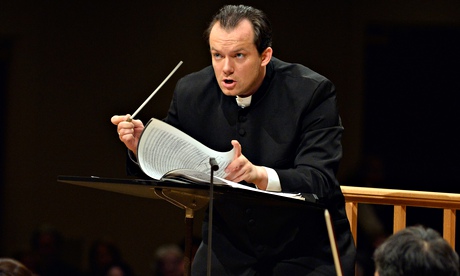
Even though he is giving his considerable all at the Royal Opera in a hyperactive account of Wagner’s Flying Dutchman, Andris Nelsons can clearly still find enough energy in reserve to give truly remarkable orchestral concerts, too. In some respects, though, the journey from pit to podium was a more logical one than usual in this case, since Bruckner’s Third Symphony is suffused with Wagnerian influences and its opening trumpet theme, which returns in splendour at the symphony’s close, is closely related to the Dutchman’s horn motif.
Nevertheless, Bruckner’s Third is a problematic symphony, on account of the composer’s many rewrites – he removed most of the more explicitly Wagnerian references – and the consequent enhancement of the already episodic character of Bruckner’s symphonic writing at this stage of his career. Making coherent sense of this symphony seems to require something more than even Nelsons can bring to it, for it is a something that eludes most conductors, perhaps because the work is just too fractured. Yet the symphony is rarely without interest or moments of lonely beauty. Nelsons’s close attention to phrasing, balance and dynamics was characteristically compelling at multiple points in the score, and with the Philharmonia playing with great intensity, there were times when the symphony flowed in ways that it rarely does in other hands.
Earlier, Paul Lewis gave a mostly rather self-contained performance of Mozart’s C major piano concerto, K503, in which his meticulous and balanced account of the piano part in the opening movement seemed somewhat at odds with the more bravura accompaniment that Nelsons provided and which, with its rich scoring, this concerto invites. Yet this is a concerto of many moods and contrasts and the collective artistry was never in doubt. The Andante felt like a Mozart opera aria for keyboard, while the fleeting changes of character in the final Rondo were impeccably done.