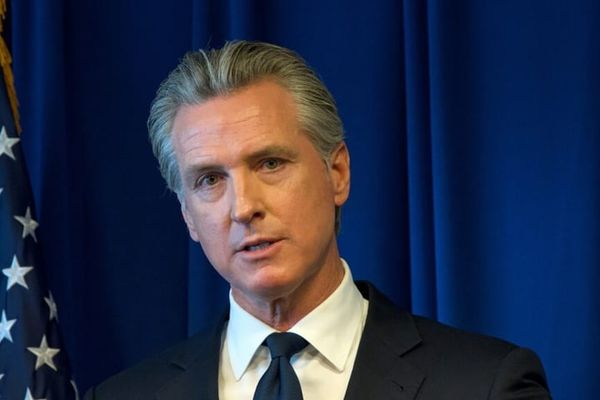
Pete Hegseth’s appointments to a key Pentagon advisory body include two men with ties to the venture capital fund where Donald Trump Jr is a partner, which has lucrative investments in military and space technology.
Defense Policy Board appointee Marc Andreessen’s firm, Andreessen Horowitz, one of Silicon Valley’s largest venture capital firms and known by the name “a16z”, co-invests alongside the Trump partnership 1789 Capital in three defense contractors. Fellow DPB appointee Blake Masters also sits on the boards of three ventures tied to 1789 Capital.
Both men now advise the Pentagon on the defense-technology sector those companies operate in.
Companies jointly backed by a16z and 1789 have already drawn billions in federal loans and contracts since the start of the second Trump administration.
The appointments by the US defense secretary not only appear to increase the influence of rightwing ideologues, autonomous weapons manufacturers, and one-time clients of authoritarian states on the world’s most powerful arsenal, but to potentially put the financial interests of the US president’s family at the heart of setting US strategic priorities.
Scott Amey, general counsel at the Project on Government Oversight said that such advisory committees are often found to have conflicts of interest. “A lot of the people appointed to them are seeking government business – specifically seeking business with the agency they’re serving,” Amey said.
He added: “So you worry: are some of these people here to raid the cupboards and learn as much as they can to give a competitive advantage to their employer or clients? Or are they trying to push contracts in a way that would benefit an employer or client.”
The Guardian contacted a16z, Masters and the Department of Defense for comment.
The DoD did not respond by deadline. A16z did not respond.
Nick Cleveland-Stout, a research associate at the Quincy Institute for Responsible Statecraft, said: “About half of this board comes from the defense industry and they’re actively working in the defense industry”, adding: “In the second Bush administration … a third of the board was made up of people that had actively worked for defense contractors. And the board today is not too dissimilar.”
Defense Policy Board
The DFB was established in 1985 as a federal advisory committee that gives the defense secretary and the under secretary of defense for policy independent advice on strategy, force structure and national security.
Although the DFB does not set policy directly, its proximity to the Pentagon’s leadership has made it influential and at times controversial. In the run-up to the 2003 Iraq invasion, the board – then chaired by the hawkish Reagan-era official Richard Perle – became an engine for the case for war, and a 2003 investigation found at least nine of its 30 members had ties to defense contractors holding billions of dollars in Pentagon business. Perle resigned as chairman that March amid conflict of interest allegations.
The board has traditionally been stocked with eminent former officials – among those removed in a late-2020 purge in the first Trump administration were the former secretaries of state Henry Kissinger and Madeleine Albright.
Hegseth disbanded it in April 2025, clearing the membership of several Pentagon advisory panels after a 45-day review he said was needed to bring “fresh thinking” and “bold changes”, before reconstituting the board on 29 June 2026 with 15 new members chaired by the former US trade representative Robert Lighthizer.
Co-investments
DPB members are connected with firms who have significant investments in emerging areas of defense contracting such as autonomous weapons and surveillance.
Masters sits on three boards tied to 1789 Capital through the Colombier blank-check companies run by the fund’s co-founder, Omeed Malik. Malik is chief executive and chairman of Colombier Acquisition Corp III, which is still hunting for a target, and led the two earlier Colombier vehicles that took the conservative shopping platform PublicSquare public in 2023 and floated the online gun retailer GrabAGun in 2025.
Masters is a director for all three.
Malik is also a former PublicSquare director. His investment bank, Farvahar Capital, was engaged as a strategic consultant to the company at $80,000 a month, and was paid $150,000 plus shares equivalent to 4% of the value of the deal for advising on its 2024 acquisition of the firearms lender Credova, according to company filings.
Comparing 1789’s previously reported holdings against a16z’s own published investment list indicates the two firms co-invested in at least five companies, three of them with significant defense business: the autonomous weapons maker Anduril Industries (whose $5bn round in May 2026 a16z co-led and which CNN places in 1789’s portfolio); the aerospace-and-defense manufacturer Hadrian, which a16z publicly announced backing and Reuters lists among 1789’s holdings; and Elon Musk’s SpaceX, which a 1789 partner has called the fund’s single biggest investment.
In the case of Anduril, a16z has been the company’s foundational venture backer since 2019, leading or co-leading every major funding round since 2019 and co-leading the $5bn round in May 2026 that doubled its valuation to $61bn – months after the US army awarded Anduril a contract worth up to $20bn. 1789 Capital came onboard as an Anduril investor in 2022.
CNN reported that Anduril was awarded about $1.25bn in federal money during the first 500 days of Donald Trump’s second term, up from roughly $760m in the comparable stretch at the end of the Biden administration.
The two funds are also aligned on Hadrian, a defense manufacturing startup that a16z’s “American Dynamism” practice publicly championed as “shoring up American manufacturing for aerospace and defense industries”, and that Reuters identified among 1789’s holdings.
Hadrian builds automated factories that turn out precision-machined metal parts for advanced weapons systems and other manufacturers. It runs a production line embedded inside a Lockheed Martin missiles plant, and in March 2026 it won a US navy partnership worth up to $900m as part of a $2.4bn plan to build three factories making components for the nuclear submarines – and an $80m US army contract to automate the Red River army depot in Texas.
Both also hold stakes in SpaceX, which a 1789 partner has described as the fund’s single biggest investment – and in Musk’s artificial intelligence venture xAI. SpaceX’s business is deeply entwined with the US government. Its president, Gwynne Shotwell, has put the company’s cumulative federal awards at about $22bn across Nasa, the Pentagon, the space force and the National Reconnaissance Office.
It flies the military’s most sensitive satellites – taking the largest share of $13.5bn in Space Force launch contracts awarded in April 2025 – and, weeks before a planned 2026 public offering, won a $4.16bn contract to build missile-tracking satellites for Trump’s Golden Dome defense initiative, plus a $2.29bn deal for a military data network in orbit.
The overlap between a16z and 1789 extends to Substack, the newsletter platform a16z has backed and helped govern since 2019. Built on a free speech maximalist ethos, it became a refuge for writers who felt shut out of mainstream media – and drew a writer revolt in early 2024 after its founders declined to remove pro-Nazi newsletters, some of them monetised, from the platform.
The public list for a16z does not include several of 1789’s most-discussed recent bets – among them Musk’s Neuralink, the search startup Perplexity, and the rare earth magnet maker Vulcan Elements, whose $620m Pentagon loan is the subject of a ProPublica investigation into White House intervention on the company’s behalf. A16z’s list omits undisclosed and crypto-token positions, so a company’s absence from it is not proof the firm holds no stake.
The companies at the centre of the overlap have drawn billions of dollars in federal contracts and loans since Trump returned to office. That is the backdrop against which Andreessen has taken a seat on the Defense Policy Board, advising the Pentagon on the very sector in which his firm – and the fund where the president’s son is a partner – are jointly invested.
Ideology and investment
1789 Capital was founded in 2022 by Malik, hitherto an investment banker, and Chris Buskirk, the founder of an early pro-Trump thinktank the Center for American Greatness, and co-founder with JD Vance of the secretive Rockbridge Network, which Reuters called “a Silicon Valley-backed donor organization to finance right-wing news stories, voter turnout operations and election polls with a goal of spreading U.S. President Donald Trump’s brand of nationalism”.
Other founders include Rebekah Mercer, a daughter of the hedge-fund billionaire Robert Mercer, was among the most influential backers of Trump’s 2016 campaign – her family part-owns Breitbart News and bankrolled Cambridge Analytica, and she reportedly pushed to install Steve Bannon atop the campaign – and has since bankrolled rightwing ventures including the social network Parler.
Malik had, according to a profile in Bari Weiss’s Free Press, been a committed Democrat until 2020 when “From #MeToo to Black Lives Matter to Covid to environmental, social, and governance (ESG) policies, [Democrats] embraced views that were antithetical to the most essential American ideals”.
The founders pitched the fund as an explicitly anti-“woke” answer to ESG investing – a $150m fund built on a framework it branded “EIG”, for entrepreneurship, innovation and growth. It set out to bankroll a “parallel economy” of conservative-friendly businesses – what Reuters later described as a network of “businesses, media outlets and political organisations designed to serve, and profit from, the America First movement”. Co-founder Chris Buskirk, publisher of the American Greatness website, summed the mission up as “build the country you want to live in”.
The early bets matched the branding: among the fund’s first high-profile deals was leading a $15m investment in Tucker Carlson’s new media company in 2024. All of it predated Donald Trump Jr’s arrival as a partner in November 2024 – and the fund’s later pivot towards defense and space technology and fintech investments.
After Trump Jr joined the firm, its assets under management ballooned, going from a reported $150m in 2024, to $1b last August, to $2.7b at year’s end, to a reported $3.5b by May, according to SEC filings.
A significant proportion of that capital came from foreign investors: according to CNN reporting and the Guardian’s review of SEC filings; 40% of assets under management were from overseas investors. Reportedly, Malik challenged the moderator at his appearance at a Saudi investment conference to find “any asset manager that has over half a billion under management that doesn’t have money from the Gulf”.
Even before making a new connection to the Pentagon board, ethicists expressed concerns about 1789 making extensive defense investments while the president’s son was on the board.
Masters is a protege, co-author and former employee of the rightwing tech billionaire Peter Thiel. Though he resigned as chief operating 0fficer of Thiel Capital in 2022 to mount an unsuccessful run for the US Senate in Arizona, Masters, along with JD Vance, was a beneficiary of Thiel’s 2022 election spending spree, with the billionaire donating $20m to the Masters-supporting Saving Arizona Pac and $15m to Vance-backing Protect Ohio Values Pac, according to FEC records.
As a political candidate, Masters ran on Great Replacement-style conspiracy theories about migrants, and called for “millions and millions of deportations. He also blamed America’s problems with gun violence on “Black people”, and praised the Unabomber, Ted Kaczynski, whose terrorism was motivated by an animus for industrial society, as an underrated “subversive thinker”.
According to his personal website, Masters still sits on the board of the Thiel Foundation, a charity whose beneficiaries have included immortality researchers, an effort to put floating cities in international waters and beyond state jurisdiction, and “dark money” funding pipelines.
His website offers a contact email address “For founders building in defense, manufacturing, infrastructure, or frontier technology”. There is no publicly available information on any venture funding he may have engaged in.
Andreessen
Marc Andreessen is a Silicon Valley venture capitalist who after decades as a Democratic donor with apparently liberal political beliefs has in recent years leaned into far-right political positions, emerging as a conservative mega-donor who was subsequently closely aligned with the Trump administration, and has participated in a range of its initiatives.
He has also invested heavily in startups that supply autonomous weapons to the US and key allies including Israel, and his business interests intersect with US defense procurement, immigration enforcement and foreign policy.
Although his right turn may be related to his evolving business interests, Semafor reported in April 2025 that he had been a central participant in a “sprawling network of influential private chats” on services including Signal, “that began during the fervid early days of the COVID-19 pandemic, and which have fueled a new alliance of tech and the US right”.
According to Semafor, the overlapping chats at times included the Palantir co-founder Joe Lonsdale; former Coinbase CEO and “network states” advocate Balaji Srinivasan; rightwing commentator Richard Hanania; broadcaster Tucker Carlson; and Sequoia investor and outspoken Trump supporter Shaun Maguire.
In 2023, Andreessen published a Techno-Optimist Manifesto, which critics described as “neoreactionary” in which he nominated as “patron saints of techno-optimism” figures including the fascist poet Filippo Tommaso Marinetti; neoreactionary writer Nick Land; and self-described “race naturalist” philosopher Neven Sesardić, who has defended the idea of racial differences in intelligence.
Despite Andreessen’s claim in the manifesto that he was not sketching out a political movement, the manifesto staked out radical positions, including that “people only do things for other people for three reasons – love, money, or force. Love doesn’t scale, so the economy can only run on money or force.”
It also included: “Deaths that were preventable by the AI that was prevented from existing is a form of murder.”
In July 2024, just days after an assassination attempt on Trump in Butler, Pennsylvania, Andreessen and his business partner Ben Horowitz announced in a podcast that Trump’s policy proposals were a better fit with what they were then calling their “little tech” agenda.
That year, Andreessen Horowitz each donated $2.5m to a pro-Trump super Pac, with Andreessen donating a further $844,600 – the legal limit – to Trump’s campaign and the Republican party. ProPublica reported that all told, Andreessen donated more than $5m to Republican groups and $33.5m to Fairshake, a pro-cryptocurrency Pac. That organization spent about a third of its $40m war chest supporting pro-crypto Democrats, a third on pro-crypto Republicans, and a third attacking Democratic critics of the crypto industry.
This cycle, Andreessen and his wife Laura Arrillaga-Andreessen have contributed more than $43m so far to a $115m spending spree from Ben and Felicia Horowitz and their a16z firm, according to FEC records. Together, they have spent more than anyone else on political donations, including the liberal donor George Soros, according to FEC records.
On 25 March, Andreessen was appointed to the President’s Council Advising on Science and Technology (PCAST). That body is chaired by the former Trump “crypto Czar” David Sacks, and includes other tech billionaires who have publicly supported Trump including Oracle’s Larry Ellison, Mark Zuckerberg and Nvidia’s Jensen Huang.
Early in the the administration, Andreessen described himself as an “unpaid volunteer” for the Elon Musk-led “department of government efficiency” (Doge), and during the transition he interviewed candidates for senior roles in the departments of state and human services along with the Pentagon.
Andreessen venture fund, Andreessen Horowitz, has invested in manufacturers of autonomous weapons and surveillance systems including Anduril Industries, Castelion, Hadrian, Saronic, Shield AI and Skydio.
Between them, these companies have sold systems to the US military, and to domestic agencies, including Skydio’s provision of drones to ICE and Anduril’s hundreds of millions in contracts for autonomous surveillance towers for Customs and Border Protection.
The companies have also sold systems to foreign governments including the United Arab Emirates and Israel.
Within weeks of the 7 October 2023 Hamas attacks, as Israel began its retaliatory attacks on Gaza, Skydio had reportedly sold at least 100 drones to the IDF. According to Andreessen Horowitz’s own publicity materials, Shield AI’s Nova 2 drone “was used by Israel Defense Forces in the aftermath of the October 2023 Hamas attacks to search for civilians and barricaded shooters inside targeted buildings”. Late last month, the Jerusalem Post reported that an Anduril delegation led by its CEO and co-founder, Brian Schrimpf, led a sales trip to Israel “to promote deals to sell the company’s products to Israel’s Ministry of Defense”.