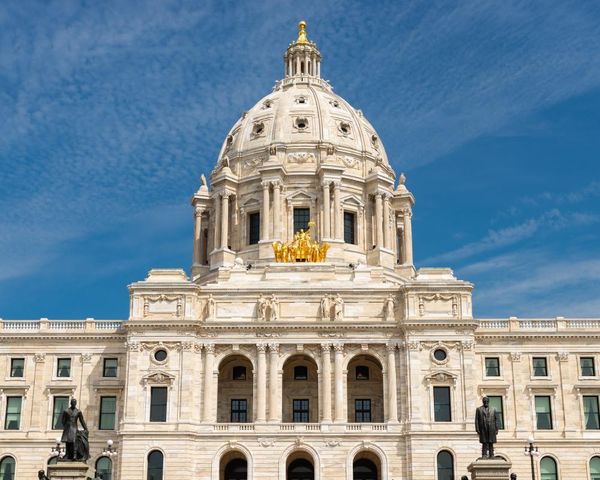
Minnesota primaries could mark change of path for Democrats and Republicans
Minnesota voters on both sides of the aisle are weighing the direction of their parties – and their chances of winning over the general electorate – in marquee statewide races on Tuesday.
On the left, Peggy Flanagan, the state lieutenant governor and a progressive, faces off against Angie Craig, a US representative, for the Democratic bid for US senate in a race punctuated by the role of immigration enforcement in the state that saw two residents killed by immigration agents in a winter surge.
On the right, Mike Lindell, an election denier and pillow salesman, carries Donald Trump’s endorsement in a three-way race for the Republican nomination for governor, where Republicans face an uphill battle to challenge Amy Klobuchar, the Democratic contender and a US senator, now seeking the governor’s office.
After Tuesday, the general election for the open governor and US senate seats will shape up, signaling a change for top roles in the state. Governor Tim Walz, a Democrat, initially sought a third term, but dropped his bid after ongoing fraud scandals threatened to distract from the race.
Tina Smith, the Democratic US senator, decided not to run again, saying she wanted to spend time with her grandkids and make way for new faces in the chamber. She has endorsed Flanagan.
The state leans Democratic. It has not elected a Republican statewide since 2006, when Tim Pawlenty won a second term as governor. A Republican presidential candidate has not won the state since 1972. Still, Republicans hope to seize on fraud problems in state programs, including criminal cases against a sprawling group accused of organized theft of meals for children, services for kids with autism and housing programs.
Wisconsin considers democratic socialist for governor amid US wave of progressive wins
Wisconsin voters will decide on Tuesday whether to nominate a democratic socialist for the state’s highest office in the latest test of an anti-establishment wave among Democratic primary voters.
Francesca Hong, a democratic socialist state lawmaker, emerged as the frontrunner in a four-way race to succeed Tony Evers, the Democratic governor who is not seeking another term.
Evers threw his support behind David Crowley, the Milwaukee country executive. Crowley previously left the race, before reentering it on 18 July.
Crowley and Evers toured the state in the last two weeks, centering his campaign around electability, saying Crowley was more poised to win a general election in a swing state like Wisconsin than Hong.
Eyes turned to the Wisconsin governor’s race after Abdul El-Sayed won the Democratic primary for US Senate in Michigan last week in the most recent example of a progressive beating out a moderate. Next door, Minnesota voters have also been weighing a US Senate primary between a moderate and a progressive.
After a wave of wins of progressives and democratic socialists in solidly blue parts of the country, the midwest primaries centered more on electability concerns given the close nature of statewide races there.
‘Fiercely independent’ South Carolina votes on Lindsey Graham’s Senate successor
In the race to replace the late US senator Lindsey Graham, 10 candidates have been barnstorming South Carolina diners, church halls and recreation centers, compressing a normal year of campaigning into about a fortnight.
The Republican party is staging a special primary election in the state on Tuesday to choose Graham’s replacement. His sister, Darline, who has been serving as interim senator following his sudden death last month, is on the ballot.
If no candidate wins an overall majority of votes, the top two will advance to a runoff on 25 August. Polling suggests that this is the most likely outcome.
“You know, South Carolina politics is very local,” said Eaddy Roe Willard, a longtime Republican activist in South Carolina’s Richmond county. “Something one of our former chairmen used to say about presidential candidates: we don’t decide whether or not we’re gonna vote for you until we’ve had a chance to shake your hand at least three times.”
On Friday Russell Fry, a Republican representative, pressed the flesh at Savage Craft Ale Works in West Columbia. On Monday morning, Darline Graham shook hands at Lizard’s Thicket breakfast restaurant, 2 miles away. Mark Sanford, the former South Carolina governor, and US representative Ralph Norman were also just a few miles down the road in Aiken on Friday, Willard said.
After Lindsey Graham’s death on 11 July, Henry McMaster, South Carolina’s governor, appointed Darline Graham to fill the vacancy in the US Senate.
Lindsey Graham had already won the Republican primary election for his seat, so the Republican party must hold a special election to replace him on the ballot in November’s general election. The timeline is brutal by American political standards, holding an election within a few weeks of the vacancy.
The winner will face Annie Andrews, the Democratic nominee and a pediatrician, in November.
Wisconsin and Minnesota primaries set for clash between progressives and Democratic establishment
Hello and welcome to the US politics live blog.
Democratic primaries for governor in Wisconsin and US senator in Minnesota will once again see left-wing candidates face off against more traditional ones.
The party’s ideological rift, that has already been seen in contests across the States this year, shifts to the upper Midwest later today.
In Wisconsin, state representative Francesca Hong, a self-described democratic socialist, is front-runner for the party’s nomination for governor in a swing state where winning the governor’s mansion is central to Democrats’ hopes for 2028 and beyond.
In Minnesota, Peggy Flanagan is running for the nomination for an open Senate seat against centrist Democratic representative Angie Craig. Meanwhile, seven Minnesota Republicans are vying to face off against likely Democratic gubernatorial nominee senator Amy Klobuchar in November.
The primaries come a week after Abdul El-Sayed narrowly defeated Haley Stevens in Michigan’s divisive and costly US Senate primary.
El-Sayed’s victory has energized progressives, while stoking fears among Democratic party leaders that the shift to the left, particularly in battleground states like Michigan and Wisconsin, will make it more difficult to win in the November midterms.
The left vs center theme is on display in Democratic primaries in multiple states voting on Tuesday, with other significant races also taking place in the likes of Alabama and South Carolina.
In other developments:
-
President Donald Trump departed on a secret military flight from Turkey last month when the White House said he was flying aboard Air Force One, an extraordinary move prompted by an Iranian assassination threat, the Washington Post reported on Monday.
-
Trump signed an executive order that will involve splitting up the highly effective measles, mumps and rubella (MMR) vaccine into three single shots. The president also announced an overhaul to the childhood immunization schedule, scrapping recommendations for the hepatitis b, Covid-19 and influenza vaccines. He also suggested that the number of inoculations is linked to the rate of autism in the US, despite no proven link between the two. Medical experts have blasted the changes, calling it “problematic and deeply concerning.”
-
Todd Blanche has been sworn as US attorney general, cementing Trump’s installation of his former personal attorney in charge of the Department of Justice. Blanche, who has been serving as acting attorney general since April, was confirmed in his new position during a ceremony at the White House on Monday.
-
Trump has named White House staff secretary Will Scharf to become White House counsel and assistant to the president, replacing David Warrington, who is taking a job in the private sector. In taking up that role, Scharf will become the White House’s top lawyer after overseeing the administrative work of the Oval Office in his current position.
-
Lawyers for David Hearn, the Olympian who was arrested for alleged property destruction of the reflecting pool before his charges were dropped, said that the Trump administration is “continuing to attack an innocent man”.
Updated