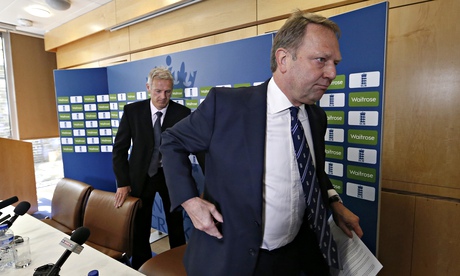
For Paul Downton, the World Cup fiasco, in which England were eliminated before the knockout stages, was the final straw. It is easy to blame the players, and even easier to blame the management, whose job it is to prepare these same cricketers, even if they cannot go on the field and bat, bowl or field for them. But ultimately, accountability for such a disaster has to rest with the man at the top. If the timing appears to be hasty, then Downton was due to go to Antigua over the next few days for Monday’s start of the Test series against West Indies.
Earlier in the year, at a board brainstorming session in Warwickshire, the new ECB chief executive, Tom Harrison, was charged with authoring a strategy for the next four years and beyond. The appointment of Harrison was seen as a move towards a higher‑profile, more obviously hands-on CEO than his predecessor David Collier, particularly with a new chairman due to start in May.
He already had it in mind to look at the management structure of the organisation and it is likely he had such a move pencilled in then, with England’s performance in white ball cricket, and the turmoil that surrounded what was a bespoke buildup to the World Cup, merely making it an inevitability now.
Whether others will, or should, follow remains to be seen; England have a young, developing side that will go through some more tough times over the next year, but it is not unreasonable to assume that even an indifferent performance in the Caribbean in the next month could see the end of Peter Moores as the head coach.
Downton will not be replaced directly but instead there will be a newly created role of director of England cricket, an appointment the success of which will be based alone on performance at the top level, and who will be responsible directly to Harrison. Here it needs to be explained that Downton’s role was considerably more broad-based than just the senior England team, with responsibility for all England cricket, at all levels, and including women’s and disability cricket, with a further responsibility for the centre of excellence at Loughborough, the restructuring of which took a considerable amount of his time during the first part of his employment.
What this new role actually entails is not yet clear but one assumes it is more in line with the Australian appointment of Pat Howard as high performance director, than the Indian one of Ravi Shastri, who hovers over the coach, Duncan Fletcher, and appears to dilute rather than enhance his authority.
Howard, it should be noted, came from international rugby and rugby coaching rather than a cricket background and, although Harrison would surely prefer to employ someone with international cricket experience (the usual names will be lobbed into the ring, including Michael Vaughan and Andrew Strauss), the job is not simply one that takes away responsibility from the head coach: they will look at all options.
A personal choice would be Nasser Hussain, but he, like the others mentioned, would need to see it as vocational more than anything: ECB are not cheapskates but it is doubtful they could afford any of them otherwise.
At the time of his appointment, headhunted to succeed Hugh Morris, Downton appeared to have all the credentials and more to fulfil the role as advertised: he had a significant and successful career at international and first-class level; was a qualified coach; since retirement from the game because of a serious eye injury had sat on committees at Middlesex, the ECB and MCC; and had long high‑level management experience in the City.
But in the aftermath of the Ashes whitewash last winter, he was handed a hospital pass of epic proportion. His decision to tell Kevin Pietersen that he would not be selected for the World Twenty20 kickstarted a saga that has certainly not abated with time and indeed has gathered in intensity, as the ECB, inept in its own public relations and run ragged by Pietersen’s outstanding PR and legal eagles, has been battered and bruised.
However, those who see the departure of Downton as the door opening for Pietersen to step through and back into consideration for the England team might be heading down the wrong road. The ECB chairman elect, Colin Graves, is already coming to understand that being a blunt outspoken Yorkshireman is all very well when dealing as an autocrat within his own business but that more care needs to be taken when speaking in his new role.
So saying that if Pietersen was serious in his desire to play for England again then he needed to do what all other players must do, is readily translated as an olive branch, when it was no such thing.
However, when Pietersen failed to attract any attention at the IPL auction beyond his base price, the opportunity was there for him to reiterate his own position. One wonders if the same desire would be there had he got a $1.5m contract in, say, Mumbai, rather than the deal offered in Hyderabad.
As it stands, despite the PR efforts, the chances of Pietersen representing England again are remote and it may just be that this is precisely the conversation that he is said to have had with Graves (who, lest we forget, does not take up his position for a month).
But that is something with which Downton’s successor, and Harrison, must deal. The only certainty is that the issue will not disappear just yet. The hospital pass has just been handed on.