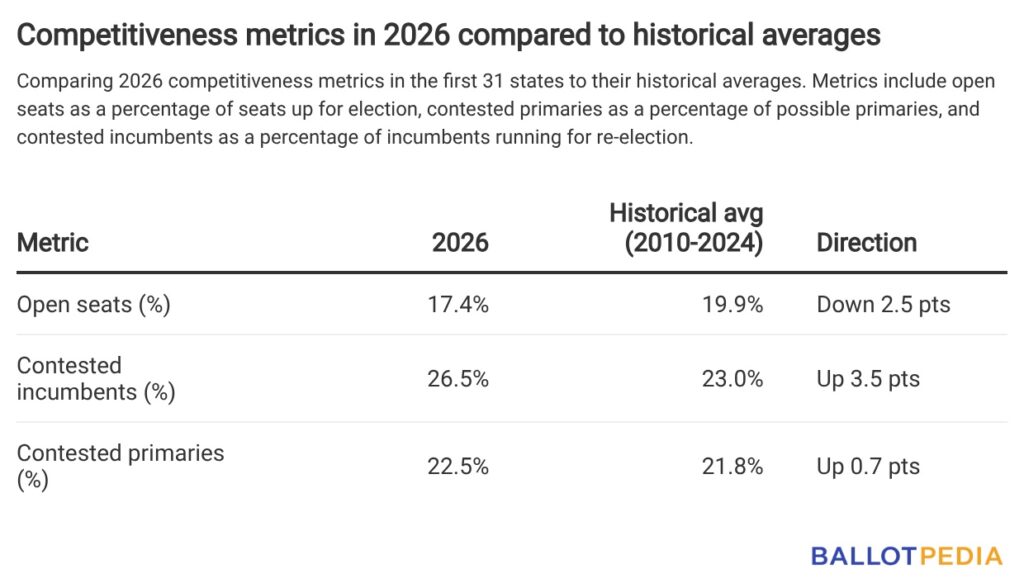
Across 31 states with completed candidate filing data, an average of 23% of incumbent state legislators are running in contested primaries this year — the second-highest share since 2010, trailing only 2022. At the same time, the average share of open seats, at 17.4%, is the second-lowest since 2010.
Among the 31 states with completed 2026 candidate-filing data — Alabama, Arizona, Arkansas, California, Georgia, Idaho, Illinois, Indiana, Iowa, Kentucky, Maryland, Maine, Michigan, Montana, Nebraska, New Mexico, New York, North Carolina, North Dakota, Nevada, Ohio, Oklahoma, Oregon, Pennsylvania, South Carolina, South Dakota, Tennessee, Texas, Utah, Washington and West Virginia — three patterns emerge compared to those states across even-year cycles since 2010:
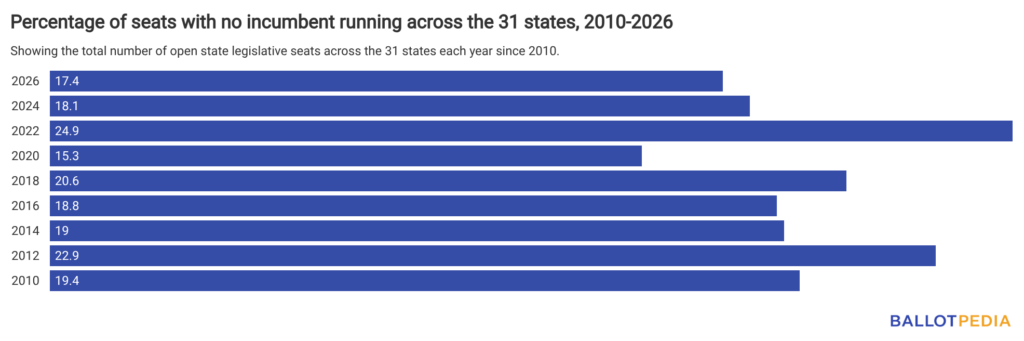
Across 31 states with completed candidate filing data, an average of 23% of incumbent state legislators are running in contested primaries this year — the second-highest share since 2010, trailing only 2022. At the same time, the average share of open seats, at 17.4%, is the second-lowest since 2010.
Among the 31 states with completed 2026 candidate-filing data — Alabama, Arizona, Arkansas, California, Georgia, Idaho, Illinois, Indiana, Iowa, Kentucky, Maryland, Maine, Michigan, Montana, Nebraska, New Mexico, New York, North Carolina, North Dakota, Nevada, Ohio, Oklahoma, Oregon, Pennsylvania, South Carolina, South Dakota, Tennessee, Texas, Utah, Washington and West Virginia — three patterns emerge compared to those states across even-year cycles since 2010:
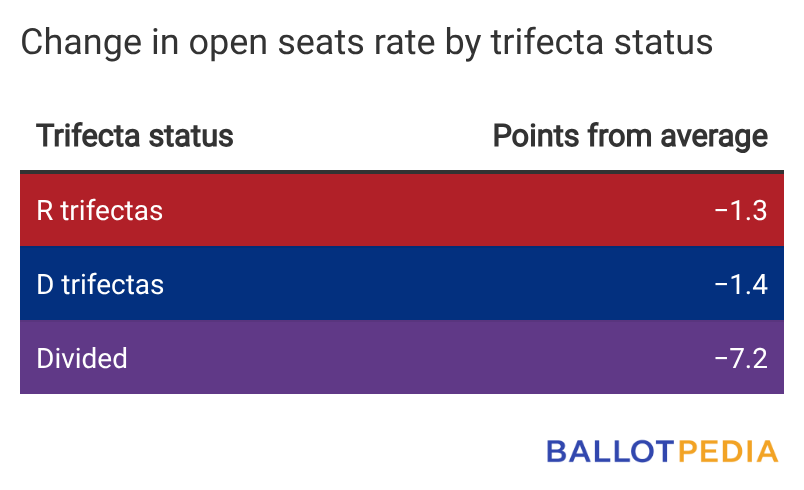
The 31-state set includes 17 Republican trifectas, eight Democratic trifectas, and six divided governments — open seats are down across all three categories, with the largest average declines occurring in states with divided governments.
Nevada, which has a divided government, had the largest decline in share of open seats, down 13 percentage points below its historical average. Nine states buck the trend and show increases in open seats this year. In four of those states, the share of open seats is five percentage points or more above average — Maine (+10 points), Nebraska (+8 points), North Dakota (+7 points), and Texas (+5 points).
Number of incumbents facing primary challengers
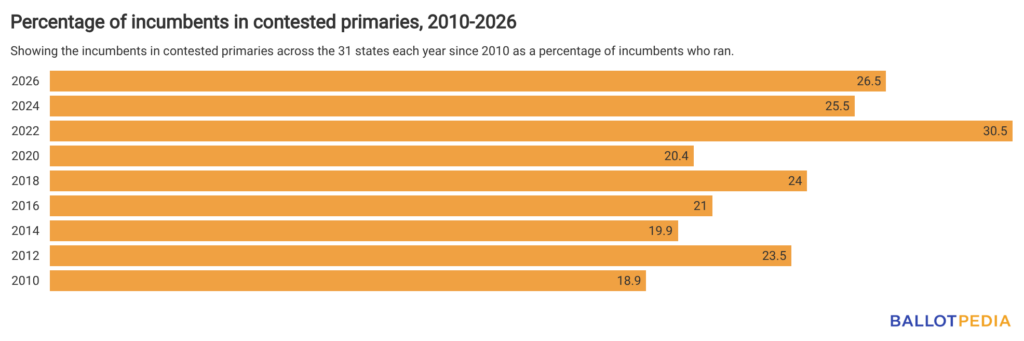
Between 2010 and 2024, an average of 23% of incumbents in the 31 states in our analysis had primary challengers each year. In 2026, 26.5% of incumbents are running in contested primaries, second only to 2022 at 30.5%.
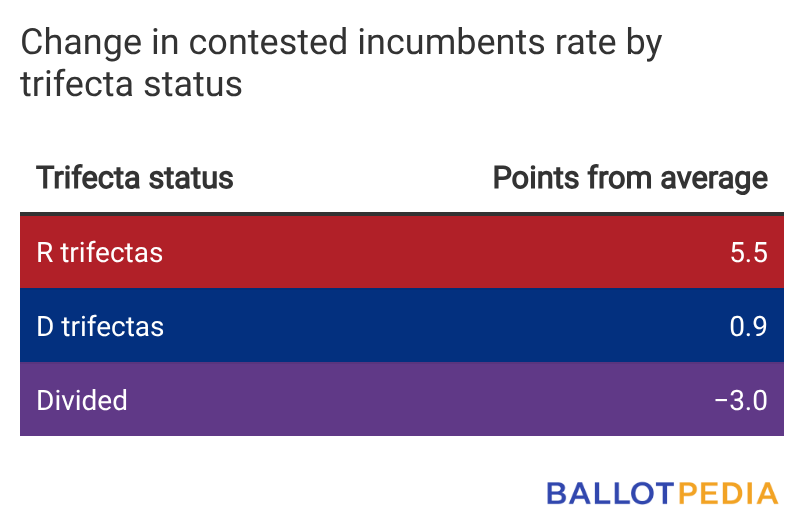
The share of contested incumbents increased primarily among Republican trifecta states, where incumbent contests are up 5.5 points on average. Contested incumbents are up by less than one point on average in Democratic trifecta states and are down three points in states with divided governments.
Nineteen states are above their own historical averages for contested incumbents this year, with 11 states more than five percentage points above average. The biggest jumps occurred in Indiana (+10 points), New York (+12 points), North Dakota (+22 points), Oklahoma (+14 points), Oregon (+13 points), and South Dakota (+38 points).
Twelve states have below-average incumbent contest rates this year, seven of which are more than five percentage points below average. The biggest drops occurred in Maryland (-16 points) and Michigan (-15 points).
Number of primary elections with more than one candidate
This year, an average of 22.5% of possible primaries are contested across the 31 states, 0.7 percentage points higher than the historical average of 21.8%.
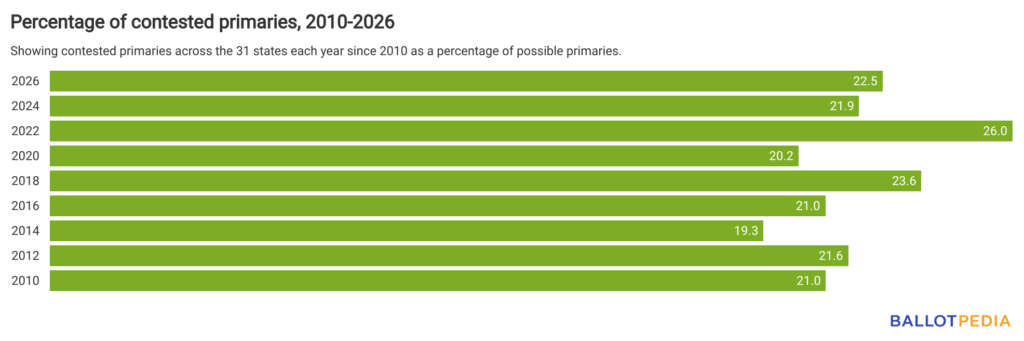
While the states are not far from the average number of contested primaries collectively, there are a handful of noteworthy up- and downswings.
Three states are running more than eight points above average: Indiana (+10 points), North Dakota (+9 points), and South Dakota (+14 points). Two states are running more than eight points below average: Maryland (-11 points) and Michigan (-10 points).
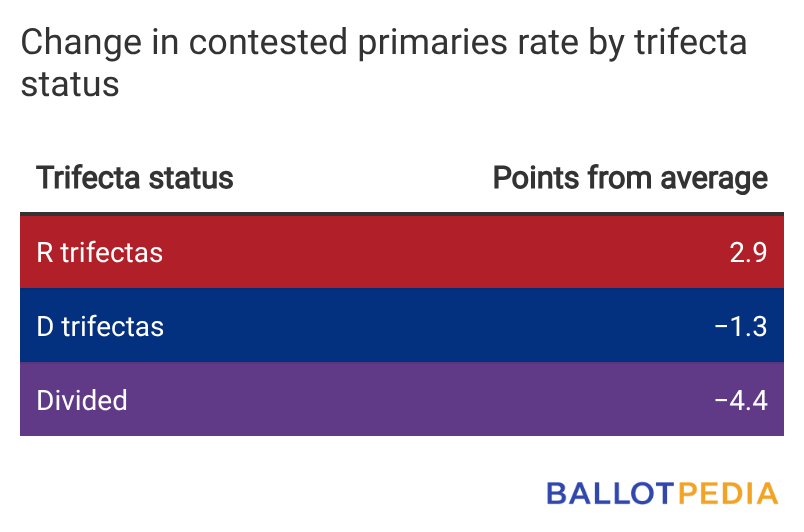
Contested primaries also increased primarily among Republican trifecta states, where the share of primaries with more than one candidate are up almost three points on average. Contested primaries are down one point on average in Democratic trifecta states and down four points in states with divided governments.
Click here to see our analysis of primary election competitiveness in state and federal government this year.