The novel coronavirus pandemic has brought dramatic changes to school life, as teachers and students have to build and maintain relationships with each other while maintaining social distance. The search for new ways of living amid the pandemic continues.
--Umbrellas distributed
Children were seen walking in line on a school road, using umbrellas under the scorching sun. It was Aug. 19, the day when the second semester began at a Chikugo municipal elementary school in Fukuoka Prefecture.
The umbrellas were meant to both prevent heatstroke and keep children from getting too close to each other. The municipal board of education distributed all-weather umbrellas to about 3,000 students at 11 municipal elementary schools.
In many schools, students are being asked to submit cards to their teachers that list their body temperatures, measured that morning, and information on their physical condition. Children who did not take their temperature at home have it taken at school.
Some schools, including Tokyo metropolitan high schools, have introduced thermo-cameras to detect temperatures automatically when a person stands in front of the camera. At Tokyo metropolitan Hakuo High School, it has become the new norm for students to form three rows and hold up their bangs as they pass in front of thermo-cameras every day at the entrance.
--Learning through screens
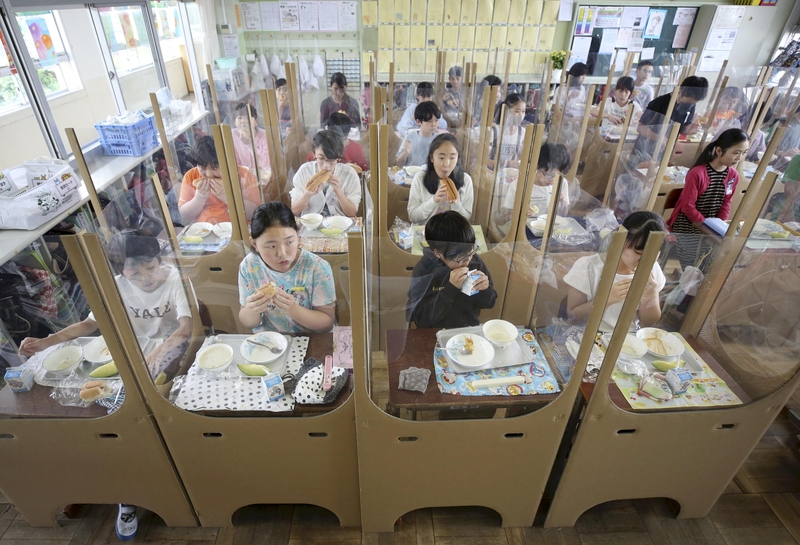
An urgent task is preventing the spread of droplets in the air. At Soka municipal Soka Elementary School in Saitama Prefecture, transparent L-shaped partitions measuring 1.25 meters by 1.4 meters are installed around each desk.
During a math lesson for sixth graders, the class was divided into groups of four to five students and they wore face masks and conversed with each other through the partitions when they discussed ways of obtaining a quotient through division.
"It's a bit hard to hear others well, but this method is safe," a student said. Vice Principal Shinichi Watanabe said: "It's imperative to conduct classroom lessons while ensuring safety. We took the best measure we could."
The Misato municipal board of education in Saitama Prefecture has devised virus prevention measures, including avoiding group discussions and having each student share their opinions on sticky notes or a small whiteboard.
The new teaching guidelines, which were introduced in the current school year starting in April, prioritize active learning in all subjects, centering on discussion and presentation. The method adopted by the Misato municipal board of education is thus aimed at communicating with each other in "words," because it is difficult to do so via "sound" amid the coronavirus pandemic.
At private Seibi High School in Gifu Prefecture, classes with 40 or more students are divided into two groups when lessons are given. Half of the students move to a vacant classroom and receive lessons via a video conference system.
--'Air tag' created
Lunch has changed completely, too.
Conventionally, students ate school lunches while chatting, with their desks placed close to each other. Now, however, it has become the norm for students to eat silently while looking at the blackboard in front of them.
At some schools, there is no customary chorus of "Itadakimasu" (Let's eat). At Sendai municipal Arai Elementary School in Miyagi Prefecture, meals are distributed in the corridor and lunch breaks are staggered by grade.
At municipal Shibahara Elementary School in Tokyo's Katsushika Ward, about 100 balls of various kinds, four times the usual number, are made available to students during lunch break to encourage them to play ball games. This is intended "to decrease the chances for students to be in direct contact," school principal Rie Yabuki said.
A new game called "air tag" has been created in which the person who is "it" only has to come within one meter of their target.
--Directed remotely
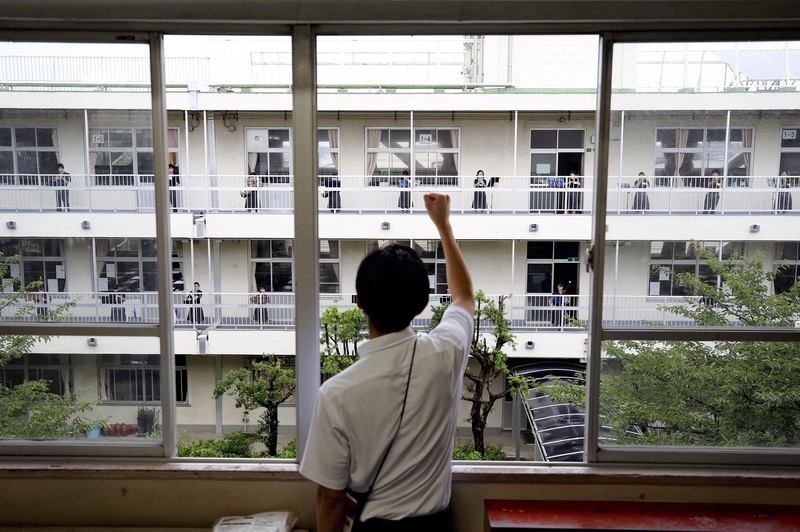
"Let's get started," called teacher Masafumi Kudo, 29, an advisor for the orchestra club of Funabashi municipal Miyamoto Junior High School in Chiba Prefecture. Speaking through a window on the third floor of a school building, Kudo was looking at verandas on the second and third floors of a separate school building, about 10 meters away from the main building with a courtyard in between.
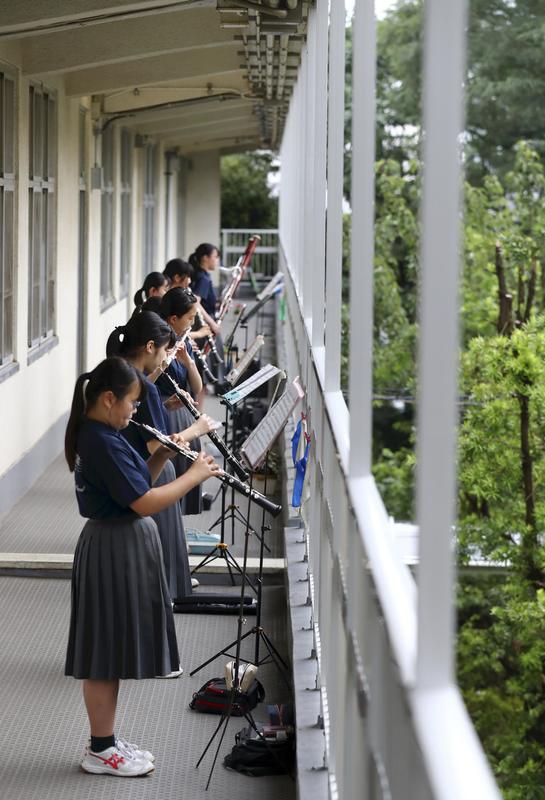
About 30 students standing at intervals of one to two meters played flutes and horns under the teacher's direction.
This practice has continued since the school reopened after a long suspension due to the pandemic. Students who play violins and other stringed instruments vulnerable to sunlight and humidity were dispersed in six places, including classrooms whose windows are fully opened and the landings of stairs.
An entire group rehearsal, involving about 70 students, has not been held once since the school reopened.
"The only option now is to have exercises individually and in groups formed by the kind of instrument played," Kudo said. Practice is restricted to 90 minutes on weekdays, with half the time spent conventionally.
When infections spread, the judo club of Saitama's prefectural Omiya Higashi High School adopted "air uchikomi" (no-contact repetition practice) in place of the uchikomi practice of grappling with each other.
Judo club members wearing face masks were divided into pairs, with each person holding the end of an obi belt. One person repeatedly applied moves, while the other person responded to them.
The practice of directly grappling with opponents was resumed in August, but changes may be forced again if the virus spreads further.
Concerned about the coronavirus? Look for information and contact numbers here if you suspect you have contracted the virus and are exhibiting symptoms.
PLEASE NOTEThe Japan News is providing this story for free to help all readers keep informed about the coronavirus.
Read more from The Japan News at https://japannews.yomiuri.co.jp/