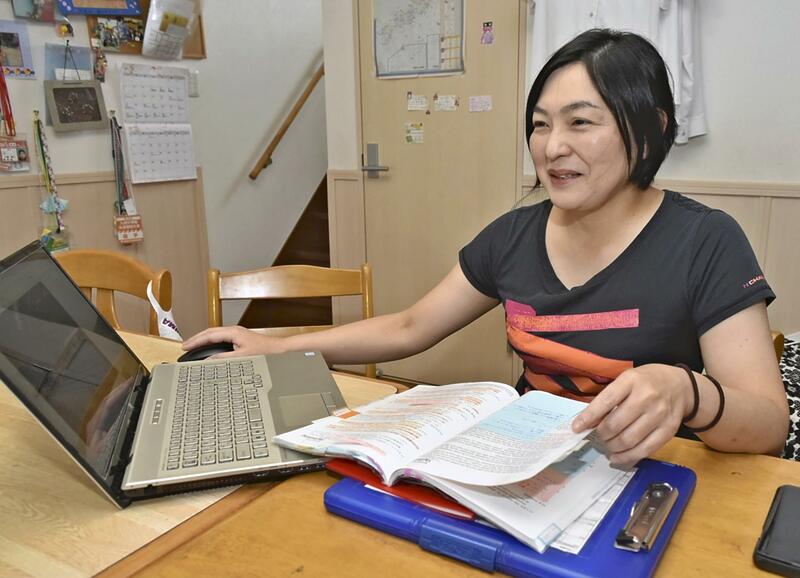
MIYAZAKI -- Miki Kawagoe, a sports instructor in Miyazaki Prefecture, is serving as a judge during the swimming events at the Tokyo Paralympic Games.
Kawagoe, 48, has worked for about 20 years as a swimming instructor for elementary school children with disabilities. "I will strive to make impartial judgments so athletes will be able to concentrate on their competition," Kawagoe said ahead of the Games.
In Paralympic swimming, some competitors start races by diving in from a seated position on the starting blocks, while others start from a position already in the water. As these starting positions differ depending on the degree of the swimmers' physical disabilities, judges must prepare for the competitions by understanding the physical condition of all the swimmers.
Another important role for judges is to make sure swimmers touch the wall properly on turns.
Kawagoe was around 26 when she first saw a physically disabled person taking part in a sport. Gazing at the scenery while traveling by train, she spotted someone playing tennis in a wheelchair. She was impressed by the player's pursuit of the ball and ability to strike it back with all their might. She had an inspiring revelation: "Despite such physical disabilities, they can move around so well."
After she returned from her trip, she took a course to become a sports instructor for people with disabilities. She obtained a license in 2000, just half a year after her train-window epiphany. As she had been involved in swimming from childhood to college, she started a swimming class for disabled children, mainly elementary school students, at a swimming club in Saito, Miyazaki Prefecture.
She currently works as an instructor at a gym in Miyazaki City. She has also given instruction to top-notch athletes who have participated in national contests. "It was fun to teach them while talking with each other, as their types of disabilities varied," she recalled.
She decided to aim at becoming a Paralympic judge when it was decided in 2013 that Tokyo would host the Games in 2020. Feeling that her work as an instructor had contributed to her own personal growth, she wanted to give something back. Through further study, she obtained qualifications including an international judging license, which is needed for applying for a judge's position at the Paralympics. She also learned the rules for Paralympic swimming. She was finally chosen as a judge after passing a physical skills test.
The Paralympics were postponed due to the novel coronavirus pandemic, and there were even fears of the event not being held at all. She was at one time perplexed as to whether she should decline the task or not, but was encouraged by her two sons, who urged her to stick with it "no matter what happens."
Through constant study of videos of past international competitions, she tried to grasp the characteristics of swimmers from around the world. "The athletes have accumulated their training, keeping various thoughts in mind. I would like to fulfill my role as a judge so that they can demonstrate their best performance."
Read more from The Japan News at https://japannews.yomiuri.co.jp/