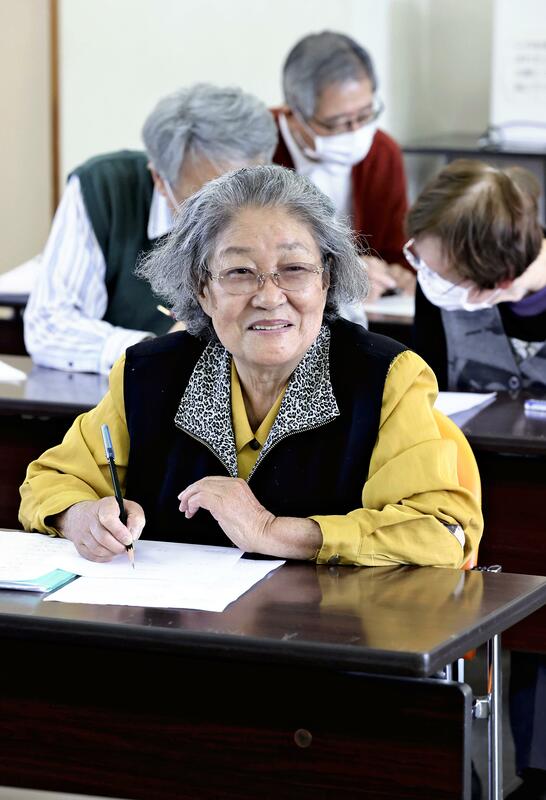
A junior high school that holds evening classes for senior citizens who missed out on learning opportunities when they were children and foreign nationals who have immigrated to Japan, among others, has continued to teach such students amid the novel coronavirus pandemic.
Although the students' backgrounds vary, they all share a key trait -- the desire to learn.
Such schools continue to provide in-person classes in Tokyo, which is currently under a COVID-19 state of emergency.
-- Measures to prevent infections
Bunka Junior High School is about a kilometer east of Tokyo Skytree in the capital's Sumida Ward, an area with many small factories and houses.
Students that attend evening classes started arriving just after 5 p.m. on the day of my visit.
Classes are held in small rooms, each accommodating a group of three or four students who appeared to be listening intently during lessons.
As of the end of April, 38 men and women aged 16 to 83 were attending evening classes. In the daytime, many of them work or take care of family members.
Only five of the students are Japanese, four of whom are over 50 years old. Family issues among other reasons prevented them from
finishing junior high school in their teens, but now they are back in a classroom to complete their studies.
The remaining 33 comprise Chinese nationals, accounting for about 80%, and students from Nepal, Thailand, and the Philippines, among other countries. Many of them are young people who came to Japan with their parents and want to graduate from high school so that they can find jobs in Japan.
In principle, students attend school on weekdays for three years. They study with the same textbooks as those used in ordinary junior high schools. They are divided into grades and classes based on their Japanese language skills and other factors, with 13 full-time teachers providing in-person instruction.
Although the school was temporarily closed in spring last year due to the coronavirus outbreak, classes resumed in June. Measures have been taken to prevent infections, such as using fans even in winter to provide ventilation in classrooms.
Before the coronavirus crisis, all students used to eat school meals together. Now, they eat in four separate places and they are not allowed to speak when eating.
Although Tokyo is currently under its third COVID-19 state of emergency, which was issued in April, in-person classes are still being conducted, as is the case with the school's regular daytime classes.
Vice Principal Yoshihisa Hanada, 57, said, "We'll continue holding classes while implementing thorough measures to prevent infections."
-- Enriching experience
"There are many things that I can't memorize, but studying is exciting and fun," said Kyoko Harada, 83, the oldest student attending evening classes at Bunka Junior High School.
Harada, who also attends a private cram school for evening school students twice a week, missed most of her junior high school education when she was young. She was evacuated to Niigata Prefecture during World War II, and returned to Sumida Ward in 1949.
She entered a public junior high school in the spring of 1950 but life was hard for her parents and younger siblings. She stopped going to school in the second term of her first year and started working to support her family.
Harada said she felt envious when she saw her former classmates preparing after graduation to begin a new phase in their lives, such as progressing to higher education or getting jobs.
In the spring of 1953, she started taking evening classes at a junior high school near her home, but it was difficult for her to study in the evening while working in the daytime. She sometimes fell asleep in class or was absent because she had to work overtime.
Harada managed to graduate, after which she got married and raised a family, but she did not feel she had studied satisfactorily.
Her desire to learn was revived in the spring of 2019 when she discovered in an information brochure for Sumida Ward residents a local junior high that holds evening school was accepting students.
After entering the school, the octogenarian said her interest in her favorite TV period dramas increased because she was studying history in class, including information about the periods in which the dramas were set.
At the school, Harada also learned that children in South America are involved in harvesting cacao, and she was able to sympathize with their plight because of her experiences. She strongly hopes that "a time will come when all children in the world will be given opportunities to study."
Harada said cheerfully, "My knowledge has increased and my life has become more colorful." She is planning to work or volunteer at a nursing home after graduation.
"I want to make use of what I learned at junior high school to help other people," she said.
-- Nationwide goal
The establishment of junior high evening schools started in 1947 when Japan had begun the long process of rebuilding after World War II.
These schools accepted students who were not able to receive compulsory education when they were younger and children who had to work during the day.
According to the Zenkoku Yakan Chugakko Kenkyukai, a national association of teachers at public junior high evening schools, the total number of such students peaked in 1955 at 5,208.
As the number of working children decreased, the number of evening school students also decreased, plunging to the 400 range in the 1960s. The facilities then started to actively accept adults, and by the 1990s were teaching more than 3,000 students. But the number started to decrease again, falling to 1,554 in 2020.
In February 2017, the government enacted a law to ensure education opportunities, aiming to establish at least one junior high evening school in each prefecture for students who were not able to attend junior high school due to truancy, among other reasons.
The number of such schools has increased from 31 in eight prefectures in July 2017 to 36 in 12 prefectures as of April this year.
Read more from The Japan News at https://japannews.yomiuri.co.jp/