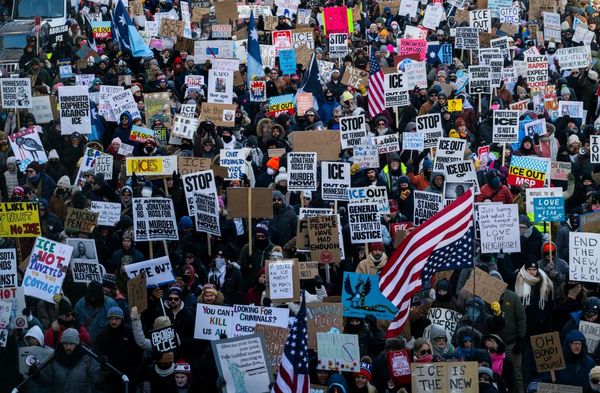
The Palestine Action Group plans to march against the Israeli president, Isaac Herzog’s, visit to Sydney next week, despite the New South Wales police commissioner extending a restriction on protests.
A spokesperson for the group, Josh Lees, called for NSW police to “exercise their discretion” and facilitate a peaceful march from Town Hall to state parliament on 9 February as part of nationwide protests against Herzog’s visit.
“We’ll be gathering in huge numbers there at Town Hall, and things will go much more smoothly if the police work with us to facilitate a peaceful march,” Lees said.
On Tuesday, the NSW police commissioner, Mal Lanyon, extended a restriction on protests for another 14 days, saying Herzog’s visit was a “factor” in that decision. Herzog, who was invited by Anthony Albanese in the aftermath of the Bondi terror attack, will visit Australia for four days.
The extended restriction prevents the authorisation of protests under the form 1 system, effectively banning the ability for protesters to march in designated areas without the risk of being arrested.
Police were given the controversial power to restrict protests in 14 day increments for up to 90 days after a terror attack after the Minns government rushed laws through parliament last year in the wake of the Bondi terror attack. The power is currently facing a constitutional challenge and will go before the court on 26 February.
Sign up: AU Breaking News email
Lanyon said of his decision “We’re still less than two months from what is the worst terrorist incident in New South Wales history today.
“I have considered that there remains a significant risk to community safety by public assemblies, and I have extended that declaration for a further 14 days.
“I know that there is significant animosity about president Herzog’s visit,” Lanyon later said. “I need to balance up the level of animosity about his visit with the need for community safety, and that’s what we’ve done.”
NSW Labor MP and barrister Stephen Lawrence has questioned the constitutiality of the laws and fears the suppression of protest will potentially inflame tensions among the police and those rallying.
Speaking with ABC Sydney’s Drive program on Tuesday afternoon, he said the extensions “should concern all people in New South Wales, because these are very, very serious impacts on civil liberties.”
He said that he feared the laws may impinge on public safety.
“When you seek to suppress protest … you can have [an] extreme amount of violence. You can have people hurt. And I think everyone is really better off if we know if these laws are constitutional,” he said.
“I’m just not sure that continually extending this thing to apply it to the visit of the Israeli president is actually going to make us more safe. I think it could be creating a flashpoint, and it concerns me.”
The Palestine Action Group has submitted a form 1 for the protest. But Lanyon told reporters when announcing the extension that it would not be accepted given the march would fall within the restricted area.
The current designated area includes Town Hall and takes in the northern part of the CBD and the eastern suburbs. Hyde Park is no longer included after it was carved out ahead of the Invasion Day rally.
Lanyon said other factors considered by police were “at least 10 antisemitic incidents” that are currently being investigated. He also pointed to police charging a man under hate speech laws after he allegedly made an antisemitic remark during an anti-immigration rally on 26 January.
Lees said he had been trying to meet with police to discuss the planned route of the march. He pointed out that there had been no safety issues at the near weekly pro-Palestine rallies held over the past two years.
“Things will go much more smoothly if the police work with us to facilitate a peaceful march,” he said.
“People should have the right to march against someone who has incited genocide.”
A UN commission concluded in September 2025 that Israel had committed genocide in Gaza. That commission, which does not speak on behalf of the UN, stated that Herzog, Israeli prime minister, Benjamin Netanyahu, and then defence minister, Yoav Gallant, “have incited the commission of genocide”.
Israel’s foreign ministry rejected the commission’s report, calling it “distorted and false” and claiming it “relies entirely on Hamas falsehoods”.
Herzog has called the genocide case against Israel in the international court of justice a “form of blood libel” and pushed back on criticism of his 2023 statement that “it is an entire nation out there that is responsible” for the 7 October attacks on Israel. He claimed he had been taken out of context, and noted he had said in the same media appearance that Israel would respect international law and there was no excuse for the killing of innocent civilians. The ICJ is yet to issue its final ruling.
On Tuesday, the premier, Chris Minns, said he had “a lot of meetings” with Lanyon in relation to Herzog’s visit, but denies he has sought to influence the decision.
“There’s a need to protect both the president as an invited guest to Australia and also regular Australians as they go about their jobs and their lives in Sydney next week. And we want to make sure that we’re balancing those protections in the next seven days,” he said.