

Palantir Technologies (NASDAQ: PLTR) is scheduled to report its Q2 earnings after the market closes on Aug. 3. If history is any guide, it will be a strong report, and PLTR is likely to fall the day after.
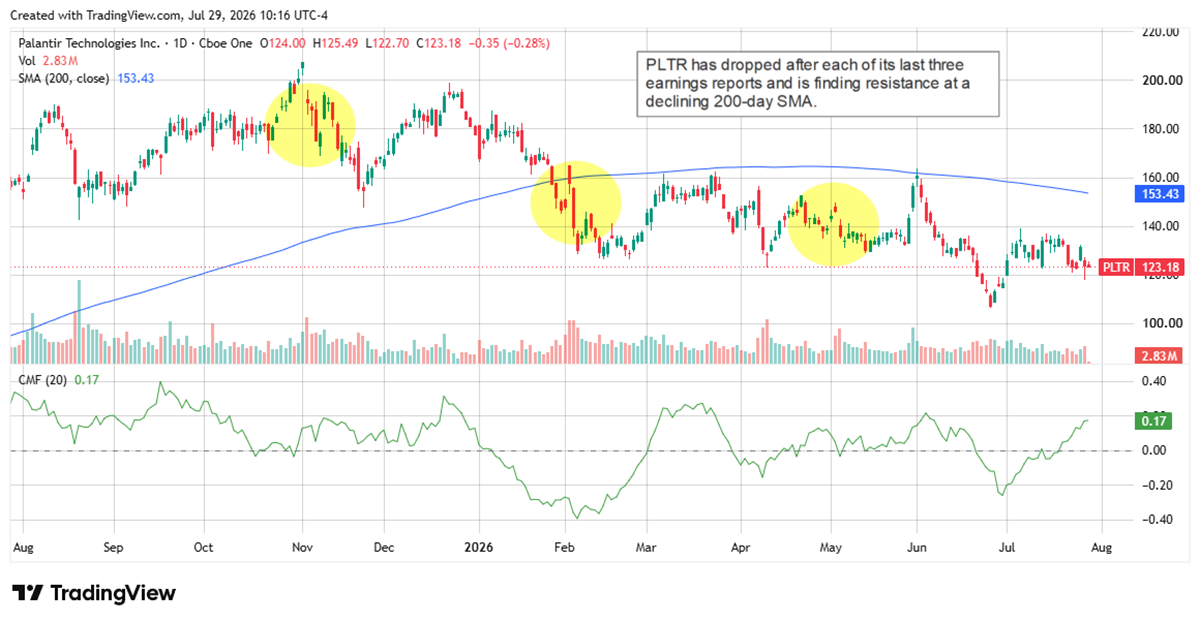
That's been a pattern the last three times the company has reported earnings. In each case, Palantir has failed to recapture its prior high and is finding resistance at a declining 200-day simple moving average (SMA).
All of which is to say that PLTR has been, and will likely continue to be, a poor trade. That’s true for both long and short investors. On at least 15 occasions in 2026, PLTR has moved by at least 5% in a single trading session. Traders on the wrong side of those trades got hurt.
Nevertheless, after breaking decisively below $130 in late June, PLTR is up roughly 6%. That’s significant at a time when many technology stocks are under pressure. That could be evidence that investors are beginning to buy into a compelling bull case, but would require a close above its 50-day SMA, something it hasn’t managed since its late-June breakdown.
Focus on the Business Model More Than History
Palantir is expensive by virtually every traditional metric. Chief executive officer (CEO) Alex Karp recently remarked that Palantir has more business than it can handle and will reach $15 to $18 billion in free cash flow (FCF) in the next two years.
That would make many of the discount cash flow (DCF) models for PLTR comically inaccurate. However, many investors will look back to companies like Microsoft (NASDAQ: MSFT) and Cisco Systems (NASDAQ: CSCO). At one time, both companies had lofty valuations. Buying and holding required immense patience (14 years for MSFT; 25 years for CSCO) before the companies were re-rated.
This is where it’s important to compare apples to apples. Cisco was as dominant in its niche as Palantir is now. But it didn’t have Palantir’s moat.
Microsoft’s growth has come from the sheer breadth of its enterprise. Microsoft isn’t one thing; it has many levers from which to generate revenue and free cash flow.
By contrast, Palantir is still largely a story about two customer types: government agencies and a growing but concentrated list of large commercial accounts. That's both the risk and the opportunity.
Palantir's Foundry and AIP platforms create deep switching costs once a customer's data ontology is built out, arguably a stickier moat than Cisco's hardware ever had. But Palantir doesn't yet have Microsoft's diversification across cloud, productivity software, gaming, and advertising. A slowdown in U.S. government spending or a stumble in commercial AI adoption would hit Palantir's growth story far harder than a similar setback would hit Microsoft's.
What Could Go Wrong?
Whenever PLTR has had a significant pullback, buyers, and specifically institutional investors, have stepped in. Some of that is programmatic, since Palantir is now part of both the S&P 500 and the Nasdaq-100. But the “smart money” wouldn’t be blindly buying the stock if it truly believed the valuation story.
Instead, the recognition is that, if the bull market remains in place, PLTR is likely to have a tailwind, and institutions will be willing to buy any dip. That’s not to predict a bear market is coming anytime soon. However, that’s where the bear case would have the most bite. That said, such price action would impact the entire market and not be an indictment of any specific stock.
There's also a company-specific risk from competition. Hyperscalers like Microsoft and Amazon (NASDAQ: AMZN), along with model developers like OpenAI and Anthropic, are pushing deeper into enterprise AI orchestration, the same territory Palantir has claimed as its own.
For now, however, that’s a future concern. There’s no evidence in Palantir’s earnings report that it’s losing market share to these companies.
Will PLTR Clear Its Valuation Hurdle?
Will history repeat itself? The simple answer is that it could. The business is strong and is likely to report strong growth. At the same time, even with a pullback of approximately 30% in 2026, Palantir still trades at a hefty premium of 105x forward earnings and a price-to-sales (P/S) ratio of around 66x.
Palantir will remain volatile and may therefore not be suitable for every investor. However, the long-term bull case for PLTR remains in place; analysts remain bullish, institutional buying outpaces selling by about 3:1, and more importantly, the company is likely to show another quarter of strong growth.
Palantir's business is executing better than almost every software company on the market today. But price and value are two different things, and the last three earnings reports suggest the market wants more value for the price. Investors chasing PLTR into its Aug. 3 report should size positions with that pattern in mind, regardless of which side of the trade they're on.
The article "Palantir’s Earnings Setup Puts Its AI Growth Story Back on Trial Again" first appeared on MarketBeat.