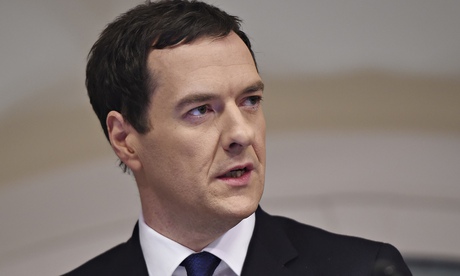
George Osborne has insisted that the prime minister wants to take part in televised debates before the general election – and challenged the broadcasters to “come up with a good plan”.
Speaking on ITV’s Good Morning Britain on Thursday, the chancellor defended David Cameron’s refusal to take part in the debates unless the Greens were invited to participate.
He said that although Cameron took part in televised debates before the general election in 2010, the situation had changed: “There is a new issue actually and the new issue is this: there are lots more parties out there. You can either have a debate where you get all the parties, and it seems a bit odd to choose the Liberal Democrats and not the Greens.
“[David Cameron] wants to get the format right,” he said, “but I think most people watching this will say, ‘Look, we’ll either watch all the parties taking part in this debate or let’s have the head to head between the two people who could be the prime minister – David Cameron and Ed Miliband.’”
He continued: “We’re just saying come up with a good plan. Of course we want to take part. There would never have been TV debates in this country if it hadn’t been for David Cameron last time saying he would take part.”
Miliband and Cameron have accused each other of running scared of TV election debates as broadcasters discuss whether to “empty-chair” the prime minister if he refused to take part.
In the Commons on Wednesday, the Labour leader said Cameron’s insistence on the involvement of the Green party was a “pathetic excuse” for not taking part in the debates. Cameron accused Labour of being “chicken” for refusing to consider the participation of the Greens.
At the same time, broadcasting insiders described a “flurry of phone calls” between the BBC, ITV, Channel 4 and Sky after the leaders of Labour, the Liberal Democrats and Ukip said the TV companies should go ahead with the debates without Cameron, if he refused to show up.
TV executives were reluctant to speak publicly about their response, but a former senior BBC executive said broadcasters were “prepared to be tough”.
Roger Mosey, the BBC’s former editorial director, called on the broadcasters to run the debates without Cameron – and provide an empty lectern for him – if he pulled out. “Those who are willing to put themselves on the line should be allowed to do so,” he wrote in an article for the Guardian. “Those who don’t can watch at home and see what an empty chair looks like over 90 minutes of prime-time television.”
Miliband accused the prime minister of making a “pathetic excuse”.
The developments came after an unprecedented set of identical letters to Cameron from Miliband, Nick Clegg and Nigel Farage, saying they were prepared to press ahead with the debates without him, if he would not agree to the format set out by the broadcasters – which does not involve the Greens. The three political leaders challenged the television companies to provide an empty podium to represent the prime minister in case he does not attend.
Speaking in the Commons, Miliband accused Cameron of using the absence of the Greens to dodge the debates, while Clegg was heard to shout “excuses, excuses” from his place next to the prime minister on the front bench. Labour backbenchers made clucking noises.
“Are you really telling the people of Britain you’re going to seek to deny them the TV debates, if you don’t get to choose who’s in them,” the Labour leader asked.
Cameron hit back, saying that Miliband was “chicken” for refusing to contemplate the inclusion of the Greens. The opposition leader said: “I’ll debate anyone the broadcasters invite. But the man who said it would be feeble to back out of the debates was you.
“We all understand as long ago as last Thursday your abiding passion was to give the Green party a platform, but it is frankly a pathetic excuse.”
In his final comment, Miliband said the prime minister was “running scared of these debates and, in the words of your heroine Lady Thatcher, you’re frit.”
As the two men argued across the dispatch box, the Green party leader, Natalie Bennett, released her own letter to Labour, the Lib Dems and Ukip saying their refusal to include her party was putting the whole idea of the debates at risk.
“Staging the debates without the prime minister might score a point but would not serve the public, who rightly expect the political parties and the broadcasters to find a format that is acceptable to all concerned,” she said.
“As a substantial majority of the British public would like to see the Green party included in the debates, an alternative way forward would be for you to agree to this. This is the way forward which serves both democracy and the electorate best.”
Broadcasters have not ruled out “empty-chairing” Cameron in the proposed debates, due to take place in April, but are understood to be hopeful that the prime minister can be persuaded to take part.
Privately, one broadcaster said: “We are still obviously very keen that David Cameron takes part. The whole point of the leaders’ debate is that we hear from the leaders of the main political parties.”
There is nothing in the BBC’s guidelines or the rules developed by the media regulator Ofcom that would prevent any channel broadcasting a pre-election debate without the Conservative leader present.
But the absence of Cameron may be problematic, particularly for Channel 4 and Sky News, which, under proposals published by broadcasters last year, plan to host a head-to-head debate featuring only Cameron and Miliband.
Ed Miliband, Nick Clegg and Nigel Farage have sent a letter to Cameron over the debates row.
The BBC, under the same plans, would host a debate with Cameron, Miliband and Clegg, while on ITV the three of them would be joined by a fourth party leader, Ukip’s Farage. Separately, the Guardian, the Telegraph and YouTube have offered to host a digital debate with all five party leaders.
Any change to the format of the debates is likely to involve tortuous negotiations between the broadcasters, who took around six months of discussion to come up with the original three-debate plan published in October last year.
In her letter, Bennett said the Greens believed ITV was open to adding the party to its debate lineup. “In our discussion with ITV, they made it clear that they have not made a final decision on which parties to invite and would be prepared to change their current position in the light of fresh developments. If you indicated that you were open to the inclusion of the Greens, then I feel sure that ITV would respond.”
The BBC’s draft election guidelines do not specifically cover debates. They say: “Candidates or parties declining to take part in constituency/ ward reports or debates cannot, by doing so, effectively exercise a veto over such coverage. However, this does not weaken in any way the BBC’s obligations of fairness in ensuring the audience is informed of all main strands of argument.”
The corporation’s guidelines add: “If a party declines to put forward a representative or nominates someone in a way which risks unfairness to other candidates, the item/ programme may go ahead without them.”
Former BBC controller of editorial policy Phil Harding told Radio 4’s PM programme he hoped the BBC would have the courage to “empty chair” David Cameron if it came to that. “I certainly hope the BBC would have the courage to do that if necessary. [BBC Director general] Tony Hall made a very strong speech in the light of charter renewal saying they might come under pressure but would resist that pressure and be politically independent.
“The voters are the most important people in this equation. The BBC should not be cowed in any way.”
Ofcom’s rules say “due weight must be given to the coverage of major parties during the election period”. The media regulator attracted criticism last week when it said it was minded to confer major party status on Ukip, but not the Green party.
Ofcom stressed that these were its initial thoughts as it launched a public consultation on its list of major parties. The Greens have until early February to make their case before a final decision in early March.
The list of major parties is important for Ofcom’s regulation of election coverage, in particular requiring the relevant broadcasters to allocate at least two party election broadcasts to each major party.
However, the media regulator said it was an editorial matter for broadcasters, which leaders were represented in any possible election debate .
The regulator’s current list of major UK-wide parties consists of the Conservative party, Labour and the Lib Dems.
In Scotland and Wales, respectively, the major parties are joined by the Scottish National party and Plaid Cyrmu. In Northern Ireland, they are joined by the Alliance party, the Democratic Unionists, Sinn Féin, the Social Democratic and Labour party, and the Ulster Unionists.