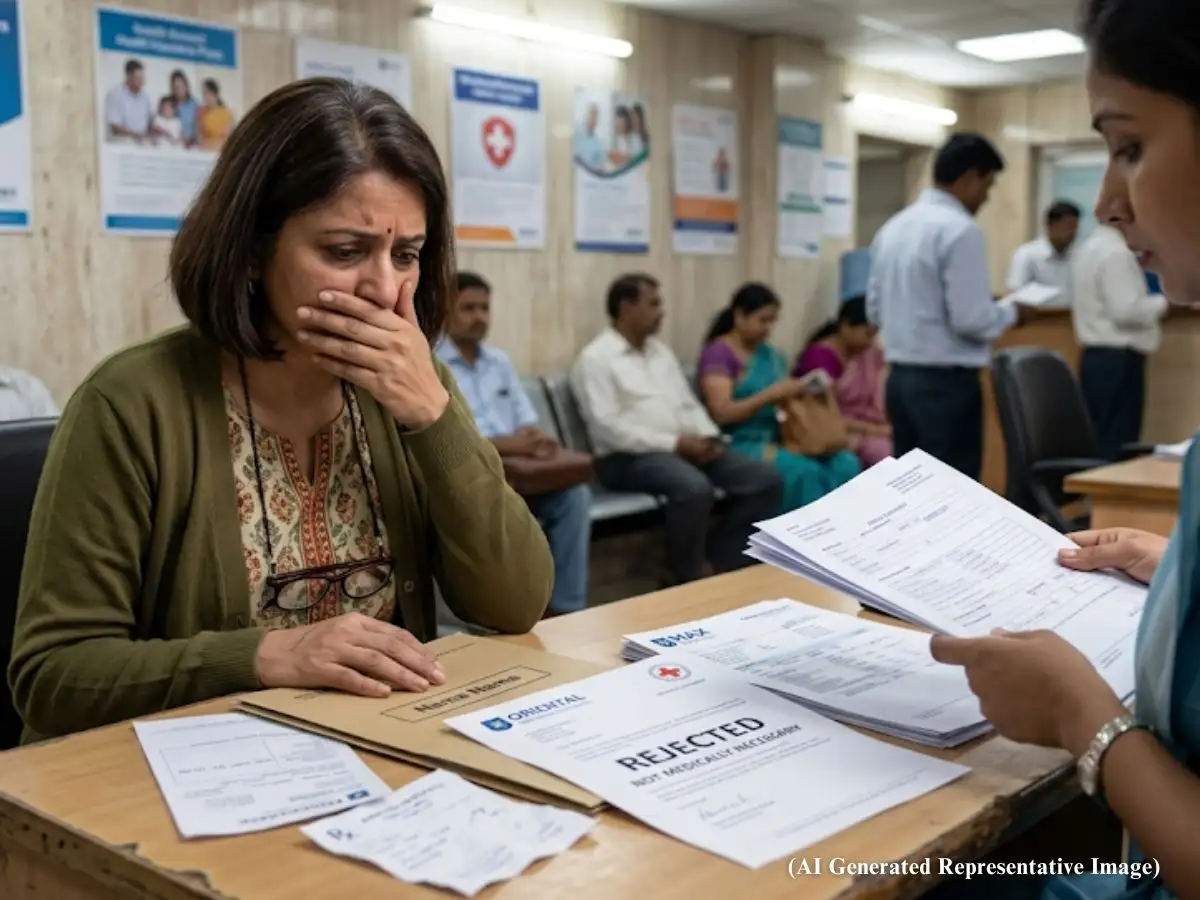
A Delhi consumer commission has ordered Oriental Insurance Company to pay a total of Rs 2.24 lakh to a woman after it rejected her health insurance claim on the ground that her hospitalisation was not medically necessary, a position the court found to be without basis.
The complainant, Shivani Tomar, a resident of Ghaziabad, had been covered under a health insurance policy with Oriental Insurance since November 2010. She was admitted to Max Healthcare Hospital in Vaishali, Ghaziabad, on 25 November 2023 after experiencing chest heaviness, palpitations, breathlessness, severe abdominal pain, nausea, a throbbing headache, and low blood pressure.
She spent Rs 1,54,144 out of pocket on her treatment after the insurer declined to authorise cashless hospitalisation, and later rejected her reimbursement claim entirely.
What the insurer said
Oriental Insurance rejected claim No. 6431435 on the ground that all investigation reports and vital parameters were normal, that no active line of treatment had been administered, and that the hospitalisation was undertaken solely for observation and diagnostic purposes.
The company relied on Clause 5.2 of the policy, which excludes expenses where the primary purpose of admission is diagnostic evaluation.
Tomar contested this, saying she had undergone a biopsy, endoscopy, MRI, ultrasound, and other procedures during her stay, and had received IV fluids and IV antibiotics. She was subsequently diagnosed with severe acute gastritis, hypothyroidism, and an ovarian cyst.
She sent a legal notice to the insurer in February 2024. When no resolution came, she filed a complaint before the District Consumer Disputes Redressal Commission in Delhi later that year.
What the commission found
The commission, presided over by Divya Jyoti Jaipuriar and Member Dr. Rashmi Bansal, noted that Oriental Insurance failed to appear before it or file a written statement. Its right to file a defence was formally closed in December 2024.
With the insurer producing no evidence of its own, the commission examined the medical records Tomar submitted. It found that the discharge summary clearly recorded both the diagnosis and the treatment administered, and that the procedures conducted during her stay could not be equated with a routine outpatient visit.
The commission also took a clear position on the exclusion clause the insurer had relied upon. It said the word "primarily" in Clause 5.2 carries significant weight, and that for the exclusion to apply, diagnostic evaluation must be the dominant and overriding purpose of admission. In Tomar's case, she was admitted with specific medical complaints that warranted clinical attention, and she received active treatment alongside investigations.
"An insurance company cannot substitute its own assessment in place of the clinical judgment of medical professionals, particularly when no contrary medical evidence has been produced," the commission stated in its order.
What the court ordered
The commission allowed the complaint and directed Oriental Insurance to pay Tomar the full claim amount of Rs 1,54,144, along with interest at 6 per cent per annum from 29 December 2023, the date the claim was rejected, until full payment is made.
It also ordered the insurer to pay Rs 50,000 as compensation for mental agony, harassment, and financial hardship, and Rs 20,000 towards litigation costs, bringing the total directed payout to Rs 2,24,144.
The insurer has 30 days from the receipt of the order to comply. If it fails to do so, the entire amount will attract interest at 9 per cent per annum until realisation.
Check the case judgement here: