The proportion of people who fully self-isolate after testing positive for Covid-19 has fallen dramatically since the rules were scrapped in England at the end of February, a new survey suggests.
Fully self-isolating means staying indoors and completely avoiding contact with other people, which includes keeping away from people within your own household.
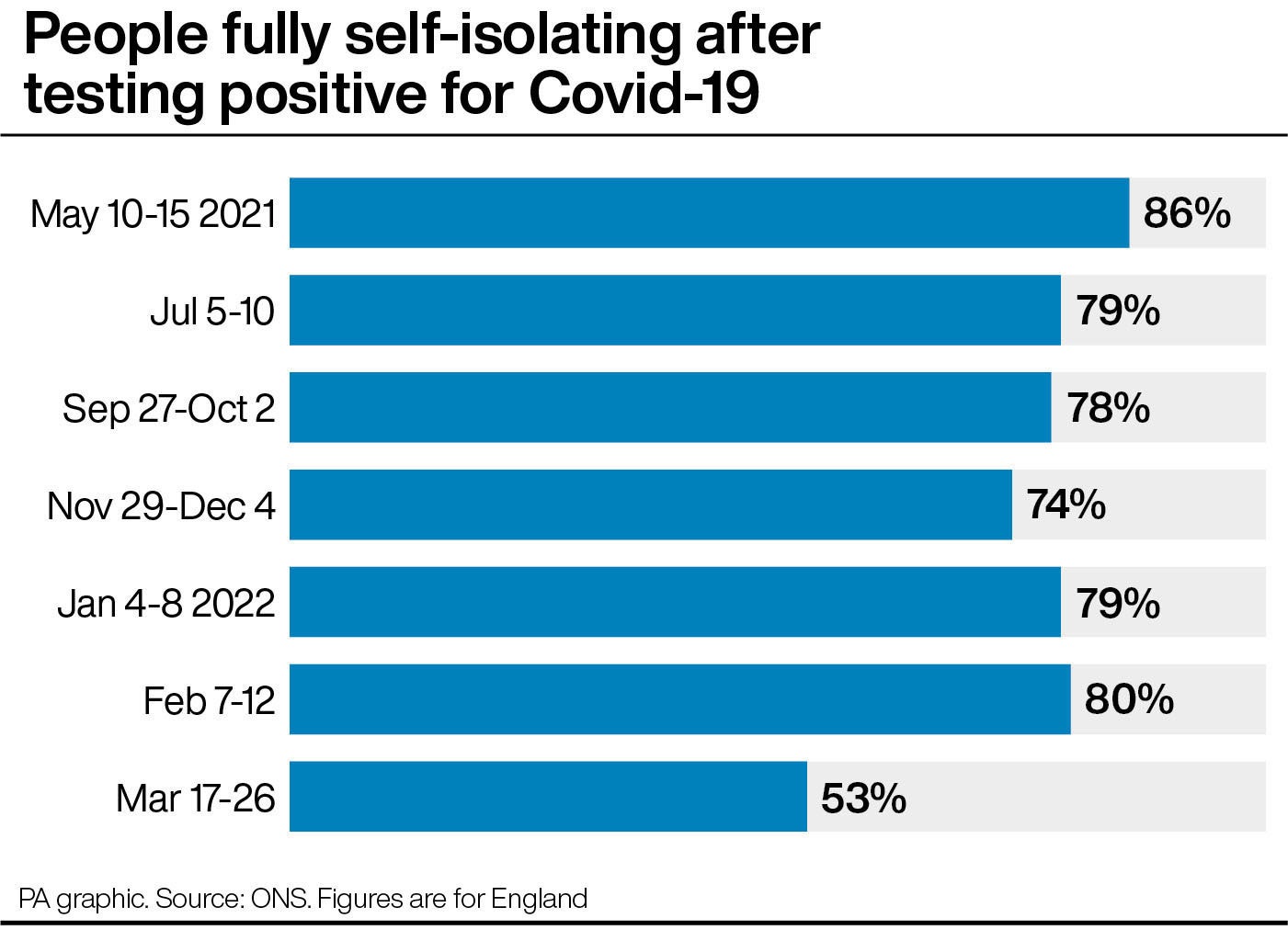
Just over half (53 per cent) of people questioned said they had followed the full advice for self-isolating, down from 80 per cent in February when isolation was a legal requirement.
The survey was carried out by the Office for National Statistics (ONS) between March 17 and 26, nearly a month since the Government removed all rules for self-isolation in England on February 24.
At the time of the survey, adults and children who tested positive for coronavirus were advised to stay at home and avoid contact with others for at least five full days, and to follow this guidance until they had received two negative test results on consecutive days.
Around 40% of those who had completed self-isolation said they had isolated for 10 days or more.
Levels of compliance with the self-isolation guidance were lower among 18 to 34-year-olds (48 per cent) and 35 to 54-year-olds (53 per cent) than among people aged 55 and over (56 per cent), the ONS found.
They were also lower for males (49 per cent) than females (55 per cent).
However, almost all respondents agreed that it is important to follow self-isolation advice.
Tim Gibbs, head of the ONS public services analysis team, said: “Today’s data show compliance with self-isolation advice was notably lower compared with levels reported earlier in the year.
“It is important to note that self-isolation was advised but not legally required during the time of data collection.
“Of those who did not fully follow self-isolation advice, the most common reason for those leaving the house was for outdoor recreation or exercise.”
The survey also shows that 55 per cent of respondents who left their homes during self-isolation or while they had symptoms said they had worn a mask every time they went outside, down from 66 per cent in February.
Some 91 per cent of respondents said they had no difficulty accessing Covid-19 tests - although the survey was carried out before free testing was ended for most people in England on April 1.
Nearly two-thirds said they would still take a test if they had to buy one.
The ONS noted the survey has a relatively small number of respondents (1,286 adults in England) who have self-reported their behaviour, and as such care needs to be taken when interpreting the results.