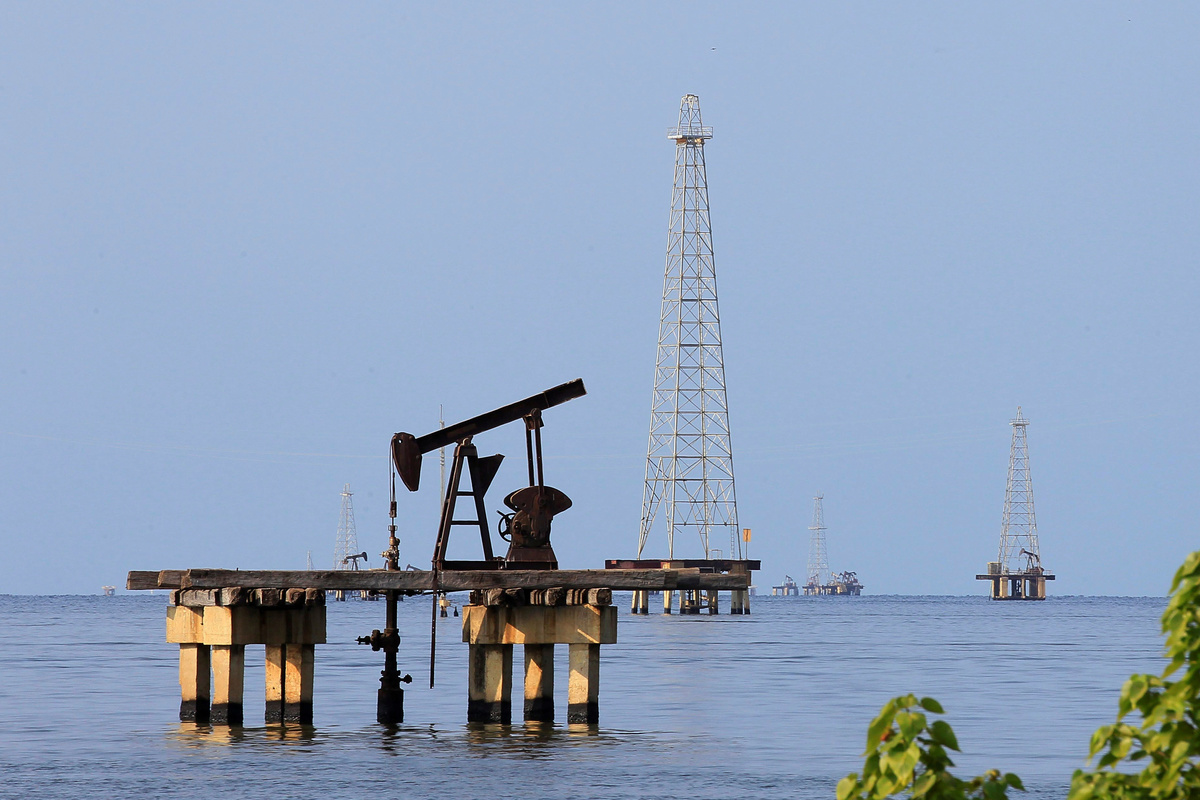
NEW YORK (Reuters) - Oil futures ended little changed on Wednesday after supply curbs, including further talk on an extension to OPEC-led cuts, offset rising U.S. crude inventories and record production.
An intensifying political crisis in Venezuela that threatens oil exports already reduced by U.S. sanctions and Washington's May 1 deadline to halt Iranian oil sanction waivers were also supportive.
Brent crude oil futures settled at $72.18 a barrel, up 12 cents, or 0.2%, after falling as low as $71.30. U.S. West Texas Intermediate crude futures (WTI) ended 31 cents, or 0.5%, lower at $63.60 a barrel, up from its $62.77 session low.
U.S. crude inventories jumped 9.9 million barrels last week to 470.6 million barrels to their highest since September 2017 as imports grew to their highest since January and refining rates dropped below 90 percent of total capacity, the Energy Information Administration said.
Crude output in the United States, the world's top producer, rose to a record high of 12.3 million barrels per day last week.
"A drop in refining activity and a rise in imports has helped propel crude inventories to another large build," said Matt Smith, director of commodity research at ClipperData. "The vast majority of the build was on the U.S. Gulf Coast - with refinery runs ticking lower and waterborne imports on the rise."
However, Brent reversed its downward course after Oman energy minister Mohammed bin Hamad al-Rumhy said that the Organization of the Petroleum Exporting Countries (OPEC) was intending to extend supply cuts at its June meeting.
Crude prices have risen over 30% so far this year, supported mainly by an OPEC-led deal to cut 1.2 million bpd of supply for six months. In April, Brent increased about 6.5% and WTI rose 6.3%, their fourth consecutive month of gains.
While Washington has demanded the group increase output to make up for the shortfall from Iran, OPEC's de facto leader Saudi Arabia said on Tuesday it had no immediate plan to do so, and that the pact could be extended to the end of 2019.
The market also watched for developments in Venezuela, where thousands of marchers rallied to opposition leader Juan Guaido's call for a May 1 uprising against President Nicolas Maduro.
Many observers feared the protests could lead to escalating violence and further disruptions to crude supply, though the OPEC-member nation's oil-producing regions are far afield of the capital of Caracas.
The unrest adds to a range of fluid geopolitical factors, including the U.S. sanctions on Caracas and Tehran, which have roiled the oil market in recent months.
Washington last week said no waivers on the Iranian oil sanctions would be granted after Wednesday, but it remains unclear whether Iran's top oil customer China will comply.
Iran's oil minister Bijan Zanganeh on Wednesday said "those who use oil as a weapon against two founding members of OPEC are disturbing the unity of OPEC and creating the death and collapse" of it.
For a graphic on U.S. crude oil production & exports, click: https://tmsnrt.rs/2ULQiTd
(Additional reporting by Noah Browning in London, Stephanie Kelly in New York, and Henning Gloystein in Singapore; Editing by Marguerita Choy and Emelia Sithole-Matarise)