/Jen-Hsun%20Huan%20NVIDIA's%20Founder%2C%20President%20and%20CEO%20by%20jamesonwu1972%20via%20Shutterstock.jpg)
Nvidia (NVDA) stock was in focus on June 1 after the company unveiled its first-ever PC processor – the RTX Spark superchip – at the Computex conference in Taiwan.
CEO Jensen Huang characterized this as the most fundamental reinvention of the PC in 40 years, with the chip combining Nvidia’s Blackwell RTX graphics processing unit with a new N1X Arm-based processor developed in collaboration with Microsoft (MSFT) over three years.
According to Huang, the chip delivers one petaflop of AI performance, supports 120-billion-parameter large language models (LLMs), and offers up to 128 GB of unified memory, positioning it as a direct competitor to Intel, AMD, and Apple in the $200 billion personal computer market.
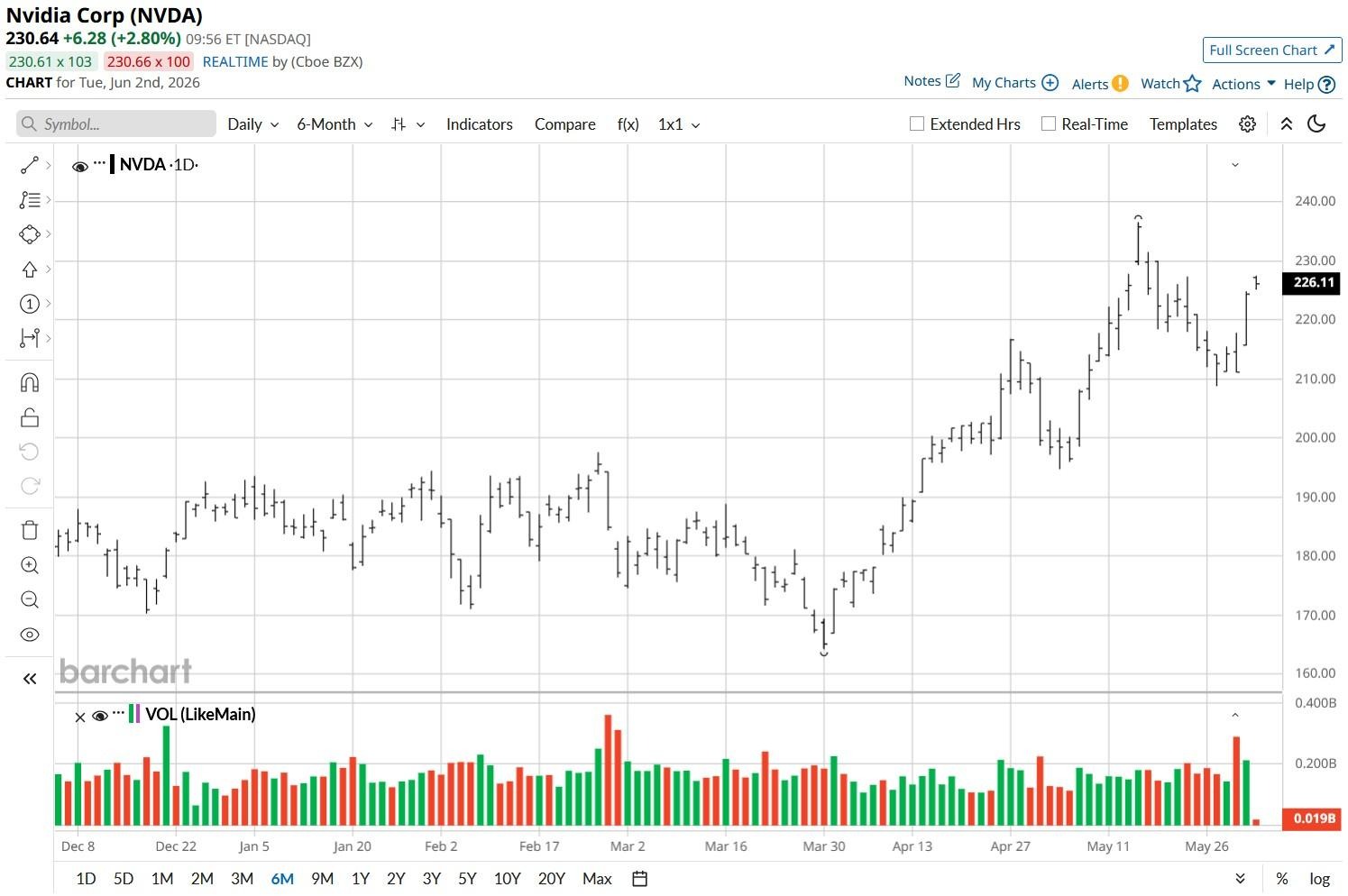
Nvidia shares gained about 4% on Monday, breaking out of a short-term downtrend channel that traders had been monitoring.
Despite recent gains, NVDA is up only about 20% year to date, significantly underperforming the iShares Semiconductor ETF (SOXX) which has gained some 90% over the same period.
Significance of Nvidia’s PC Announcement For The Sector
Nvidia’s PC chip launch sent ripples across the semiconductor landscape, creating clear winners and losers.
DELL (DELL), HPQ (HPQ), and ARM (ARM) all pushed higher, as these companies stand to benefit from manufacturing and architecture partnerships.
Conversely, incumbent PC chipmakers suffered, with Qualcomm (QCOM), Intel (INTC), and Advanced Micro Devices (AMD) ending in the red as the market repriced competitive positioning in real time.
NVDA announcement also saw Ark Invest’s Cathie Wood make a decisive portfolio rebalancing, acquiring about 300,000 Nvidia shares worth $63 million while simultaneously selling about $56 million worth of AMD.
This represents a notable philosophical pivot for Wood, who had previously maintained a skeptical stance toward Nvidia’s valuation, noting that AI’s value will ultimately accrue to implementation companies rather than semiconductor manufacturers.
What Else Did Huang Announce At Computex?
Beyond the PC chip, Huang made several other announcements that bolstered investor confidence.
He unveiled the Vera CPU designed specifically for agentic AI workloads, identified a new $200 billion total addressable market for Nvidia in CPU-based agentic computing, and confirmed that next-generation Vera Rubin AI chips have entered full production.
He also designated Marvell Technology (MRVL) as the next trillion-dollar company, sending Marvell shares up more than 20%, and reassured investors by dismissing fears that artificial intelligence would displace software firms.
Why RTX Spark Is Bullish for NVDA Shares
The RTX Spark announcement is bullish for NVDA shares for several key reasons.
The company crashed the Windows PC processor party Intel and AMD have jointly hosted for four decades, opening an enormous new revenue stream beyond data centers.
Devices from Dell, HP, ASUS, Lenovo, MSI, and Microsoft Surface are scheduled to arrive this fall, ensuring immediate commercial scale. Tech Times
Plus, RTX Spark brings together 30 years of Nvidia innovation – including CUDA, RTX, DLSS, and TensorRT – to slim Windows laptops, locking users into Nvidia’s software ecosystem.
NVDA’s fundamental position remains exceptionally strong as well, with Q1 revenue of $81.61 billion representing 85% year-over-year growth, and data center sales reaching $75.25 billion, up 92%.
The company carries only $8.5 billion in total debt against $13.24 billion in cash and equivalents, and generated nearly $100 billion in free cash flow, giving it one of the strongest balance sheets globally.
Risks Facing Nvidia Stock in 2026
However, risks remain notable for investors. Nvidia guided for zero data center compute revenue from China in the current quarter due to export restrictions, compared to $4.6 billion a year earlier.
Plus, it carries $119 billion in supply commitments that raise inventory cycle concerns.
The broader market also faces headwinds from elevated oil prices driven by U.S.-Iran tensions, with Brent crude (CBQ26) above $94 a barrel. Plus, money market pricing has essentially priced out rate cuts for 2026 while increasing odds of eventual hikes.
NVDA shares’ beta of 2.24 means they amplify market moves, creating vulnerability if geopolitical risks intensify or if the AI spending cycle decelerates.
What’s the Consensus Rating on Nvidia?
Wall Street analysts remain overwhelmingly bullish on Nvidia’s prospects.
Tigress Financial’s Ivan Feinseth recently raised his price objective to $425, maintaining a “Strong Buy” and calling Nvidia stock the must-own core holding for the AI investment cycle.
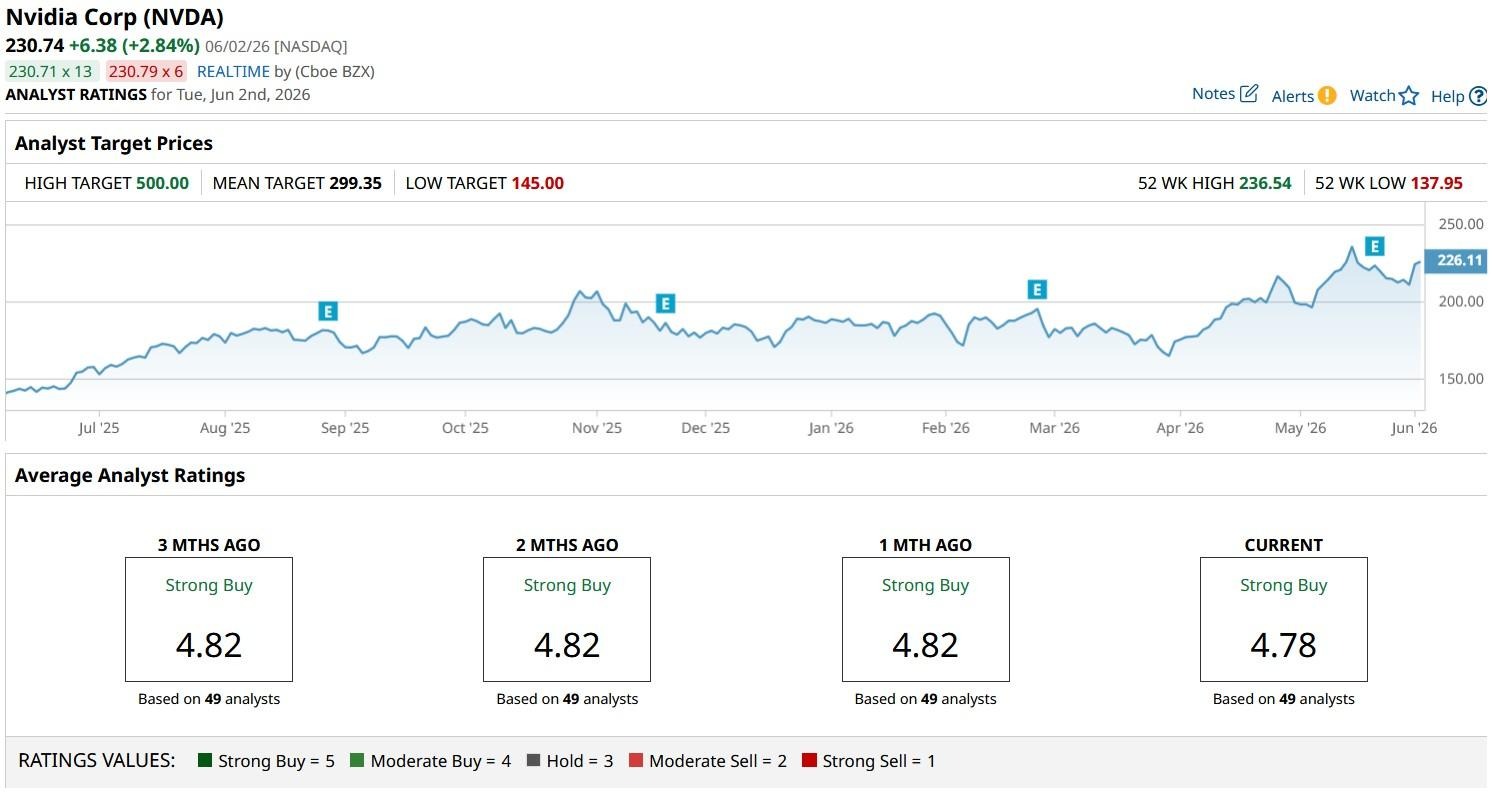
The consensus among 49 analysts covering the NVDA shares includes 43 “Buy” recommendations, with a 12-month consensus price target of about $300, representing roughly 30% upside from here.
This article was created with the support of automated content tools from our partners at Sigma.AI. Together, our financial data and AI solutions help us to deliver more informed market headline analysis to readers faster than ever.