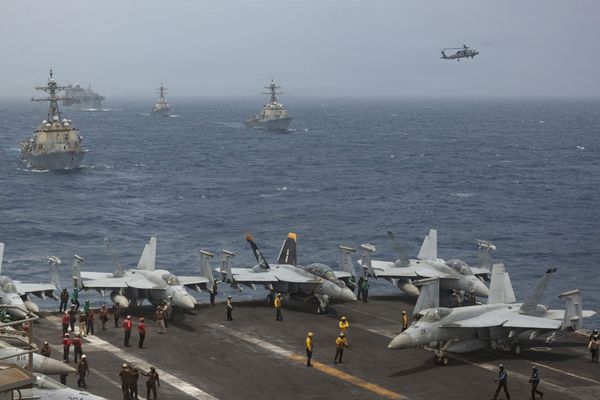

The establishment of an East Coast Naval Base at Newcastle would result in the loss of the port's container terminal, cause a drop in property values and make the city a military target, a previously secret trove of state government documents show.
Conversely, if the base was built at Port Kembla, hundreds of millions of dollars would need to be spent upgrading Lower Hunter road and rail transport infrastructure to cope with a massive increase in freight sent to Newcastle.
The documents, prepared by the NSW Cabinet Office and Premier's Department assessed the suitability of the two ports as a future base for a fleet of nuclear-powered submarines under the AUKUS deal.
Greens MLC Abigail Boyd recently obtained the 217-page bundle under privilege.
A benefit-cost-ratio analysis, which gave a Newcastle base a rating of 1.79, estimated the project would be worth nearly $150 million to the region.
Hundreds of millions of dollars would be spent on port upgrades and the construction of specialised shipyards, and nuclear-certified facilities, while between 3000 to 5000 highly skilled jobs would also be created over several decades.
Despite the massive economic benefits, there would also be significant downsides.
This included the project's incompatibility with a deep-water container terminal.

The Port of Newcastle is developing the project, which will become a major catalyst in the region's economic development in coming decades.
"The decision to locate the ECNB at either Port Kembla or Port of Newcastle may determine the location of the second container port (at either Port of Newcastle or Port Kembla - where the ECNB is not located)," a preliminary cost-benefit analysis for the project says.
As a result of the increased volumes of freight going to the port where the ECNB was not located, the state government would be required to spend at least $30 billion to upgrade freight transport links in and around that city.
Government officials noted that key stakeholders had previously raised the fact that China Merchant Holdings would hold a 50 per cent stake in the port until 2112, potentially limiting development and future investment.
"This ownership structure has been raised as a potential issue by investors, (including potential Japanese investors), as well as the Australian Government in considering Port of Newcastle for the future East Coast Base," a ministerial briefing note said.
Analysts also assessed the community's "willingness to accept" the ECNB and the likely implications it would have on property values and community attitudes.
"The ECNB will harbour submarines that have nuclear reactors fuelled by highly enriched uranium on board," a benefit transfer study said.
"In the event of a military conflict the ECNB could be a target for Australian military adversaries. For these reasons NSW residents may perceive the ECNB similarly to a nuclear power station as a source of environmental disaster risk."
The government assessment cited UK housing data post-Fukushima, which showed a 2.5 per cent drop in home values within a 15-kilometre radius of a nuclear facility.
When the analysis was applied to Newcastle, it found that 129,000 homes would suffer an average loss of $8125, or $1.048 billion.
The analysis applied a 50 per cent discount due to the project's multi-decade timeline.
Aside from socio-economic and political factors, the biggest drawback for Newcastle is considered to be the port's relatively narrow entrance, which is heavily traversed by large, commercial coal carriers.
The documents ultimately conclude that Port Kembla would be the most cost-effective location to build the base in NSW. Brisbane was also considered.
Greens defence spokesman David Shoebridge said while the documents indicated that Port Kembla was the preferred site for the AUKUS submarine base, Newcastle was still very much on the radar.
"At the end of the day the decision will come down as much to community pressure as it will to financial or defence calculations," he said.
"No matter where the base ends up, Newcastle or Port Kembla, the safety and security of the entire east coast will change forever. A giant base filled with the US nuclear assets is a priority military target, something the report makes clear. You only need to look at the war in the Gulf right now to see that US bases don't make you safe, they make you a target.
"The base will also see massive flow on effects. A nuclear submarine base in Port Kembla would effectively end other non-military uses there and strangle the broader economy. A nuclear submarine base in Newcastle would also dominate the port, with layers of defensive infrastructure from missiles to perimeter no-go zones. That would compromise the Newcastle Port's ability to link up with future industries and future jobs."
The vast majority of the assessment process was done during the term of the former state Coalition government. NSW Planning Minister Paul Scully said this week the government was not currently working on the project.
The NSW government documents state the Commonwealth has "committed to ensuring a decision on the location of the base is undertaken by the end of 2023 and be operational by 2040", however, the federal government said this was not the case.
A spokesman for Defence Industries Minister Pat Conroy said the federal government had agreed in-principle to the Defence Strategic Review recommendation that an east coast facility be established for Australia's future submarine capability.
"Further decisions on the east coast base will be made at the appropriate time, in order to meet timelines. A final decision won't be taken until later in the decade," he said.
The government has said its two key priorities under the optimal pathway to a sovereign conventionally-armed, nuclear-powered submarine capability are to upgrade HMAS Stirling in Western Australia, to enable the Submarine Rotational Force - West, and the design and construction of the submarine construction yard at Osborne in South Australia.