- In today’s CEO Daily: Diane Brady gets CEOs’ reactions to Trump’s AI executive order.
- The big story: Mass shootings rock Australia and Brown University.
- The markets: Early gains in Europe; losses in Asia.
- Plus: All the news and watercooler chat from Fortune.
Good morning. What do companies in health care, insurance, utilities, construction, professional services, financial services, education, transportation, waste management, and alcohol/cannabis distribution, among others, have in common? They’re regulated at the state level. In certain areas (food safety, environmental standards and data privacy), a mix of state and federal mandates apply. Washington sets the baseline, and individual states layer on laws that aim to reflect the priorities of local voters. In the absence of a federal missive, like Roe v. Wade in legalizing abortion, state regulations apply.
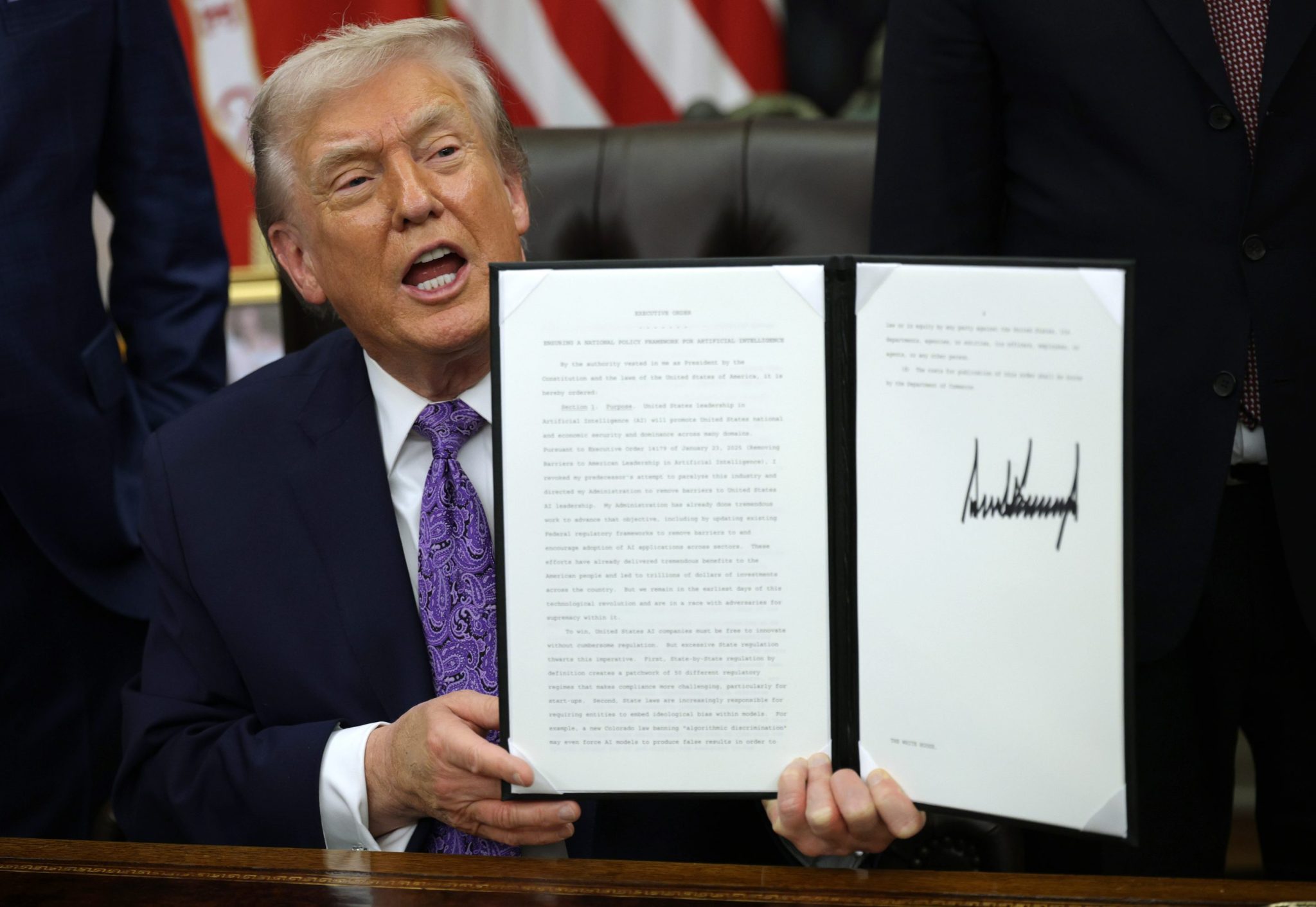
So one might assume that CEOs would welcome President Donald Trump’s executive order on AI last week that blocks state laws setting AI standards in favor of “a minimally burdensome national standard.” Silicon Valley types like OpenAI CEO Sam Altman, venture capitalist Marc Andreessen and, of course, AI czar David Sacks, praise the move as necessary for America to compete against the bête noire of China. But seven leaders I spoke with had more mixed views. (I spoke to them without attribution to encourage honest feedback.)
Nobody wants a growing patchwork of state laws that cause confusion, rising compliance costs, or what one person called “a race to be the Delaware of AI.” But neither do they want a vacuum when it comes to mitigating the risks or a situation where laws are set by the White House instead of Congress. Among the concerns:
The executive order is probably not legal. Everyone agreed that Trump can’t dismiss state rights with the stroke of a pen. As law firm Fisher Phillips notes, “all current and pending state and local AI laws will remain enforceable unless and until a court blocks them through an injunction, or Congress passes a federal law that preempts them.” The consensus: Congress should act—and fear-mongering doesn’t help. “I’m in a state with a lot of regulation and a lot of innovation,” said one California-based CEO. “What matters is resources, talent and technology.”
Businesses want clarity and protection. Tennessee’s ELVIS Act protects individuals from the unauthorized use of AI to mimic their voice and likeness; Texas prohibits its use for unlawful discrimination or sexually explicit content. Colorado requires companies to inform consumers when AI is used for high-stakes decisions from hiring to lending. Smaller businesses want the behemoths of tech kept in check. “Rules can level the playing field,” said one source, “and it’s more expensive to set standards in court.”
The U.S. needs to maintain its competitive edge. The EU Artificial Intelligence Act gives people the right to opt out of having their data used to train models, which stifles innovation. China has an AI Plus framework and President Xi Jinping has proposed creating a World Artificial Intelligence Cooperation Organization (WAICO) to promote a global governance system. The U.S. needs to, as one person put it, have a seat at the table with laws that protect copyright, patents, market access and consumer protections while driving innovation. The U.S. Chamber of Commerce, for its part, praised Trump’s effort to eliminate the patchwork of state laws but also called on Congress to establish a federal AI framework to “deliver the certainty and stability” companies need to “harness [AI’s] full potential.” “I’d rather have less regulation than more regulation,” an enterprise tech leader told me on Friday, “but I’d rather have some regulation than no regulation.”
Contact CEO Daily via Diane Brady at diane.brady@fortune.com