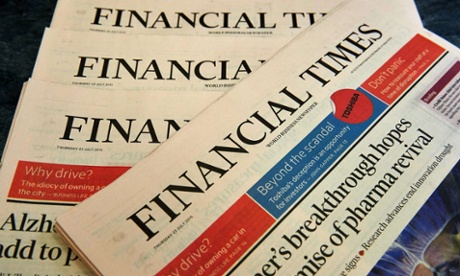
The new Japanese owner of the Financial Times has moved to reassure staff that it is not planning to cut jobs and will leave the existing management in place.
In an email sent to FT employees, Nikkei president Tsuneo Kita and the company’s chief executive Naotoshi Okada said the company plans to invest to make the FT “extremely profitable”.
“The Financial Times will continue to enjoy complete editorial independence and freedom, just as all news organisations should have,” says the email. “We hope that John Ridding and his management team will continue to lead the trustworthy pink paper into this new chapter.”
“We want the FT to be extremely profitable, and we want to achieve this through investments that lead to more customers and exciting new products, not through a reduction of the workforce.”
The letter also acknowledges that the deal will have come as a surprise to many staff. Up until minutes before the deal was announced, media organisations including the FT were reporting that German media group Axel Springer was in the lead to acquire the company.
“We can imagine that the news of the acquisition came as a surprise to many of you. Indeed, some may feel puzzled or worried,” says the email.
Kita and Okada also stressed that Nikkei shares a cultural outlook with the FT on business and the role of government.
“Since its establishment in 1876, Nikkei has consistently pushed for a free market economy that is private-sector driven and business-friendly. We believe the involvement of the government should be limited to an appropriate size.”
Earlier on Friday, the National Union of Journalists FT chapel emailed staff calling for a campaign “around jobs, employee rights and editorial independence”.
“We have many questions about the sale but few were answered at yesterday’s meeting with John Fallon,” said father of the FT chapel Steve Bird. “Thanks to the excellent story in the FT, however, we now know that this was indeed a last minute bid, that Nikkei was in the running for five weeks and that our building is not included in the deal. Although we did find out that senior executive roles have been protected.”
“These facts do not help John Fallon’s argument that there was extensive ‘due diligence’ although many agree that the choice of prospective partner could have been worse.”
It adds: “One option is that the chapel takes a lead in drawing up a charter - to include both principles and specific needs - as a public statement of intent by FT journalists.”