Nick Clegg will on Friday call on voters in the 11 Scottish constituencies held by the Liberal Democrats to vote tactically to keep out the Scottish National party.
On a visit to the key battleground of Gordon, where the former first minister and leader of the SNP Alex Salmond is standing against Christine Jardine for the Liberal Democrats, Clegg will say: “In 11 Scottish seats, you face a simple choice: do you want an SNP MP or a Liberal Democrat MP?”
In Gordon, the popular sitting MP Sir Malcolm Bruce is retiring after 32 years in the House of Commons. According to polls by Lord Ashcroft, Jardine, a former journalist and party media adviser, is facing a 15.5% swing to the SNP.
Ashcroft’s polls suggest that the Lib Dems could face near-wipeout in Scotland, and the party has been concentrating its campaign in Scotland on holding as many of its 11 seats as possible.
Clegg will urge wavering Labour and Conservative voters: “In these seats the Liberal Democrat candidate is the only one that is in a position to beat the SNP.
“So if you are someone who is considering voting for the Conservative or Labour candidate, my message to you is this: lend us your vote and we can stop the SNP winning in your constituency.”
Longer term polling evidence shows that more former Lib Dem voters have swung behind the SNP since 2010 than to Labour or the Tories.
Clegg will also criticise the SNP’s economic policies, saying: “The SNP are not the party of Scotland, they are the party of debt. They want to borrow more and more money – an eye watering £180bn – and their plans for full fiscal autonomy will cost the people of Scotland £7.6bn.”
Echoing prime minister David Cameron’s dire warnings about SNP-Labour co-operation after the general election, Clegg will add: “The SNP are shouting from the sidelines and are determined to keep a minority Labour Government on life support, limping from vote to vote towards the break-up of the UK.”
“Do you really want a government on life support, with Alex Salmond deciding whether it succeeds or dies?”
Scottish Conservative MSP Alex Johnstone described Clegg’s appeal as “desperate”.
“It is inexcusable for Nick Clegg to adopt this desperate approach. Tactical voting doesn’t get anyone anywhere. If people want to walk out the polling station with their head held high, they should vote for the party whose policies they agree with most.”
Speaking at the launch of the Scottish Conservative manifesto on Thursday morning, David Cameron insisted that the only way to stop the prospect of what he dubbed “the coalition of chaos” between Labour and the SNP was “by voting Conservative everywhere, in England, Scotland, Wales and Northern Ireland.”
Scottish Conservative leader Ruth Davidson reinforced the message, saying: “The only wasted vote is a vote you don’t believe it.”
A Scottish Labour spokesperson dismissed Clegg as a “busted flush”.
“Labour voters should always vote Labour, but everyone in Scotland is welcome to vote for our better plan for a fairer Scotland like raising the minimum wage, extending the living wage and banning zero-hours contracts.”
Since the beginning of the year, a series of grassroots campaigns encouraging tactical voting across Scotland have launched – mainly online – with the aim of galvanising pro-union votes. Although the main parties have distanced themselves from these efforts, activists believe that they reflect widespread concern, among those who voted no in last September’s referendum, about the threat posed to the union by the predicted SNP landslide in May’s general election.
Last week, a YouGov poll for Channel 4 News suggests that tactical voting could save Labour up to nine seats and the Lib Dems two extra seats.
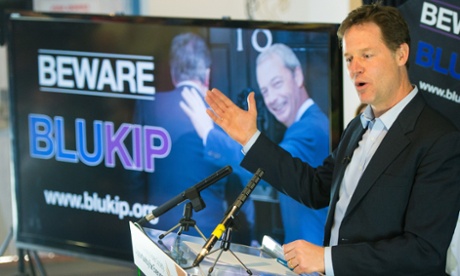
Speaking ahead of the BBC opposition leaders debate on Thursday, to which the Lib Dem leader was not invited, Clegg also warned that a rightwing alliance of Ukip, the Democratic Unionists and the Conservatives could hold power after the election unless people vote tactically for the Lib Dems.
Clegg warned that British values of “decency, tolerance and generosity” would be abandoned if Ukip and Northern Ireland’s DUP propped up a Tory minority government after 7 May – a scenario the Lib Dems have called “Blukip”.
Clegg gave the speech at Cheadle College in Greater Manchester, in a seat currently held by the Lib Dems, which is on a list of 20 marginal constituencies the party says are key to keeping “Blukip” out.
The party is calling for people to vote tactically in its favour in the 20 seats, of which 15 are held by the Lib Dems and five by the Conservatives.
“There is a very real danger that Nigel Farage and his friends could hold David Cameron to ransom,” said Clegg.
“It is a rightwing alliance that brings together people who don’t believe in climate change; who reject gay rights; who want the death penalty back; and people who want to scrap human rights legislation and privatise our schools and hospitals.”
Asked whether a call for people to vote tactically was a key element of its campaign, a senior Lib Dem strategist said: “This is how the Lib Dems have won seats for decades. Get into second place and then squeeze the third party.”
At a press conference following his speech on Thursday, Clegg was asked whether the threat of Blukip meant people should vote Labour in seats favourable to Ukip and Labour.
“I want Liberal Democrats to vote Liberal Democrat, of course I do. I’m the leader of the Liberal Democrats, I’m not going to advocate anything else.”
Clegg’s trip to Scotland comes on the same day that 55 high profile company owners, employers and entrepreneurs signed a letter published in the Financial Times, endorsing the Lib Dems’ role in government.
The letter stated: “In view of their track record in sustaining the present Government and their positive role in it, we believe it is essential to have enough Liberal Democrat MPs in the new Parliament to provide a clear and sensible voice for the centre ground.”
The letter, inspired by a similar one published in the Telegraph last month endorsing the Conservative party and signed by 103 business leaders, warns that a government of Labour alongside the SNP or the Tories with UKIP would pose a threat to Britain’s recovery.