Hello, readers. Angela Skujins here writing this Friday newsletter, with Mared Gwyn holding the pen for you next week.
Before our minds turn to the Belgium versus Spain FIFA football match at 10 pm tonight (go the Red Devils), one theme tops today's political agenda: finance.
Blockbuster borrowing. EU finance ministers are meeting in Brussels to discuss, among other issues, the Spanish proposal to create a new mechanism for EU joint borrowing of up to €850 billion per year.
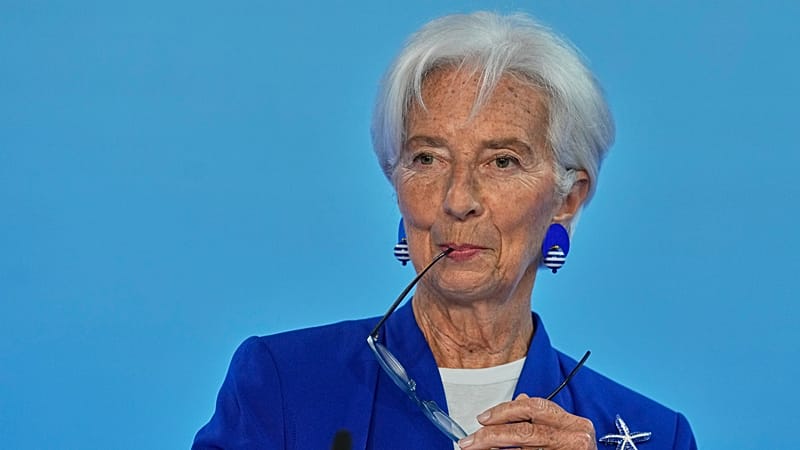
“Let’s debate it,” European Central Bank (ECB) President Christine Lagarde told Euronews’ Europe Editor Maria Tadeo in an exclusive sit-down interview on Thursday regarding the pitch.
"It's great that a country like Spain, for instance, makes a proposal and puts it on the table for debate. Now it's for the others to say, 'this part we like, this part we don't like', and how that can be addressed. I think it's good to move forward.”
To caveat: Lagarde will not be in the room when the discussion occurs, nor will she vote. The ECB’s mandate covers monetary policy, price stability and financial stability, with the debate occurring among finance ministers and European Commission representatives.
But for the uninitiated, the former French minister — who helped steer the country’s economic response during the 2008 financial crisis — is one of Europe’s most influential voices on economic policy.
When she talks about topics such as the digital euro, policymakers take heed. That is also why when the French national says she is “not a candidate” for the 2027 French presidential election, the general population listens.
Back to the pitch. Spanish Economy Minister Carlos Cuerpo, the architect of the proposal, told Euronews the plan could save billions in funding costs and reduce fragmentation.
"We think there's a good window of opportunity to put that proposal forward now. We've been having discussions on the international role of the euro over the past few months, with very good contributions on the fact that we need a safe asset," he said.
According to my colleague Eleonora Vasques, the is a need for thinking outside the box amid deep geopolitical uncertainties.
Energy prices could rise again now US strikes on Iran have resumed, and the EU faces the challenge of protecting itself against further shocks while also investing in strategic sectors such as artificial intelligence and defence.
For defence, the EU has already established a €150 billion Security Action for Europe (SAFE)joint debt mechanism. However, some countries are calling for even greater flexibility to respond to future challenges.
Besides energy, ministers will also hold another round of discussions on the urgent reform of capital markets. EU governments aim to reach an agreement by October, but an EU diplomat told Eleonora that this deadline is unlikely to be met.
Persistent divisions over technical details, regarding how to centralise the supervision of capital markets, will make it difficult to respect the timeline.
Roland Lescure, French Minister of the Economy, Finance and Industrial, Energy and Digital Sovereignty, just said on Euronews’ flagship morning news programme Europe Today that the Capital Markets Union is something Lagarde is "fixated" on but that he is "obsessed" with. Watch.
What about Budapest? EU finance ministers are also expected to approve Hungary's revised National Recovery Plan, valued at €10 billion. Sándor Zsíros spoke to an EU diplomat who expressed optimism about Fridays discussions.
Hungary updated its Recovery Plan after Péter Magyar’s landslide election victory in April, with the envelope expected to pave the way for the release of further money.
"It will be an important meeting, as this is the last legal step before our country can access several thousand billion forints of EU funds," Hungarian Finance Minister András Kármán said in a social media post ahead of his trip to Brussels.
Sanctioning Russia. The EU’s 21st sanctions package against Russia for its ongoing invasion of Ukraine is also facing fierce discussion today.
Jorge Liboreiro offers in this dispatch that EU ambassadors will meet to try and get the suite of measures over the line, with multiple issues (such as cod and LNG) still unresolved.
If no deal is reached by 15 July, the price cap on Russian oil will also be automatically revised, going up all the way to $58 per barrel. It’s an unpalatable scenario that Brussels is intent to avoid.
“We’re close,” a diplomat said. “I hope for a final discussion on Friday.” (More on that top story below).
Banning trade with illegal Israeli settlements. EU ambassadors will today mull options presented by Brussels on Wednesday regarding whether to outright ban trade with Israeli settlements, alongside stricter exporting licenses and steeper tariffs.
It comes as part of a highly-anticipated “options paper” sent by Commission chief Ursula von der Leyen to EU capitals earlier this week and first reported by my colleagues Maïa de la Baume, Mared Gwyn and Luca Bertuzzi.
As Mared writes in, ambassadors will touch base on the issue today before the paper formally goes onto the Foreign Affairs Council agenda on Monday. But it is already facing fierce opposition and steep divisions, Luca reports in this must-read analysis.
EU countries rush to avoid disastrous revision of Russian oil price cap
The European Union has entered the last stretch of negotiations to reach a deal on a new round of sanctions against Moscow, as countries scramble to avoid a politically disastrous update of the price cap on Russian oil.
Under the rules, the cap, currently set at $44.10 per barrel, must be automatically adjusted every six months to remain at 15% below the average market price.
The next review is scheduled for 15 July.
Since Russian oil soared in the aftermath of the closure of the Strait of Hormuz, the revision is certain to push the cap much higher, likely hitting $58 per barrel, which would provide the Kremlin with breathing space at a time when its economy is under growing strain and Ukraine enjoys momentum on the battlefield.
The European Commission considers this scenario unpalatable and has proposed to delay the review until January next year to keep the cap at $44.10 per barrel.
But Malta, Cyprus and, in particular, Greece, three countries with powerful maritime services, have raised questions about the postponement.
"The oil price cap was introduced by the G7 not only to reduce Russia's revenues from fossil fuel exports but also to preserve stability in global energy markets. This objective is particularly relevant in the current crisis in the Middle East," a diplomat said.
"Any adjustment to the automatic mechanism of the oil price cap should therefore be carefully calibrated in coordination with our G7 partners."
More from our newsrooms
European Parliament aims to exclude end-to-end chats from message-scanning regime
A law allowing online communications to be scanned to detect child sexual abuse material was amended by Members of the European Parliament to protect users’ privacy on Thursday. The new version, however, is set to create a clash among member states. Vincenzo Genovese and Luca Bertuzzi have more.
US approves sale of Tomahawk missiles to Germany, Chancellor Friedrich Merz says
The United States committed to granting formal approval for the sale of Tomahawk missiles and ground-based Typhoon launchers by August, although the number of missiles acquired would remain classified. Gavin Blackburn has it all.
A World Bank for defence? The lender that Europe's big powers have yet to join
Nine countries have thrown their weight behind a new multilateral bank designed to bankroll Western rearmament, but the notable caution of Europe's largest military and economic powers raises the question of whether it can become the answer to defence funding. Quirino Mealha gets into the weeds.
We're also keeping an eye on
- European Commissioner for Enlargement Marta Kos continues her trip through Montenegro.
- European Commissioner for Budget Piotr Serafin meets with European Investment Bank President Nadia Calviño in Brussels, Belgium.
That’s it for today. Eleonora Vasques, Sándor Zsíros, Mared Gwyn, Jorge Liboreiro and Vincenzo Genovesecontributed to this newsletter.