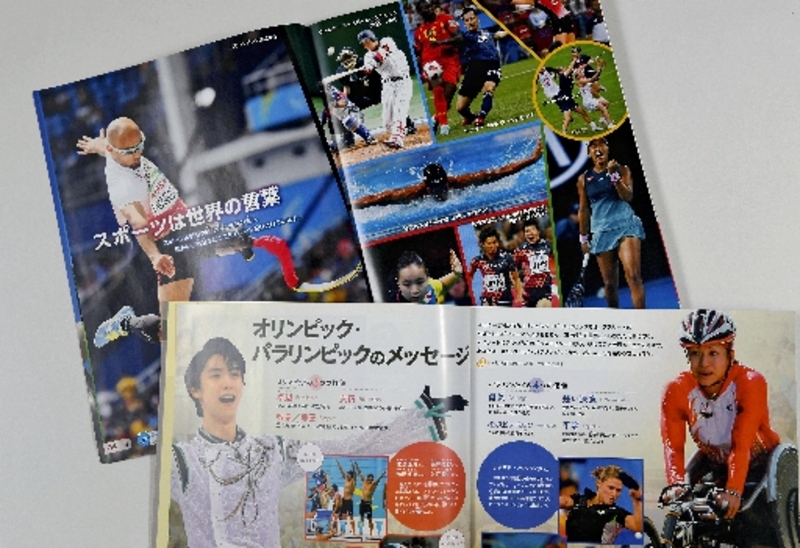
References to the 2020 Tokyo Olympic and Paralympic Games appear in 33 new junior high school textbooks authorized by the education ministry for use from spring next year.
The references appear in textbooks in nine subjects ranging from Japanese to social studies.
With the postponement of the Games amid the novel coronavirus pandemic, these sections will have to be altered, requiring textbook publishers to carefully observe the course of events in the days ahead.
A textbook on health and physical education compiled by Taishukan Publishing Co. refers to the Tokyo Games under the title "People around the world are paying attention!"
An official of the company said, "We will amend such words as "the holding" [of the Games] in line with the situation."
Nihon Bunkyou Shuppan Co. introduced the design of the "Kumi-ichimatsu-mon" (harmonized chequered emblem) created by Asao Tokoro, designer of the Tokyo Olympic emblem, from a mathematical viewpoint in a textbook on math.
An official in charge at the publisher said, "Although we believe that the value of the emblem won't be lost even with the postponement of the Games, we want to contemplate this thoroughly and respond carefully."
There is also an account in a geography textbook, which is part of social studies, that shows how a new national stadium has been constructed for the Tokyo Games to replace the old one. It also describes how the landscape of Tokyo's waterfront district, where Games-related facilities are clustered, has also undergone marked changes.
A textbook on health and physical education poses an essay question with the prompt, "Let's look back at the Tokyo Games."
Among well-known public figures, 7th-dan professional shogi player Sota Fujii is featured in a sidebar in a health and physical education textbook. On a page titled "self-formation," it describes how the etiquette of shogi cultivated the humble, composed behavior of this prodigy.
All the 106 textbooks authorized in this round utilize quick response (QR) codes. Users can access the websites of textbook publishers to look at videos on subjects ranging from handwriting (for the subject of Japanese), cardiopulmonary resuscitation (health and physical education), and sawing wood (technical arts). English textbooks are also drawing attention in this regard -- students can hear correct pronunciations of English words and sentences by accessing the publishers' websites via QR codes.
Read more from The Japan News at https://japannews.yomiuri.co.jp/