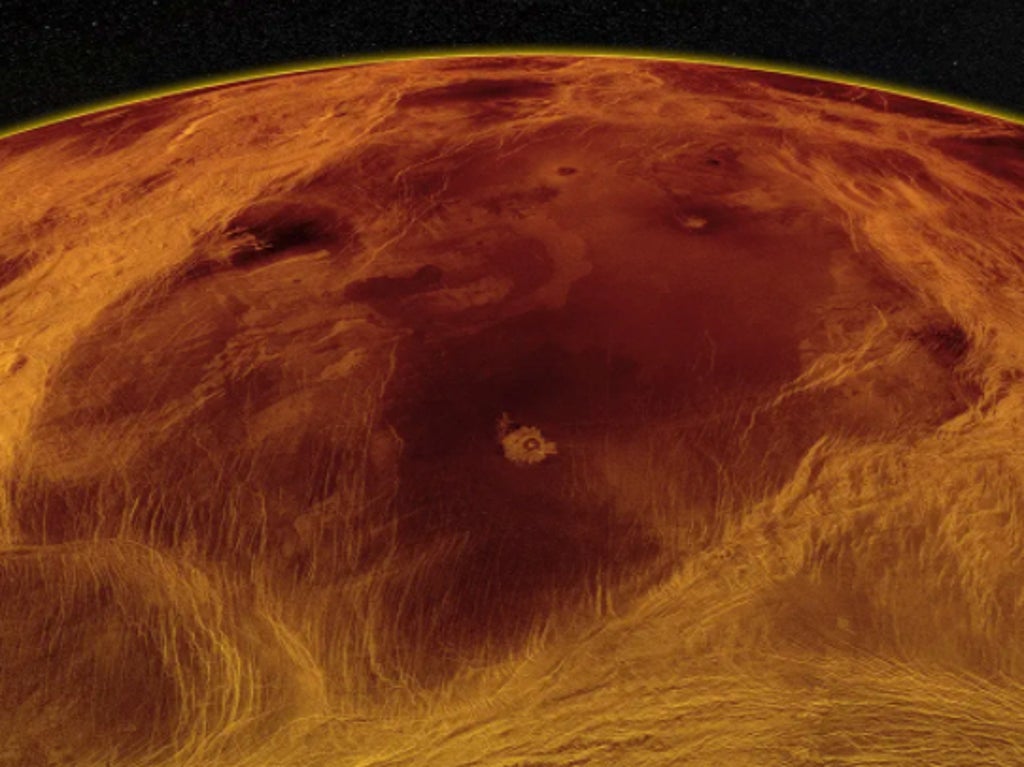
The clouds above Venus have too little available water to sustain life, according to a new study – but the research could also help us find other planets that are home to extraterrestrial life.
Scientists say the new findings rule out possible alien life on Venus, which has become a topic of hot speculation in the months since a paper indicated there was signals that suggested intriguing chemistry was happening above the planet.
It also suggests that most planets in the Solar System suffer from the same problem, and are also unlikely to be able to sustain life.
But they also report the surprise finding that Jupiter’s clouds do appear to have the right environment to possibly sustain life, though much more would need to be known to say whether it actually does.
And the tools used to determine the findings could help the search for habitable planets elsewhere in the solar system, the researchers say, helping understand distant worlds at the most minute scale.
Recommended
The new research is based on the idea that it is not the search for large bodies of water – like lakes or oceans, or evidence that they existed in the past – that actually matters when looking for alien life. Instead, it is what scientists call “water activity”, or a measure of how many water molecules are concentrated in the atmosphere.
The researchers engineered a way to study that water activity at a distance, on Venus and other planets. It suggests that the concentration on Venus is 100 times less than would be required for any kind of life to flourish on Earth.
“Our research shows that the sulphuric acid clouds in Venus have too little water for active life to exist, based on what we know of life on Earth. We have also found that the conditions of water and temperature within Jupiter’s clouds could allow microbial-type life to subsist, assuming that other requirements such as nutrients are present,” said John Hallsworth, the Queen’s University Belfast scientist who led the research, in a statement.
“This is a timely finding given that Nasa and the European Space Agency just announced three missions to Venus in the coming years. One of these will take measurements of Venus’s atmosphere that we will be able to compare with our finding.”
But scientists away from the paper, including those who worked on the research that seemed to find signals suggesting there was phosphine on Venus, noted that the research was based on what we know from life on Earth. Other kinds of life could not need the same concentration of water in the atmosphere, noted David Clements, who worked on that earlier research.
The findings also suggest that the atmosphere on Mars today is too low to support life. Studies have suggested that there needs to be water activity of at least 0.585 for metabolism and reproduction to happen – but Mars only measured 0.537, roughly similar to the second layer of Earth’s atmosphere.
The atmosphere on Jupiter, however, has a measurement of more than 0.585 when temperatures are between -40 and +10 degrees Celsius. That could be enough to allow life to flourish – though the scietnists note that there are many other potential problems with life existing in the planet’s clouds.