
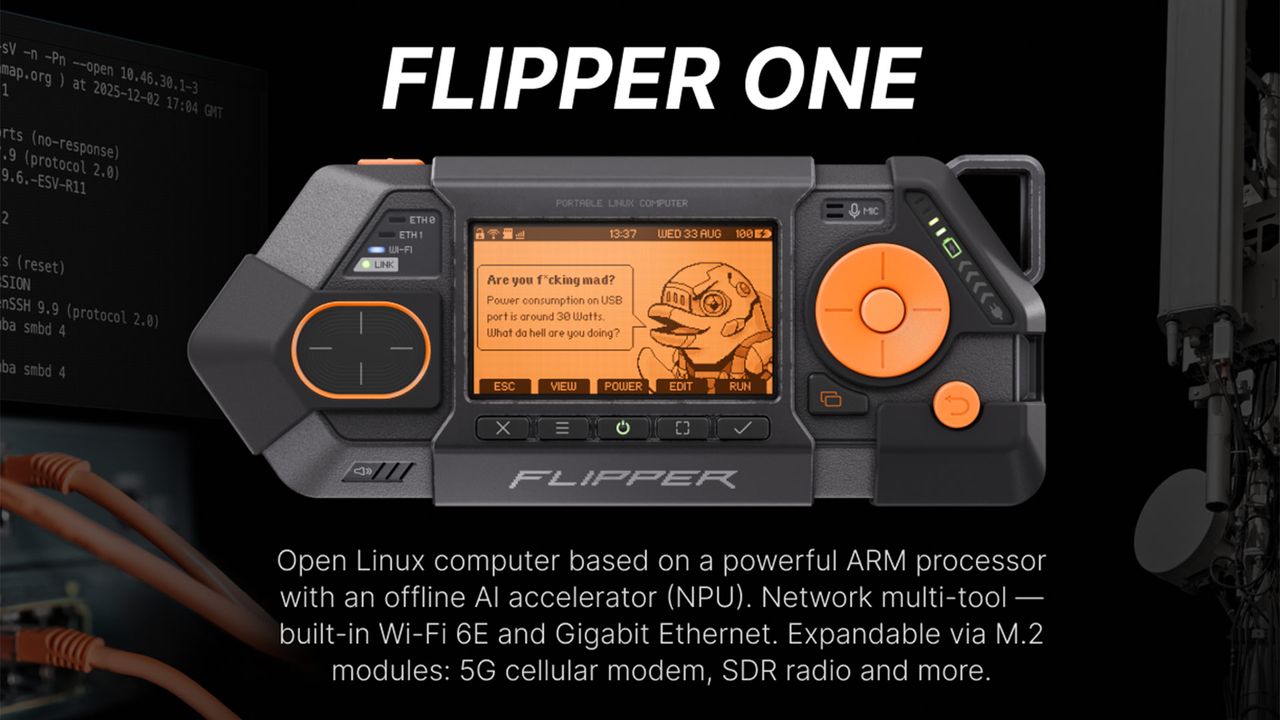
The creators of the Flipper Zero “portable multi-tool device for geeks” have announced the Flipper One. This new pocketable gadget hugely expands the original's feature set with compute, modularity, and expandability to make what is claimed to be a different category of device. The Flipper One isn’t actually ready yet, though. Instead, the Flipper Devices team is asking for help from the community to help steer and finesse the final stages of Flipper One development to meet their ambitious goals.
“Flipper Zero taught us how much you can do with a tightly scoped, open product and a community that pushes it further than you can,” said Pavel Zhovner, Co-Founder and CEO of Flipper Devices. “Flipper One is what happens when we apply the same approach to a much bigger problem — building a fully open ARM Linux device that doesn't go obsolete the moment it ships. To be honest, it’s hard, and we can't do that alone, which is why we're opening the development process from day one.”
Before we go on, the team wanted to stress that the Flipper One isn’t an upgraded Flipper Zero. They assert that “Flipper Zero and Flipper One are completely different projects built for different tasks.” However, after digesting the announcement material, we’d probably sum up that the Flipper One is a device that adds a very useful chunk of Linux compute to the geek multitool form factor established by the Zero. Whatever the case, the Flipper team has created a side-by-side infographic to compare the two devices, and we’ve embedded that below.
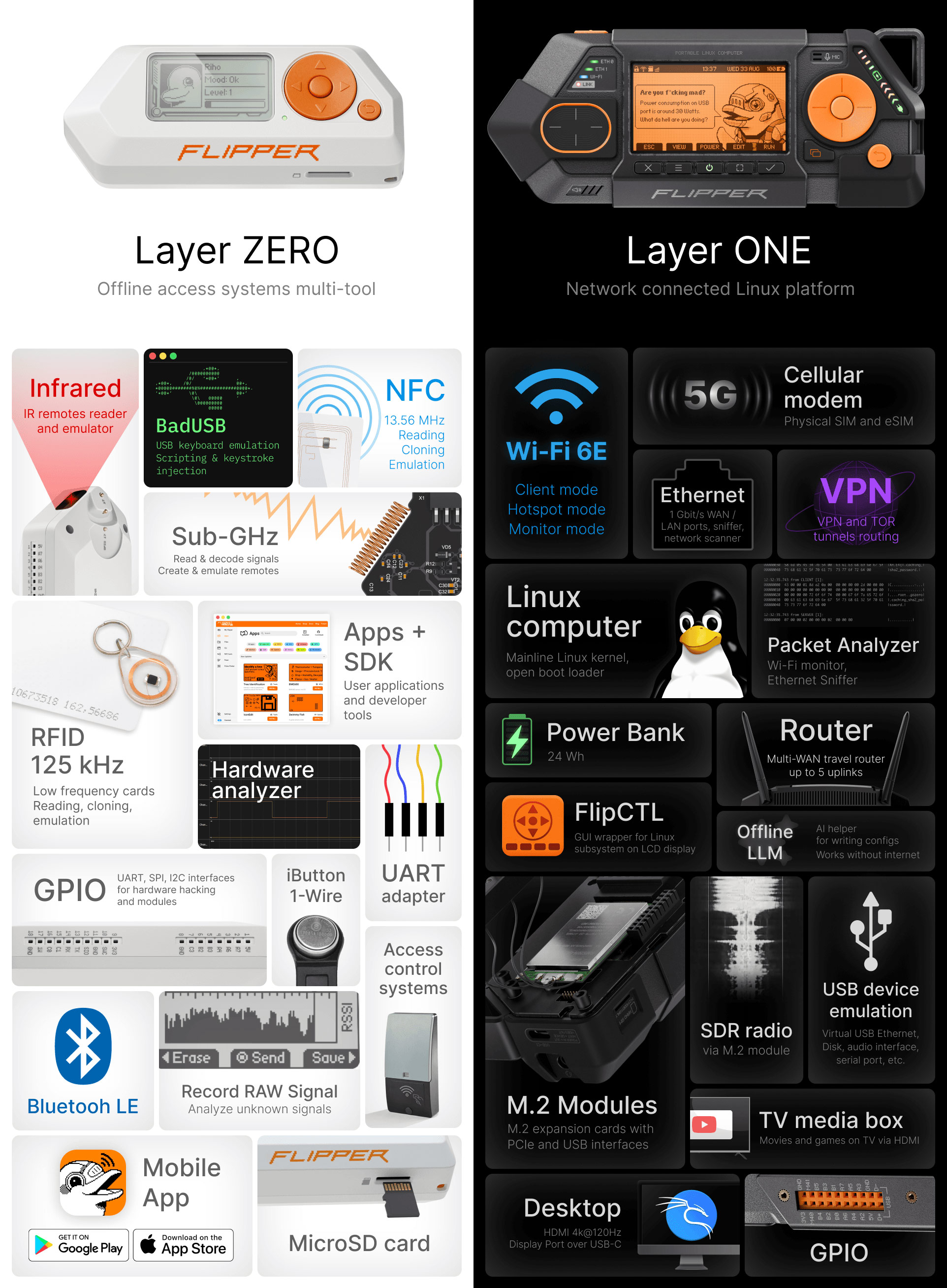
Key to the Flipper One’s expanded abilities are the inclusion of an Arm processor capable of running Linux with about the same performance level as a Raspberry Pi 5, according to the press release, plus the addition of modular M.2 expansion capabilities. These are big additions, and at this stage, the Flipper team openly admits it is still wrangling with getting everything working as intended.
Some important foundational work has been done in preparing Arm Linux for the Flipper One. For example, the team has partnered with Collabora “to push full support for the Rockchip RK3576 SoC into the mainline Linux kernel.” This is a work in progress, though, with current effort focused on power management and USB DP Alt-mode support. Moreover, drivers for the SoC’s NPU, hardware video decoding, and other accelerators aren’t fully upstream yet.
To move forward with the above and related tasks, the Flipper team has created the Flipper One Developer Portal, a public wiki with all the development documentation for Flipper One. Due to the complexity of this new networking and computing multitool, the Wiki houses sub-projects focused on Hardware, Mechanics, Linux software, MCU Firmware, User Interface, Documentation, and Testing. Anyone can join and is welcome to contribute.
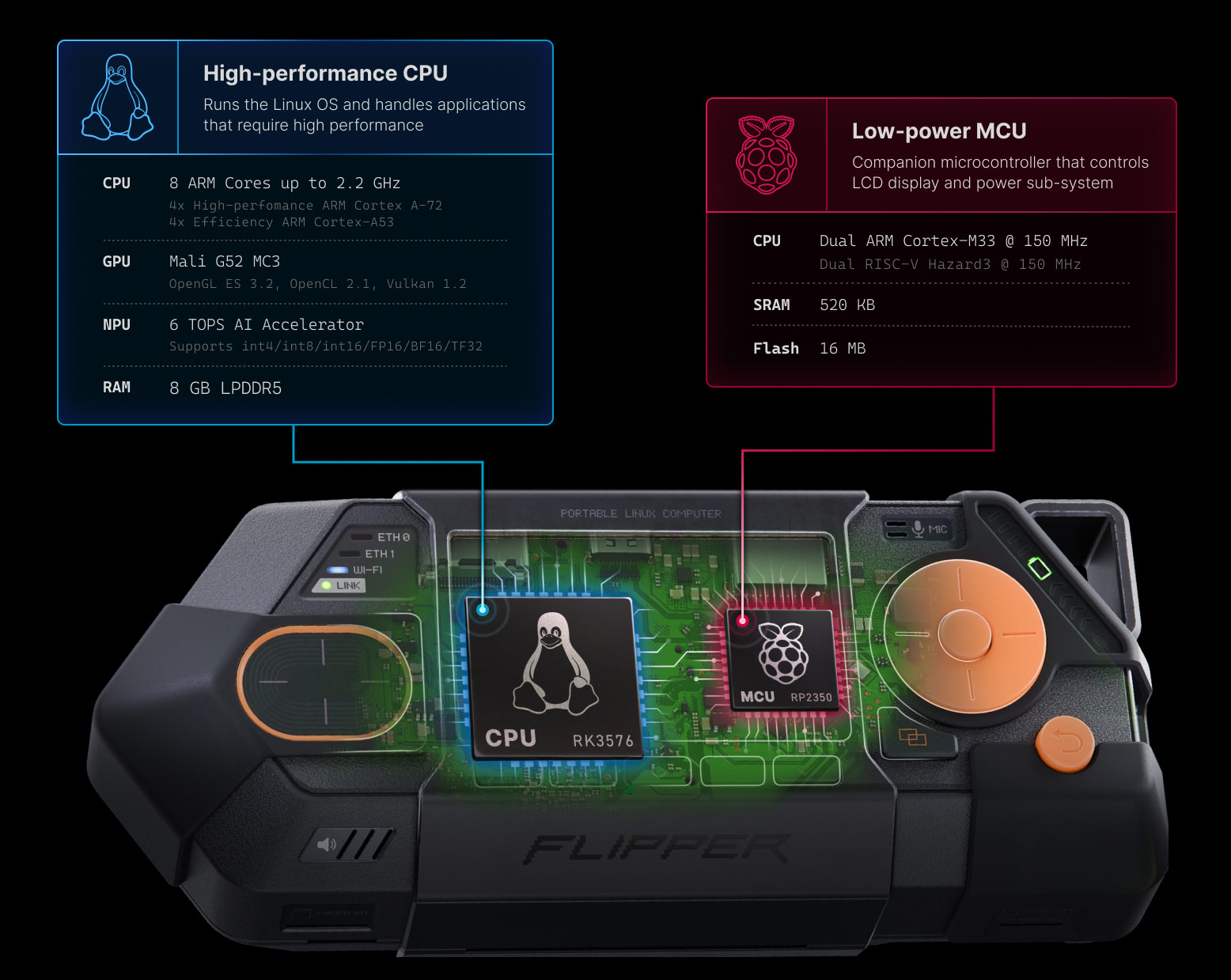
It sounds like there’s a lot of work left to do, but there’s a lot of potential in this new computing multitool. Its coprocessor architecture mixes the aforementioned octa-core Rockchip RK3576 SoC, which also packs Mali-G52 graphics, an NPU, and comes with 8GB of RAM. It is partnered by the RP2350 low-power MCU. Importantly, the MCU can work alone, bringing a lot of functionality to Flipper One without even getting into Linux. The CPU and MCU communicate and work together using an interconnect system.
To make the most of the power inside a Flipper One, the OS must be optimized for the task(s). So, the development team is making Flipper OS, based on Debian. A key project in this development is FlipCTL, a framework for interacting with the device on a tiny screen using just a D-pad and a few buttons.
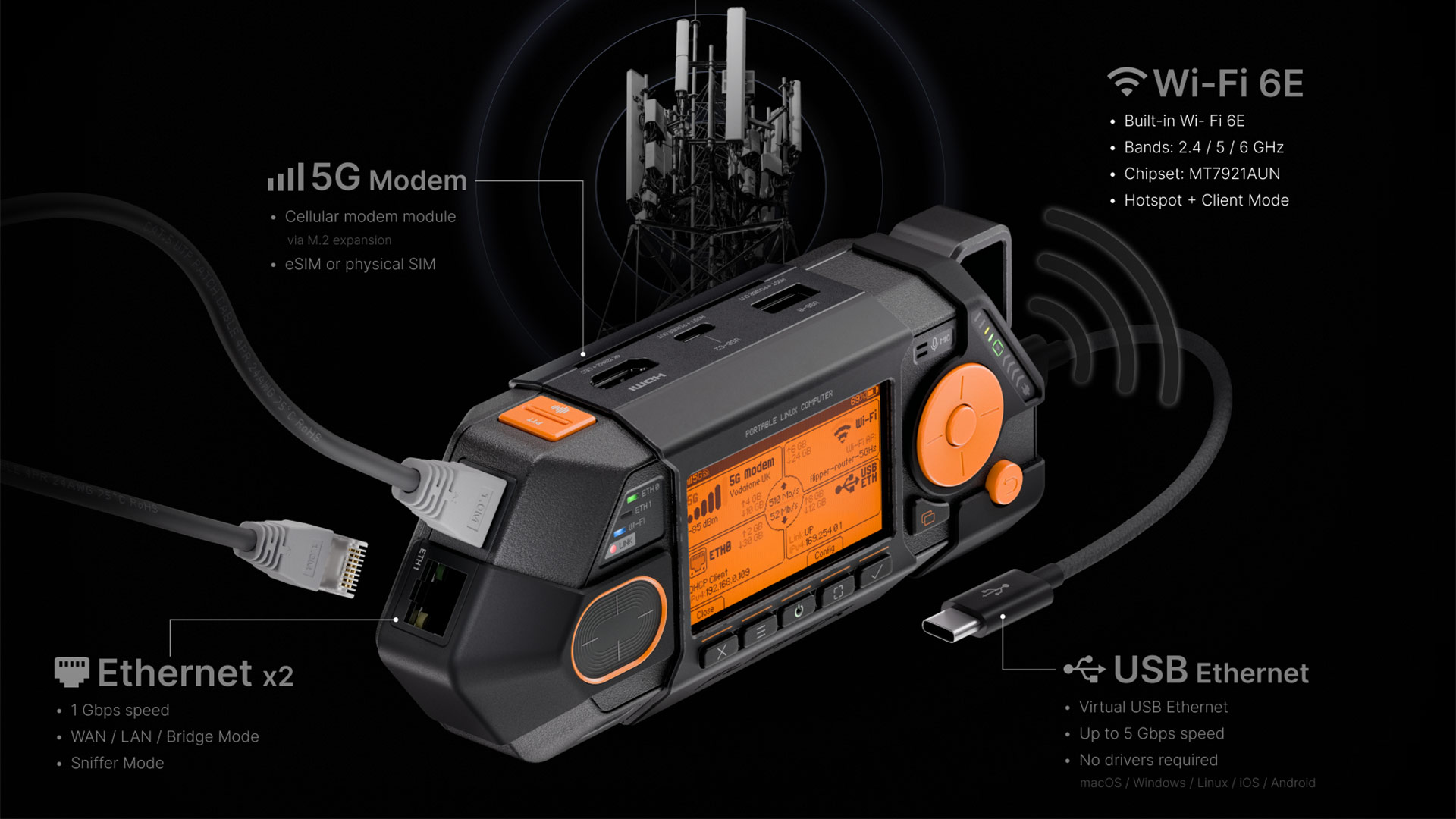
If you have access to a big screen, Flipper One can charge, output video to a monitor, and connect USB peripherals — all via a single USB-C DisplayPort Alt Mode cable. The built-in full-size HDMI port is also envisioned as a big-screen boon, with Flipper One connecting and becoming a “hacker’s TV media box.”
Flipper One’s open hardware module system with a widely compatible M.2 slot and GPIO port also boosts its capabilities beyond the network multitool skills it seems a natural fit for.
Lastly, no new device press release can neglect to mention AI. In this case, the Flipper One is touted as a device with a built-in AI accelerator (Rockchip's integrated NPU, remember) that can run LLMs locally. There are a couple of wrinkles to achieving this functionality right now. However, Flipper One will support external AI agents through integrations when you have internet connectivity.