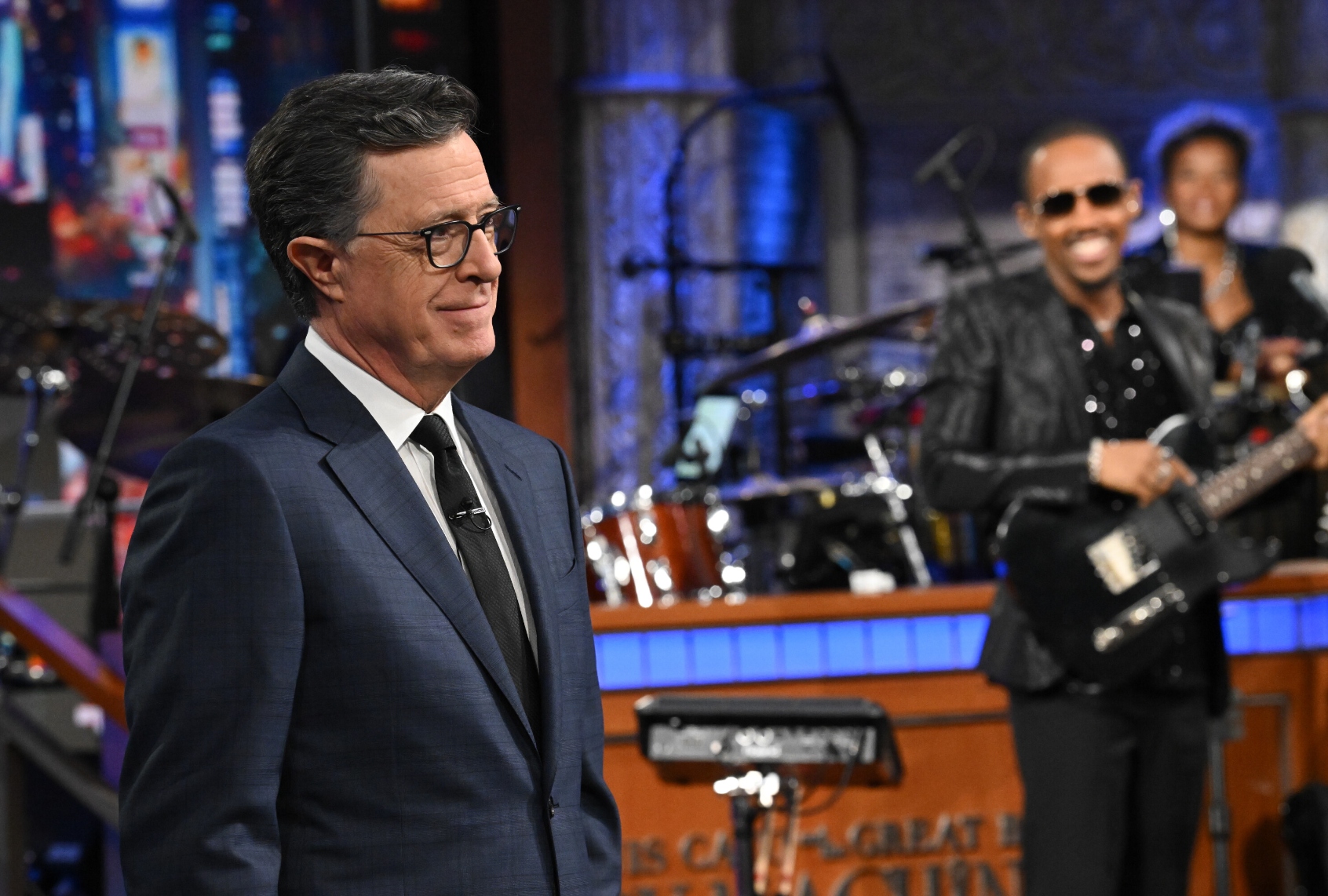
Long before CBS announced it was pulling the plug on “The Late Show,” its host Stephen Colbert had already laid claim to helming one of late-night’s greatest finales.
The very last episode of “The Colbert Report,” which aired in December 2014, closed with the host launching into a rendition of “We’ll Meet Again,” accompanied by Randy Newman playing a grand piano. Shortly after Colbert launched into its opening lines, his longtime “Daily Show” colleague Jon Stewart joined him onstage.
Then the camera cut to Willie Nelson singing along beside Bryan Cranston, Doris Kearns Goodwin and Francis Collins, who was then the director of the National Institutes of Health. From there, the stage slowly filled with former guests, more than 100 in all. There were rock stars, politicians, authors and community advocates; here was Toby Keith and conservative tax reform lobbyist Grover Norquist, there was street artist Shepard Fairey and Big Bird. Smaug the dragon from “The Hobbit” made a special taped appearance, because why not?
And at the end of it all, Colbert flew off in Santa’s sleigh toting his prized Captain America shield, with unicorn Abraham Lincoln and “Jeopardy!” host Alex Trebek, the man with all the answers. Bombastic yet intimate, fantastical yet sensible, Colbert’s farewell to his Comedy Central audience and his conservative alter ego was about as lovely and loving as TV can be. It’s as if he knew that was the last time he’d be allowed to really get as weird as he wanted.
Who knows if Thursday’s last “Late Show” will be that adventurous? CBS and Colbert are keeping the guest roster a secret, with the network only teasing that it will run longer than the standard hour. It’s not as if its overtime will throw off any other shows since “The Late Late Show” and “After Midnight” preceded it in death.
But when the last lights switch off in the Ed Sullivan Theater, the curtain also drops, perhaps permanently, on the brand of surreal, seat-of-your-pants comedy that former “Late Show” host David Letterman gifted to broadcast TV.
Shortly after CBS announced it was ending “The Late Show” last summer, Letterman posted a YouTube video montage of segments from his reign in which he gleefully lambasted CBS for disrespecting the show, summing it up with the description, “You can’t spell CBS without BS.”
Absurdist comedy, the kind that was Letterman’s, his “Late Night” successor Conan O’Brien’s and Colbert’s specialty, is the very soul of free speech because it pushes honesty and truth past mundane notions of propriety. The absurdist’s power rests in their ability to befuddle and bewilder, trusting the joke will land with the right folks and insult their target’s intelligence.
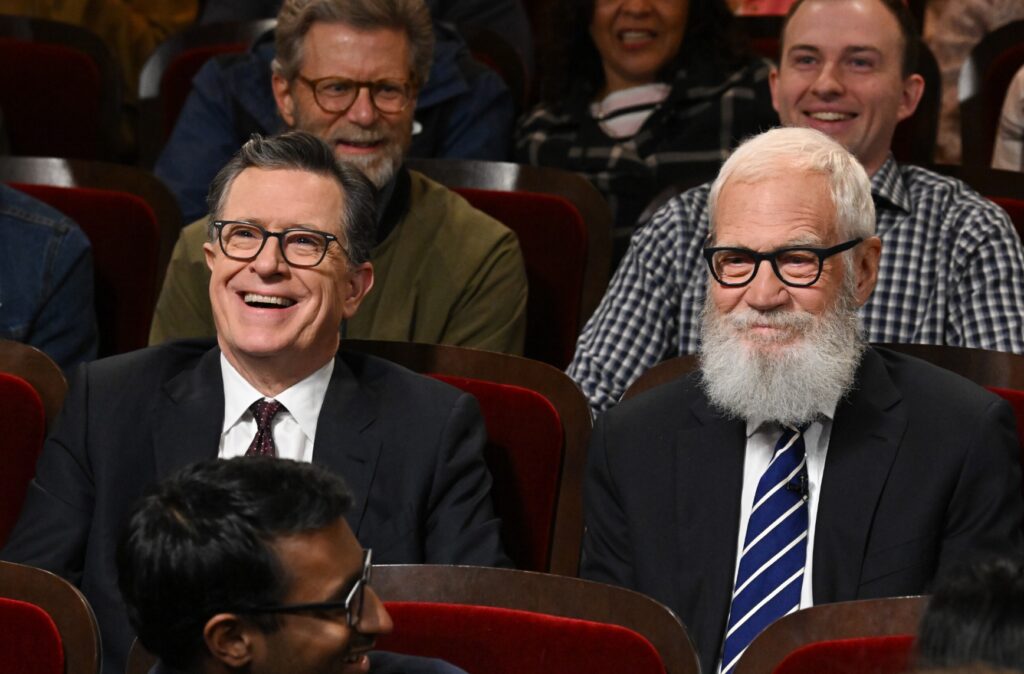
Stephen Colbert and David Letterman. Photo: Scott Kowalchyk ©2026 CBS Broadcasting Inc. All Rights Reserved.
Many people are mourning the end of “The Late Show” as a casualty of the Trump administration’s crackdown on free speech, enabled by corporate oligarchs. They are not wrong. But when it goes away, so do our nightly doses of Colbert’s affable clowning, the kind that irritates thin-skinned despots in a way other comics can’t quite match.
Jimmy Fallon doesn’t try. Seth Meyers is stupendous at hooks and jabs delivered at a lightning pace, but straightly, leaving the performance of absurdity to news headlines. Jimmy Kimmel, who most agree is next on the White House’s hit list, delivers his jokes with blunt force in the same way we’d imagine him doing while manning a grill with a beer in his hand.
Next to them, Colbert plied his art slyly, even mildly, but regularly and in ways the nerdiest students of comedy could appreciate. Like, for example, when he recently invited Letterman back to “The Late Show” for one last goodbye and recruited him to throw company furniture, watermelons and a three-tiered cake off the theater’s roof.
In a genre that runs on toothless punchlines, Colbert’s commitment to the cheerful, zany weirdness he sharpened on the Second City stage and flaunted on “Strangers with Candy” ensured his bite broke the right villain’s skin when warranted. The part that makes it work is his wisdom and sincerity.
Granted, in the talk-variety host Hall of Fame, the Letterman wing is extremely exclusive. There’s him, O’Brien, Colbert as of Friday morning, and not many others. Television genealogists may point out that Colbert’s branch of the talk show family tree is still represented by his Comedy Central brethren on “The Daily Show,” including Stewart, and John Oliver on “Last Week Tonight.”
But what Letterman did – first on “Late Night with David Letterman” on NBC, then to a lesser extent on “The Late Show” – was add an element of unpredictability that was sometimes feral to our otherwise gentle bedtime routines. He introduced segments that didn’t make sense, and shouldn’t have been funny (and sometimes weren’t), but they worked because they were cathartic.
Some were unhinged, like Crispin Glover’s Kafkaesque break with reality on “Late Night,” or the time on “The Late Show” when Letterman seated an effigy of himself in a chair and proceeded to ceaselessly punch it, even after the audience’s laughter died. Many of his gags cemented his genius way of blowing raspberries at power, including CBS bosses. That style of hosting understands the laws of physics and gravity, and gets what a release it can be to drop your overlord’s precious things from a great height simply to enjoy the pleasure of watching them smash to bits.
Colbert’s version is gentler but also the most successful. He brought us in on the joke without losing sight of why we watched him in the first place: to glean whatever laughs we could not from his madness, but from the maddening state of the world. He knew the best way to battle malicious political lunacy is to show us what a joke it is, smiling brightly all the while.
Colbert took the reins of Letterman’s comedy tradition once he received the green light from CBS to reclaim the aspects of his Comedy Central self. Even so, “The Late Show with Stephen Colbert” was and is sincere and wholesome, even moving at times. Letterman brought us back to ourselves in the wake of 9/11. Colbert has reminded us of our humanity through this administration’s endless string of catastrophes.
Of course, the difference between the collegiality that defined the finale of “The Colbert Report” and whatever “The Late Show” does is about a dozen years of partisan tribalism and MAGA delusion. Most right-wing celebrities and politicians avoided sitting down with Colbert once the Trump era lurched into full-speed shambling.
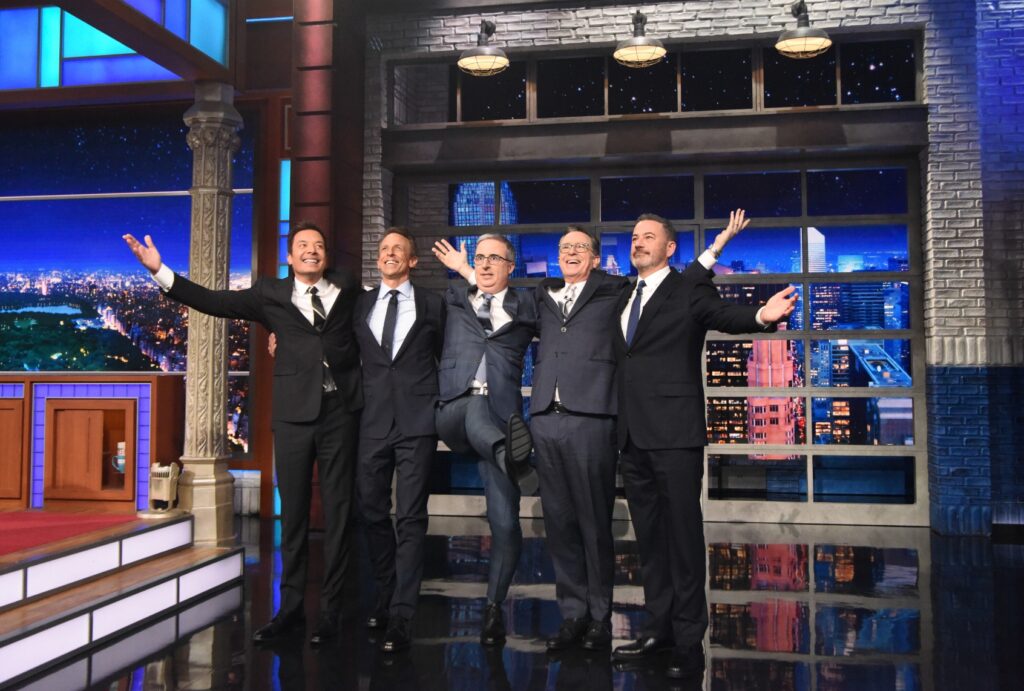
Stephen Colbert and Jimmy Kimmel, Jimmy Fallon, John Oliver, and Seth Meyers. Photo: Scott Kowalchyk ©2026 CBS Broadcasting Inc. All Rights Reserved.
And in the show’s final days, the roster of A-list guests who swung by to pay their respects fits the definition of the liberal elite: Tom Hanks, Steven Spielberg, former President Barack Obama and Bruce Springsteen among them. Colbert named Pope Leo XIV as his dream guest for the finale, which is unlikely but certainly appropriate. They are on the same team, after all.
I’m not referring to Colbert’s Catholicism, but their shared place on the President’s enemies list. CBS’ official reason for canceling “The Late Show,” the top-rated broadcast show of its kind, claimed that its model is no longer economically sustainable. While that was news to most people, including its host, everyone watching the merger of CBS’s parent company, Paramount Global, and David Ellison’s Skydance, must have assumed its completion would require some blood sacrifice. Just not this one.
So when Colbert was fired shortly after he likened Paramount Global’s $16 million payoff to settle Trump’s ludicrous $20 billion lawsuit against “60 Minutes” to “a big fat bribe,” few people accepted the network’s reason. Not even when sources estimated “The Late Show” was losing $40 million a year. Having Colbert revert his political satire to its classic fighting form, then, only worked for CBS until it wasn’t convenient. That was never far from our thoughts as we watched “The Late Show” thrash, often jubilantly, against the coming night over the 10 months that the network gave it to bleed out.
Selecting “We’ll Meet Again” as the sing-along tune to end “The Colbert Report” was both nostalgic and symbolic. It was British songstress Vera Lynn’s signature send off for soldiers on their way to the front in World War II, offered as an expression of kinship and a kind of prayer, an assurance that acknowledges uncertainty: “We’ll meet again, don’t know where, don’t know when,” says the chorus, “But I know we’ll meet again some sunny day.”
That same spirit applies here, since this is not the end for Colbert any more than it was for Letterman or O’Brien’s exits from network TV. Letterman is enjoying his elder statesman status with an interview show on Netflix, “My Next Guest Needs No Introduction,” that he makes on his own schedule. O’Brien has a popular podcast, a travel show on HBO Max, is a two-time Oscar host and recently went viral with a bizarre meltdown on “Hot Ones” reminiscent of one of his old “Late Night” tears.
Want more from culture than just the latest trend? The Swell highlights art made to last.
Sign up here
I doubt any of the post-“Late Show” options that Colbert is considering involve disappearing. Peter Jackson announced that Colbert – a J.R.R. Tolkien obsessive – and his son Peter McGee are collaborating with screenwriter Philippa Boyens on a new “Lord of the Rings” film, for one. Beyond that, I’m sure any of the streamers would happily fork over an ungodly payday to have exclusive access to his talent.
In any event, Colbert has recently voiced the epiphany that maybe his firing was a blessing: “[It] takes a lot of bone marrow to do the show every day,” he told People magazine. That’s true. Trevor Noah left “The Daily Show” after a seven-year run for similar reasons. “After Midnight” host Taylor Tomlinson came to that same conclusion in a slight year and a half. Both barely lost a step between their exits and full-time returns to the stand-up comedy circuit.
The loss to network TV comedy, however, is massive – and given the viewership migration away from traditional broadcasters toward online platforms, something that can only be delayed, not avoided. “As we all understand, you can take a man’s show,” Letterman told Colbert. “You can’t take a man’s voice. So, that’s the good news of this.” We can sleep easier then, knowing we’ll meet again — someplace other than CBS.
The series finale of “The Late Show with Stephen Colbert” airs at 11:35 p.m. Thursday, May 21 on CBS.