A Cambridge University engineering student has spun his way into the record books, achieving the longest duration for spinning a fidget spinner on one finger.
James Goh, 23, made his own fidget spinner to achieve the Guinness World Records title in 30 minutes 34.54 seconds, beating the previous record by almost five minutes in the process.
He was at school when the popular children’s toys took the world by storm in 2017.
“This has been a hobby of mine since I was a kid, so I’m delighted to get the record – although my finger did ache a little bit after holding it in the same position for so long,” he said.
“I suppose in a way I’ve taken the fidget out of fidget spinning!”
His record is about 20 times longer than a standard spinner bought in a shop.
The record-breaking attempt took place in Hong Kong, where Mr Goh lives when not studying in Cambridge, on December 16, 2025.
James said his fascination with gyroscopes began when he saw the spinning top in Christopher Nolan’s 2010 sci-fi film Inception.
As part of their degree, Cambridge engineering students study the physics of gyroscopes, which are critical components used in everything from smartphones to spacecraft navigation systems.
The Queens’ College student drew on his learning, specifically in aerodynamics and tribology – the science of friction – to boost his hobby.
“People do often ask me why I’m so interested in spinning tops and fidget spinners,” he said.
“There’s definitely something hypnotic about them and their mechanical efficiency is pretty remarkable.
“I also think it’s got a lot to do with being competitive; it’s a very interesting optimisation problem because the goal keeps shifting.
“There are always new materials or techniques to use to tweak the design – there are always improvements that can be made.”
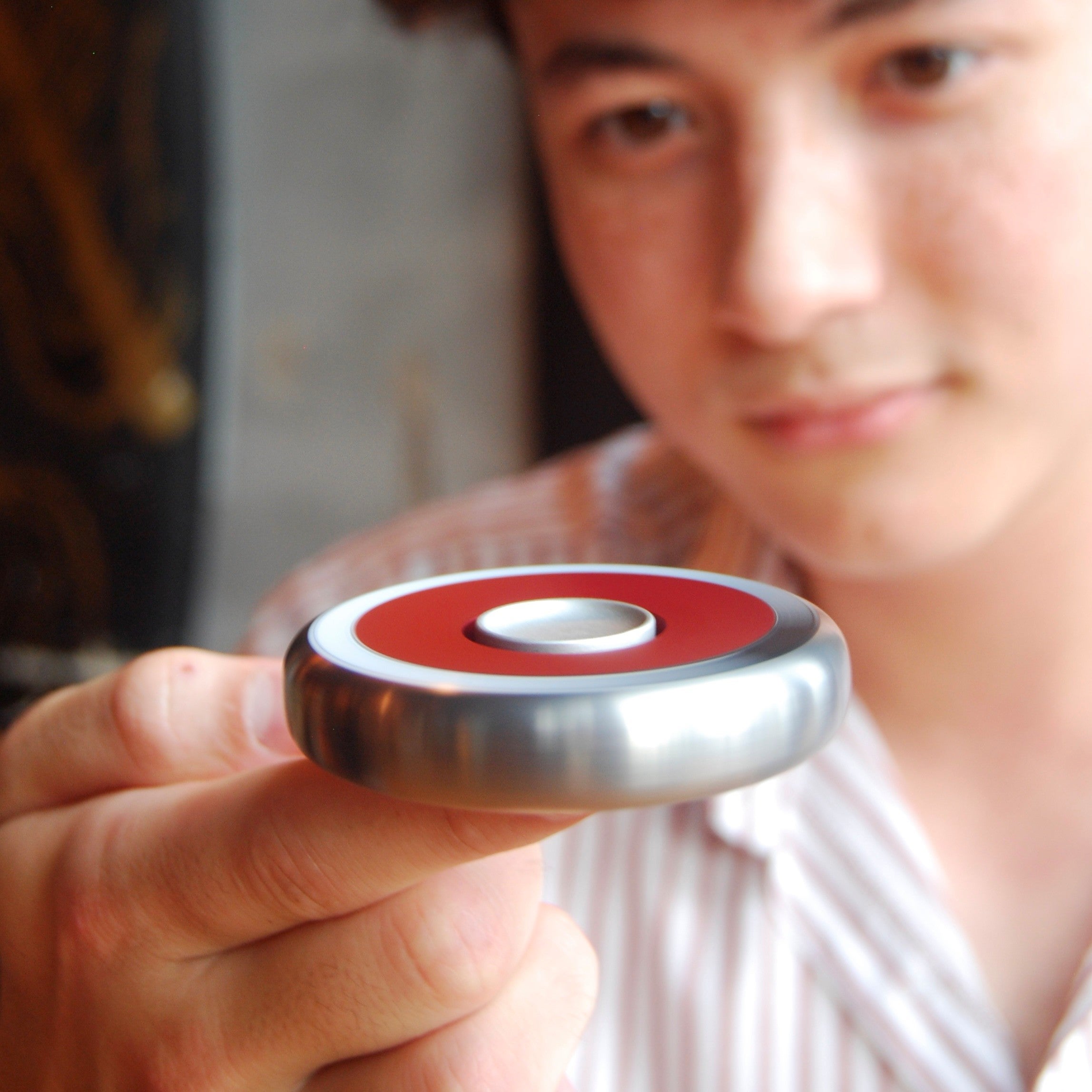
James – who is currently studying on the Manufacturing Engineering Tripos, an option for the final two years of a Cambridge engineering degree – used academic papers to inform his experiments and help figure out the Guinness World Record-breaking formula.
He originally devised his formula for spinning tops, but then used it to engineer his “pulsar fidget spinner” and set the new record.
“It involves a lot of data collection to come up with 3D models, which I then make in the workshop,” he said.
“Differential equations have helped me a lot to refine the formula, although there is no actual analytical solution, because technically it’s unsolvable.
“There’s no magical, optimal spinning time, but you can get close to it.”
The core of James’s spinner is made from lightweight hollow aluminium while tungsten – an extremely dense metal – is concentrated around the edges to store kinetic energy.
It means all the weight is on the outside – creating a “high moment of inertia” – and helping it spin for longer.
He said: “Designing a spinner is basically about three things: maximising the energy you start with, minimising the energy you end with and transitioning between those two states as slowly as possible, so you’re losing energy as slowly as possible.
“The tricky thing is that these factors are all in conflict with each other, and in a really complicated way.”
Trump’s Iran warning sends oil prices soaring and global markets tumbling
Hong Kong court hears final arguments in former Tiananmen vigil organizers' national security trial
It's official: Wes Streeting of the Labour Party wants to be Britain's next prime minister
F1 security boss who fractured skull in Silverstone buggy crash sues for over £200k
When are the London Tube strikes and what lines are affected?
UK set to be hotter than Athens as temperatures climb to 26C ahead of bank holiday