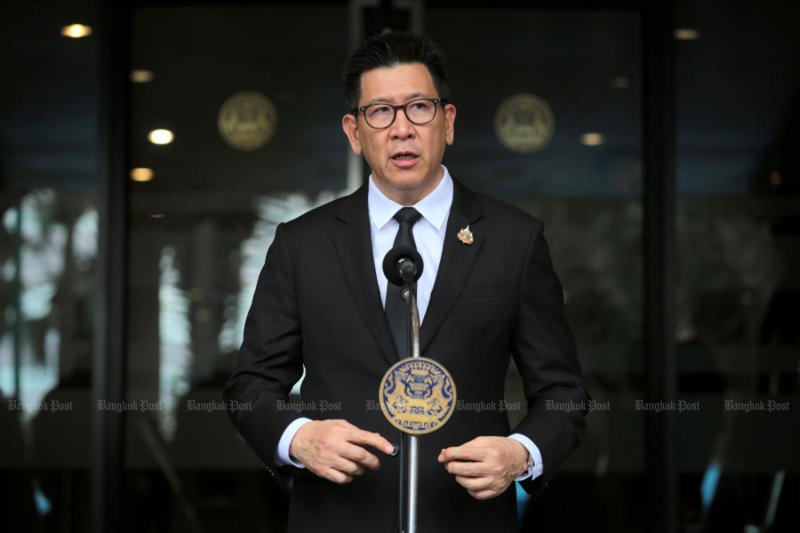
The government is preparing to establish a national reform agenda for the next four years, according to Finance Minister Ekniti Nitithanprapas.
Mr Ekniti said the first meeting of the newly established Joint Public-Private Consultative Committee, chaired by the prime minister with Mr Ekniti as vice-chair, will focus on long-term planning for national reform.
The emphasis is on driving long-term infrastructure investment projects, energy sector reform, upgrading education, and finding new markets for the country, as well as gutting regulations that limit investment -- an issue rating agencies still view as problematic for Thailand.
He said efforts to tackle regulatory obstacles to investment will be carried out by the Board of Investment (BoI) through its "Thailand Fast Pass" programme, aiming to unlock investment more quickly.
The government will pursue a "Quick Big Win" approach to national reform, identifying what can be achieved over six months, one year and four years, said Mr Ekniti.
"The new committee's first meeting on Monday will include the president of the Federation of Thai SME Association, as the government wants national growth to encompass small and medium-sized enterprises in order to achieve inclusive growth," he said.
"The BoI is expected to adjust its foreign direct investment strategy to increase the use of local content in order to build supply chains in Thailand. This approach is similar to the period around 1981, when Japanese investors relocated production bases to Thailand, especially in the automotive industry, which led to the growth of related supply chains. The current global context requires greater use of modern technology."
To develop modern industries such as artificial intelligence, data centres are required, noted Mr Ekniti. If Thailand has data centres, it can expand its cloud services industry, he said.
The BoI is exploring ways to make cloud services more affordable, said Mr Ekniti.
Because the focus is not on short-term policies, GDP growth this year is not a government priority, he added, though the goal is economic growth of more than 2% in 2026.
"We must preserve our strengths, which offer stability, and eliminate our weaknesses, such as high dependence on foreign energy," said Mr Ekniti.
"We must implement projects to transition energy use, upgrade workforce skills, and improve investment regulations."
IMD ranked Thailand 26th out of 70 nations for competitiveness, up from 30th last year.
However, Thailand ranked near the bottom at 67th in the energy sector due to its high reliance on imported energy. This was reflected by the current account deficit in April, when Thailand imported energy equivalent to nearly 10% of GDP.
He also referred to the latest credit rating assessment by S&P, which maintained Thailand's rating.
The country has strong external stability, with foreign reserves of around US$300 billion, more than 2.5 times its short-term debt, while unemployment remains low and investment conditions are improving.
S&P views government stability as an important factor in enabling structural reforms.
"We must reform infrastructure, energy, labour skills, education and the public health system, which IMD is also concerned about," said Mr Ekniti.
S&P is not concerned about Thailand's public debt level, but is concerned about drivers of economic growth, he noted.
Vice-finance minister Santitarn Sathirathai said national stability is crucial in a world of increasing instability. He pointed to US interest rate cuts ending, while Japanese bond yields have risen. Meanwhile, interest rates in Thailand's neighbours were hiked to prevent capital outflows.
"Stability is important as it allows us to avoid being forced into implementing policies that may not be suitable for Thailand's economy," said Mr Santitarn.
"However, stability alone is insufficient; we also need a new growth story."