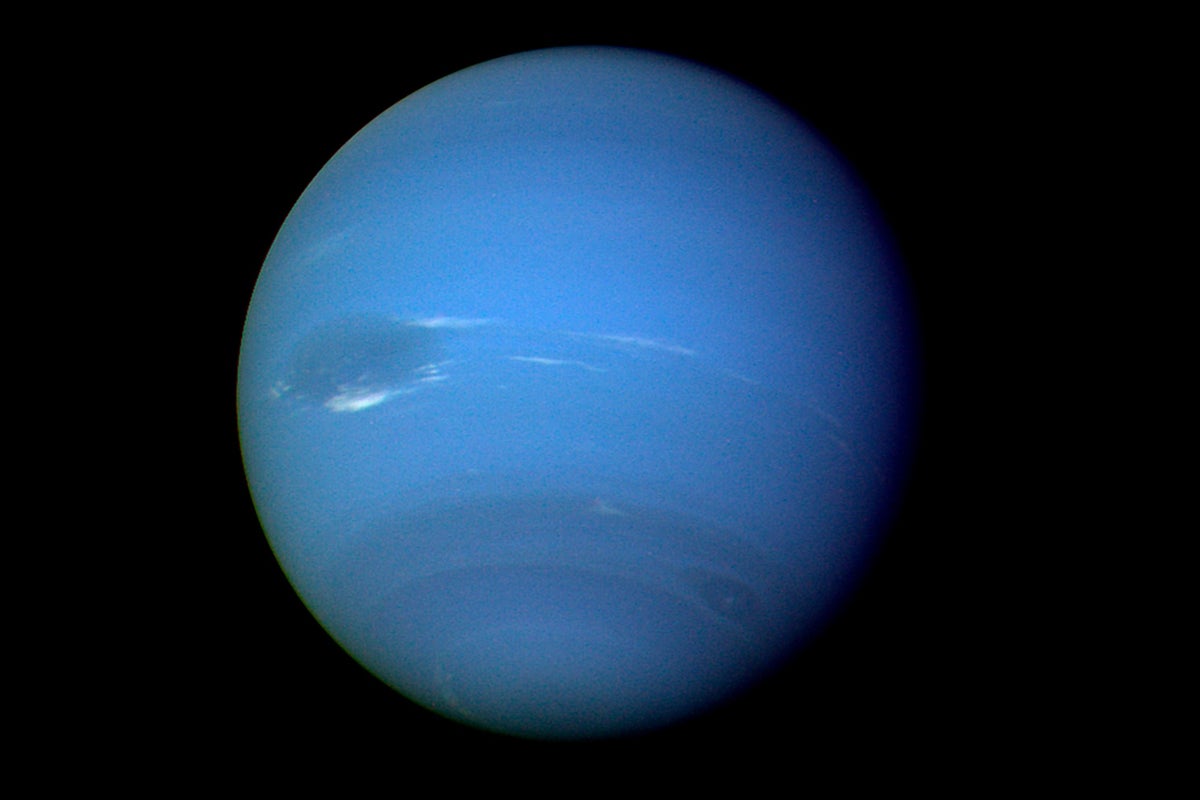
Neptune’s distant moon Nereid is likely the sole survivor of a cosmic collision that reshaped the ice giant’s planetary system billions of years ago, scientists revealed Wednesday.
The new understanding challenges previous assumptions about the moon’s origins.
Of Neptune’s 16 known moons, the largest, Triton, is believed to have violently entered the system from the solar system’s frigid outer reaches, scattering the planet’s original companions and setting them on destructive paths.
However, new observations from NASA’s Webb Space Telescope, conducted by a team led by the California Institute of Technology, suggest Nereid is not an interloper like Triton. Instead, it appears to have survived the chaos by settling into an extreme, elliptical orbit around Neptune.
"What we know about Nereid is very limited. For its size, Nereid is extremely understudied," said study author Matthew Belyakov, from Caltech.
Discovered 40 years before NASA’s Voyager 2 made its sole visit to Neptune in 1989, Nereid was named by Dutch astronomer Gerard Kuiper after the sea nymphs of Greek mythology.
Measuring approximately 220 miles (350 kilometers) across, Nereid possesses an exceptionally eccentric orbit. It takes nearly an entire Earth year for the moon to complete one revolution around Neptune, with its distance varying wildly from less than 1 million miles (1.4 million kilometers) at its closest approach to 6 million miles (9.6 million kilometers) at its farthest.
For years, Nereid was thought to have migrated to Neptune’s vicinity from the Kuiper Belt, a distant region of icy bodies. The Webb telescope’s data revealed Nereid’s composition, particularly its high ice content, to be inconsistent with typical Kuiper Belt objects. This suggests Nereid was an original member of Neptune’s system.
"We don’t have all that much evidence left around Neptune — the system doesn’t have very many moons left," Belyakov explained via email, adding that the latest findings "strongly rule out" Nereid being a wanderer captured by planetary gravity.
The findings, published in the journal Science Advances, have been met with enthusiasm.
"This is an exciting result," commented Scott Sheppard, a planetary astronomer at Carnegie Science who was not involved in the study.
He noted that the observations demonstrate for the first time how Nereid’s peculiar orbit aligns with "the history we might expect from a moon that originally formed close to Neptune and was later pushed outward from the capture of Triton."
Belyakov and his team propose that Neptune’s innermost moons likely formed from the shattered remnants of the original moons that fell victim to Triton’s arrival.
While other giant planets in our solar system boast more moons, with Saturn leading at 292, a future visiting spacecraft could definitively unravel the Neptunian system’s origin story, though no such missions are currently planned.