Afternoon summary
-
Members have voted in favour of a policy proposing free universal childcare from the age of one to six.
#gpconf passes policy to provide free universal childcare for children up to age 6!
— Newham Greens (@NewhamGreens) March 6, 2015
-
A poll has shown the people see the Lib Dems as more idealistic and honest than the Lib Dems or Ukip, but less qualified to be a serious party of government. (See 3.29pm.)
Isabel Hardman at Coffee House says Natalie Bennett redeemed herself with her speech.
Here’s an extract.
Natalie Bennett needed to give a good solid speech to the Green Party conference after a difficult few weeks, and she managed that today. The Green leader hadn’t undergone a personality transplant though, so she still wasn’t the most stirring speaker ever ..
But overall it was a solid speech. It set out what Bennett wants to do, both in terms of election campaign messages, and in terms of how she would like voters to behave.
Guido Fawkes has had some fun with the fact that Natalie Bennett was speaking in front of a green screen. You can watch his take here.
I’m sorry the blog has been quiet. I’ve been otherwise engaged writing a story.
I’ll be rounding up now, and posting a summary soon.
Caroline Lucas wraps up the session with a quote: “We are the people that we are waiting for,” she says.
Q: Does the Green party need tighter links with other Green parties in the world?
Molly Scott Cato says there is a green links organisation already encouraging these connections.
Q: Why is Syriza hesitant on adopting renewable energy? There is a lot of sun and wind in Greece?
Kostas Loukeris says there is a struggle in the Greek government over renewable energy. He says he agrees. Greece is rich in sun, wind and waves. He does not see why it should drill for oil.
Scott Cato says the European parliament has specifically set aside money for renewable energy projects in Greece.
Q: There is a rumour that Russia is ready to take over Greece’s debt. Would Greece accept that?
Loukeris says this is a myth that has existed in Greece, since the time of the Ottoman empire. People think “the Russians will save us”. He does not see it happening.
He sincerely doubts that Greece would confuse its allies in this way.
And Russia cannot afford just to give money away.
Q: Should we find partners with other parties? People say the left will always be split.
Scott Cato says people need to understand how a multi-party system works. It inevitably leads to coalition, and compromise. People in this country do not understand it.
Adam Ramsay says the party will debate a motion on Sunday allowing candidates to stand under a joint label with other parties. This could apply to parties like the National Health Action party.
The Labour party thinks it has all the progressive answers, he says.
The Greens should never fall into that trap.
He says they have recently become the main progressive party in the UK. But they must stay pluralist.
Q: Is Syriza trying to reform the economic system or change it fundamentally?
Loukeris says the government has been clever enough not to promise socialism. But it might be able to create new models within the existing framework. There are many ideas around for this, he says.
Q: If we are a party for everyone, aren’t we going to have to bring the right in with us?
Zoe Williams says, if you want to quote a world for everyone, you even have to take everyone with you.
She says Catholicism and neoliberalism have a lot in common. They are completely fabricated systems. What matters is the internal vitality of the rival movement. That is what is going to draw people in, she says.
Q: [To Kostas Loukeris, a senior member of the Greek Green party] What can we in the UK do to help you? And how can we avoid the rise of fascism, given what has happened with Golden Dawn in Greece?
Kostas Loukeris is speaking from Greece by Skype.
He says Greens should focus on the fact they are changing the world.
There is a big Greek community in the UK. It is based around the City. These ship owners have most of the wealth held outside Greece. We might need support for you.
On Golden Dawn, he says it is the ugliest example of the consequence of neo-liberalism. Look at Golden Dawn, Pegida in Germany, the National Front in France, and Ukip in the UK. These are all byproducts of neo-liberalism.
Zoe Williams, the Guardian columnist, says fascism does not arrive in fancy dress. It arrives looking like Nigel Farage. The fancy dress comes later.
Q: We are constantly told we need growth, which is a lie. And we are told wealth creators create jobs, which is also untrue. It is workers who create wealth.
Molly Scott Cato, the Green MEP, says she agrees with the point about growth. But debt is also a factor too. That is why the party changed its stance on the money supply.
Q: What do the panel think about TTIP [the transatlantic trade and investment partnership]?
Scott Cato says the Greens are leading the opposition to this in the European parliament. It is being kept secret because it involves big corporations setting the terms of the market. It is “utterly undemocratic and must be stopped.”
Adam Ramsay from Open Democracy says the new Greek government has said it is opposed to TTIP. It will veto it, he says. Given that, he cannot understand why it is not dead.
He says the struggle to remake the British economy won’t just benefit people in this country. It would also help people in Greece.
Panel discussion on Syriza
The panel discussion on Syriza is underway. I’ve missed the opening statements, but we’re on to the Q&A now.
Caroline Lucas starts by inviting a contribution from a UK representative of Podemos, the leftwing anti-austerity in Spain which has been attacting huge support since it launched last year.
He says Podemos shows that ordinary people can do extraordinary things.
Here’s one Green member explaining why Natalie Bennett is so popular.
There's a lot of love for @natalieben at #gpconf. Standing ovation for walking in! We know she was pivotal in creating the #greensurge
— Caroline Allen (@Green_Caroline) March 6, 2015
James Dennison, a political scientist, has posted this graph on Twitter.
It suggests that, for Green supporters, having coherent policies matters less than it does for the supporters of most other parties.
A good #gpconf is a policy-light #gpconf. GP voters just want a vision of society (thx to @philipjcowley) pic.twitter.com/1UNd5tFPsM
— James Dennison (@JamesRDennison) March 6, 2015
Greens seen as idealistic, but not a party of government - poll
ComRes has published the findings of a poll it has carried out for ITV looking at public perceptions of the Greens, the Lib Dems and Ukip.
On the plus side, the Greens are seen as the most idealistic and most honest of those three parties.
Idealistic
Greens: 41%
Ukip: 17%
Lib Dems: 15%
Honest
Greens: 23%
Ukip: 18%
Lib Dems: 12%
But the Greens are also worse on being “fluffy” and a serious party of government.
Fluffy
Greens: 26%
Lib Dems: 16%
Ukip: 7%
A serious party of government
Greens: 9%
Ukip: 16%
Lib Dems: 24%
Natalie Bennett's speech - Snap summary and analysis
Well, the members who are here certainly like Natalie Bennett. It was not exactly a speech that achieved “an explosion of excitement without raising unrealistic expectations” (see 9.16am), and at times it was rambling and unfocused, but Bennett did seem to get a genuinely enthusiastic reception. Perhaps there’s an element of showing solidarity with someone who’s had a tough time in the media recently (the sympathy clap), but there does seem to be an authentic buzz here too; people keep talking about how much larger this is than previous Green party conferences. Bennett had some good lines about the Greens being the agents of change, or a potential “peaceful political revolution”, but what was most interesting was her policy announcement on social care. Green support comes disproportionately from the young, but today Bennett announced a policy likely to appeal most to the middle aged and the elderly. Put simply, the Greens are going after the Telegraph vote. I’m not sure how well this will work, but it is an interesting act of re-positioning.
Here are the main lines from the speech.
-
Bennett said the Green party was committed to making social care for the over-65s free at the point of use.
Free healthcare is the very cornerstone of our NHS. Whether you are rich or poor you have the right to the best that is available.
That’s something the Green party will restore – and extend. For that same principle should apply to social care – the support and services that you need to lead a fulfilling life should be available when you need it, free at the point of use.
We believe that to be a decent, humane, caring society, social care must be free ...
Providing free social care for the over 65s means security and freedom from fear, suffering and loneliness for many, and it means 200,000 new jobs and training places.
Bennett did not explain how this would be funded, but she said “those who have the most” should contribute and she confirmed that the party was committed to a new wealth tax, a financial transaction tax and higher income tax for those earning more than £100,000. She also said the party would consult on how free social care could be delivered
-
She said people could achieve “something miraculous - a peaceful political revolution” at the general election by voting Green.
This election can be a turning point in history. The moment where we can deliver a better Britain, a Britain which works for its people. A Britain which cares.
Updated
Bennett says some people want business as usual politics to continue. They will vote for the politics of yesterday.
But if we all vote Green, we can change Britain for good.
Vote for the politics of the future. Vote Green, she says.
And that’s it. She’s getting a standing ovation.
Bennett it is impossible to overstate the importance of people who can vote making their voice heard.
The deadline for voter registration is 20 April. But don’t wait, she says; register today.
Bennett says the manifesto will include free social care as a core pledge.
Social care is not a privilege; it is a right.
Bennett says the same principle that applies to health care should apply to social care. It should be free at the point of use.
We believe that to be a decent, humane, caring society, social care must be free.
The Greens would introduce a wealth tax, crack down on tax evasion and tax avoidance and introduce a financial transactions tax, the “Robin Hood tax”.
Bennett says she is glad the Greens are working on an NHS reinstatement bill to remove the market mechanism from the NHS.
Bennett says the ideology of Thatcher and her successor, Blair, Brown and Cameron, has failed.
The market is short-sighted and short-term. it is blind, it is senseless. It works for the 1%; it fails the rest of us.
‘All in it together’? I don’t think so.
Bennett says things cannot carry on as they are.
Since 2000 food prices have risen 22%. But wages have fallen 7%.
It is time to end the scourge of zero hours contracts, she says.
Bennet says she applauds those who run food banks.
But individual charity is no substitute for collective justice.
This is the legacy of both Labour and the Conservatives, she says.
The Green party is calling time on the politics of low wages, job insecurity and food banks. It is calling time on the privatisation of public assets.
Bennett says Caroline Lucas “put her freedom on the line” to oppose fracking.
She shows “passion, sensitivity and courage”.
Just imagine a group of MPs in the Commons like that, she says.
Green MPs would never support a Conservative government.
(This gets a big round of applause.)
Bennett says the Greens approach the election as a central player in British politics.
But it isn’t just the Green party. Campaigns for a new politics are getting stronger. Look at the people’s assemblies, the Occupy movement, anti-fracking campaigns and fossil fuel divestment campaigns.
At last the people are fighting back.
Bennett says the green surge is much more than a hashtag, although it is a very successful hashtag.
She has seen the party expand all over the country. And the Greens got their first MEP in the south west, Molly Scott Cato.
Bennett says no one should be living in fear of not being able to feed their families, in fear of debt, worried about fracking drilling into their communities or at risk of being driven to destitution by Iain Duncan Smith.
That is the failed politics. The Green party is offering a politics that works for the many.
Bennett says she is addressing her comments to the country. 90% of people will have the chance to vote for a Green candidate. For some people, it will be their first chance to vote Green.
In 9 weeks time you will have in your hands something miraculous. The possibility of a peaceful political revolution.
Bennett says people should vote for policies that work for the common good, not the few. Britain could be a very different country on 8 May.
The politics of the future would involve the living wage, good jobs, services run for all, railways run for passengers, not shareholders, and the NHS kept in public hands.
Bennett says this has been a momentous year for the party. It has taken its place at the forefront of British politics.
Nearly 300,000 people helped to ensure the Greens were included in the debates.
They often do better than the Lib Dems in polls.
And they have become the third largest party in England and Wales. Its membership has quadrupled.
Natalie Bennett's speech
Natalie Bennett is taking the stage now. She is getting another standing ovation.
(I can’t tell whether this always happens, or whether this is partly a show of support in the wake of that interview.)
Lucas says that, even with just one seat, the Greens have been able to shape the agenda on issues like fracking and renationalising the railways. And it will be the Greens who champion the NHS reinstatement bill. This would not just repeal the Health and Social Care Act; it would turn back 25 years of Labour and Conservative marketisation.
Lucas turns to the election.
This time, the Greens are fighting “from a position of strength”.
With the SNP, Plaid Cyrmu and the Green surge, there is a change to create a “progressive alliance” in the next parliament, she says.
She says during this parliament she has worked closely with those two nationalist parties.
If there is a Labour minority government, the Greens and others can stop them advocating austerity and pandering to big business, she says.
She says she is high on Ed Miliband’s hit list of target seats because Labour do not like the Greens showing that there is a progressive alternative.
Labour want to end our presence in parliament because, deep down, they are ashamed at how they have abandoned their principles.
Caroline Lucas, the Green MP, is speaking now.
She says this is the fourth venue the party has used for a conference in Liverpool. Each one was bigger than the last. If all party members attend, even Anfield would not be big enough.
She says she wants to welcome new members. And she says they will have seen this party is different; there are no stands for BAe Systems, and no lobbyists from tax havens.
This party is different, she says. Every person’s vote counts the same.
And leadership is different here too, she says. It is something you do out of a sense of duty, not for personal gain. Lucas says when she stood down as leader, she thought her replacement would help the party grow. But she did not know by how much it would grow. She is proud to call Natalie her friend, she says.
Dobson says people are working around the clock to get the first Green MP elected in Liverpool.
Vivienne Westwood is coming to the city to do a campaign event, he says. Some 1,000 people have signed up to see her.
Dobson says Liverpool has had the second worst cuts of any council in the UK. Every person in the city has lost £252 in services. Yet Labour have voted with the government to back another £30bn in cuts, he says.
That’s a reference to Labour voting for the coalition’s charter for budget responsibility.
Martin Dobson says the Green party are the official opposition to Labour on Liverpool council. He welcomes members to the city.
(Joe Anderson, the Labour mayor of Liverpool, has also welcomed Green party members to Merseyside, with an open letter identifying what he describes as some of the party’s most “eye-catching” policies.)
Martin Dobson, the Green candidate for Liverpool Riverside, has just taken the podium. And Natalie Bennett and Caroline Lucas have come in too, to sit on the platform. They get prolonged applause, which eventually becomes a standing ovation.
I’m in the main hall of the conference centre now waiting for Natalie Bennett’s speech to start.
It’s reasonably full, but they’re not turning anyone away yet.
Here’s the view from where I am.
Green Party conference - view from the Guardian's seat pic.twitter.com/o7sBu3Xy2i
— AndrewSparrow (@AndrewSparrow) March 6, 2015
#gpconf pic.twitter.com/75pehxUb7l
— AndrewSparrow (@AndrewSparrow) March 6, 2015
Here’s the view from the balcony outside the room where we had the briefing. The Green party flag is flying over the Mersey.
Green Party flags flying outside #gpconf in Liverpool pic.twitter.com/gDlPlY3jx1
— AndrewSparrow (@AndrewSparrow) March 6, 2015
I’m back from the press briefing. A press officer was doing it and he began by telling us that the conference “is not really for journalists”, which wasn’t auspicious. What he meant was that it’s for members to make policy. Any member can turn up and vote on policy (unlike, for example, in the Labour party, where local parties are allocated a certain number of delegates). The conference won’t actually approve the manifesto, but the policies agreed will feed into the manifesto, which is being drawn up by a separate party committee and which will be published at the end of March.
The spokesman also wanted to take issue with the idea that existing Green policy would ban almost all cars. (See 12.25pm.) That’s not the case, he said. An activist just included that line in his motion to ensure it got attention, he claimed.
And here’s a shot from the bookstall.
The Greens appear to be big fans of Owen Jones (and maybe Russell Brand?) #gpconf #GreenPartyConf pic.twitter.com/A4TPClD9dd
— Federica Cocco (@federicacocco) March 6, 2015
I’m off to the press briefing now. Hopefully I will be able to file again soon, but if it goes quiet, it’ll be because I’m having trouble with the wifi.
You certainly don’t get this at other party conferences.
From the Green Party conference guide: the most Green Party thing ever pic.twitter.com/1IS4DARscN
— Michael Deacon (@MichaelPDeacon) March 6, 2015
I’ve just had an email from Labour highlighting these figures, showing that the Greens fell from second place to third place in a council byelection last night in St Pancras & Somers Town in Camden, the war ward where Natalie Bennett lives.
It's the first day of the Green Party conference today. Here's what happened in Natalie Bennett's ward last night. pic.twitter.com/IejuLtFhwH
— Siraj Datoo (@dats) March 6, 2015
Green party's conference agenda - Policy highlights
The Greens describe their conference as the “supreme decision-making body” for the party and the agenda, setting out the motions and amendments that are going to be discussed over the next four days, runs to 86 pages.
The party says it has three key campaign themes for the election.
1 - Keeping the NHS in public hands, and fighting privatisation.
2 - Ending austerity, with the living wage rising to £10 an hour by 2020 and a new wealth tax for the richest 1%
3 - Tackling climate change, by phasing out fossil fuels and nuclear power and promoting renewables.
But the full agenda is much richer. As well as containing the odd nugget for tabloid hacks looking for “barmy Greens” stories, it contains an array of proposals that you won’t find at mainstream party conferences.
Here are 15 of the most interesting.
- Making it an offence to stop women from breast feeding in public. (Or the anti Nigel Farage law, as you could call it.)
-
Amending the party’s current policy on cars. The explanation for this is a gem; note the masterly use of understatement.
Our current transport policy has a line that would ban almost all currently roadworthy cars. As this would probably prove unattractive with the electorate, this motion replaces it with text that is more in line with the intentions of the policy [which is got manufacturers to limit the speed of cars].
- Providing free universal childcare from the age of 1 to 6. This motion is sponsored by Natalie Bennett, among others.
- Extending article 5 of the human rights declaration “to all sentient life forms”.
- Extending “the human rights of life, and liberty” to ceteceans (whales and dolphins), great apes and elephants. This would ensure that the “murder, torture and kidnapping” of these creatures would “bear the same legal penalty as the relevant crimes committed against humans”.
- Banning horse racing and greyhound racing for commercial purposes. Non-commercial greyhound racing would have to take place on linear tracks, and non-commercials horse racing would have to take place on the flat.
- Banning foie gras, and any other product that is the result of force-feeding.
- Abolishing employers’ national insurance. This would be funded by increases in corportation tax and other business taxes.
- Abolishing tuition fees and writing off outstanding student debt.
- Mandating Green MPs, in the event of a hung parliament, to “do all they can to remove the Conservative party from government”. Green MPs would also be banned from joining a coalition unless the Greens are in the majority, and banned from supporting an administration including Ukip.
- Allowing parents not to nominate the gender of a child at birth if the child cannot be assigned a gender.
- Opposing George Osborne’s plans for greater devolution for Greater Manchester, on the grounds they have “no democratic mandate”, and promoting a north west regional assembly instead.
- Changing party policy so that it favours STV (the single transferable vote) as the preferred electoral system for local government, not AMS (the additional member system), so that the Greens are “in line with other democratic reform organisations”.
- Introducing mandatory reporting for child abuse.
-
Cutting £1m-plus National Lottery prizes, and having more, smaller prizes instead.
Updated
Natalie Bennett has arrived.
Bennett insists she's been practicing her speech #gpconf https://t.co/iogbU556lN
— Ian Silvera (@ianjsilvera) March 6, 2015
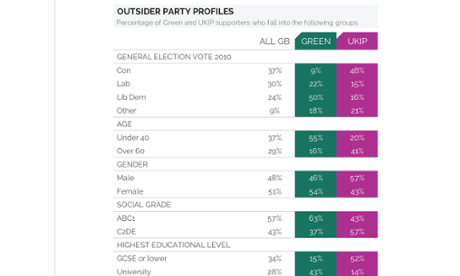
Last year, as the Ukip surge was taking off, YouGov published some research looking at the composition of people supporting the Greens now.
Around half of Green supporters voted Lib Dem in 2010.
The figures also show that Green supporters are disproportionately likely to be under 40, university educated, professional and female. For Ukip, it’s the opposite.
If you’re a detailed account of how the Green party emerged in recent years from obscurity to become semi-mainstream, this article by Adam Ramsay for Bright Green, The history of a political surge, is excellent. He looks at the internal, party, factors that have made a difference, as well as the external ones, and he argues that Natalie Bennett’s influence has been important. And choosing to have a leader in the first place was key too, he says.
All of this leads us back to another vital date: November 30 2007. Because the very existence of a leader made much of this change easier. The post was only created in the party after a referendum among the membership, whose result was declared that day. The change didn’t only allow for one new role in the party: it signalled a new seriousness.
Perhaps most importantly, in hindsight, it let the party finally move on from the “realo/fundi” (realist/fundamentalist) debates which had plagued Greens across Europe in the Nineties, and to focus instead on questions relevant to, well, anyone apart from the hacks. Closure on the issue also meant that two powerful groups in the party and their fellow travellers: Young Greens (who tended to be on the left, but pro-leader ‘realos’) and Green Left (who were very much anti-leader ‘fundies’), were able to move beyond these disagreements on internal structures, and push through the various changes I’ve listed above.
Here’s a gem from the conference agenda.
It's a shame this Green Party trainiing (sic) is on Sunday instead of before Natalie's big speech today pic.twitter.com/Q692xLXbMo
— John Stevens (@johnestevens) March 6, 2015
Someone once claimed that the most scary words that a politician can hear are: “Michael Crick is in the lobby to see you.”. But it’s good to see that he is welcome up here.
Just came out of the toilets and saw @MichaelLCrick. We're not in Kansas anymore...! #gpconf
— Rob Telford (@GreenRobTelford) March 6, 2015
Another sign of the Greens emergence as a more prominent party is that journalists are starting to write about personality splits within it. This does not happen with more minor parties, because reporters tend not to know who any of the personalities are.
Earlier this week Anoosh Chakelian wrote a lengthy piece for the New Statesman, under the headline “the Granola Pact”, about the relationship between Natalie Bennett, the leader, and her predecessor., Caroline Lucas. Chakelian’s conclusion was that, although there are tensions between the two women, they are not too serious.
The splits for now are only shallow, and the Greens’ startling last-minute success in terms of polling and membership figures remains the bigger story. Bennett is likely to hold on to the leadership, and Lucas is just as likely to remain professional and supportive, as well as a popular MP.
However, signs of infighting are not necessarily a bad thing. Blair and Brown’s civil war raged throughout Labour’s most successful period in modern times, after all. Just as press scrutiny of Green policies means they’re finally being taken seriously, internal spats means they’re finally growing up as a party. As one party official quipped on the day of Bennett’s LBC interview: “So we’re getting a pasting. Welcome to the club.”
If you are looking for a more hard-hitting account of splits within the Green party, you should read Matthew Holehouse’s lengthy article about the party for the Telegraph today.
He has been reading what party members were saying about Bennett on a private, internal online message board after her disastrous LBC interview, and the findings are not flattering.
A minority argue that the cynical public would warm to a fallible, unpolished leader.
For many members, however, it was a decisive exchange. It was preceded with an interview with the BBC’s Andrew Neil in which Ms Bennett had struggled to explain how the proposed wealth taxes would work. Later, she told BBC Radio 4 that concessions should be granted to Vladimir Putin.
“The SNP has been very adept. UKIP has been successful. We are throwing away golden opportunities”, said one member.
Another claimed a friend had left “because she didn’t trust Natalie Bennett to be a credible prime minister.”
“When she said the other day she will be our voice on the debates, my heart sank,” said another.
A recent recruit wrote: “She was a total disaster and she sounded like a rank amateur. She really has to resign and let someone take over who has the intellect to think on their feet and handle the media.”
Today's Guardian seat projection - Tories 276, Labour 271
And, while we’re on the subject of polling, here’s today’s Guardian seat projection.
Conservatives: 276
Labour: 271
SNP: 52
Lib Dems: 25
Ukip: 4
Greens: 1
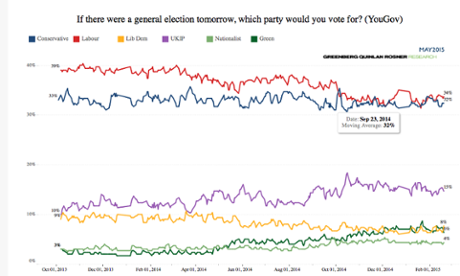
Here is a YouGov chart illustrating how support for the Greens has risen over the last year or so. It shows party support from October 2013.
And here are the figures for 18 to 24-year-olds. Amongst this age group, the Greens are the third most popular party.
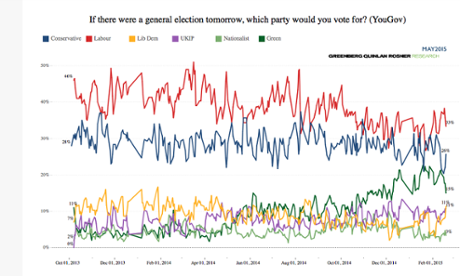
I’ve taken the charts from the New Statesman’s excellent May2015 election data website.
Updated
Caroline Lucas calls for 'progressive allliance' with SNP
I’m in the press room at the ACC conference centre in Liverpool, and it’s clear the Greens have hit the big time; Michael Crick from Channel 4 News is here.
There aren’t many other people about. The conference does not get going properly until lunchtime.
In the meantime, here’s a statement the party released overnight from Caroline Lucas, the Green MP. She says the party should try to form a “progressive alliance” in parliament after the election with the SNP (and Plaid Cymru too, I presume).
With the rise of the SNP, and with our own Green surge, we have the chance to forge a new grouping in parliament. A progressive alliance.
Of course, in Scotland and in Wales we’ll be fighting hard for our distinctive values and policies. Just as we do against those individual Labour and even Lib Dem candidates with whom we have something in common.
That’s the nature of British politics under the first past the post system.
In her new book, Honourable Friends? - Parliament and the Fight for Change, Caroline Lucas, the Green party MP, writes about how hard it has been for small parties like hers to make progress in British politics.
Conservatives, Labour and the Liberal Democrats could agree on one thing at least: they wanted to leave no space for alternative voices. Indeed, if politics were a business – and I sometimes wonder if that is so far-fetched an idea – it would be a prime case for a referral to the Competition and Markets Authority for monopolistic collusion in excluding new entrants to the market.
That’s a long-standing complaint, but over the last year it is starting to become marginally less applicable than it was. Ukip and the Greens have been flourishing, and they have both – Ukip, constantly, by a big margin; the Greens, sometimes – been coming ahead of the Lib Dems in the polls. (Today’s YouGov poll puts Ukip on 15%, the Greens 8% and the Lib Dems 6%). Greens have managed to secure inclusion in the proposed TV debates, despite Ofcom ruling that they are not a major party. And today they are holding a conference which is described as the largest in the party’s history. Around 1,3000 people are expected to attend the event in Liverpool.
The party’s membership has quadrupled over the last 12 months, and yesterday it stood at 55,638. Almost half those coming to the spring conference, which runs until Monday lunchtime, are new members.
That means the stakes are a lot higher than they used to be at previous conferences, when the party was routinely subject to a virtual national media blackout. Natalie Bennett, the party leader, is speaking this afternoon and, in a blog for the Staggers, the Green activist Adam Ramsay says this will be “the most important speech in the history of the party”.
In her opening speech to her party’s conference this weekend, [Bennett] needs to inspire an explosion of excitement without raising unrealistic expectations. She has to encourage a flourishing of activity yet gather a focussing of energy. She must give journalists one hell of a headline while speaking to the manifold concerns which have attracted almost one in a thousand adults in the UK to become a signed up Green Party member in the past year. And she will have to do all of that only 240 short hours after her “day from hell”.
That’s a reference, of course, to her recent “mind blank” or “brain fade” LBC interview.
I’m on the train on the way to Liverpool now and I will be live blogging from the conference until about 4pm.
Here’s the agenda.
1pm: Press briefing.
2pm: Natalie Bennett speaks, following an introduction from Caroline Lucas.
3pm: Panel discussion on what Syriza’s victory in Greece means for the left in Britain, featuring Caroline Lucas, Molly Scott Cato, the Green MEP, Adam Ramsay from Open Democracy (and author of that Staggers piece), the Guardian’s Zoe Williams and Kostas Loukeris, a member of the ruling council of the Greek Green party.
If you want to follow me on Twitter, I’m on @AndrewSparrow.