NASA teams are working to restore contact with one of its most advanced interplanetary satellites.
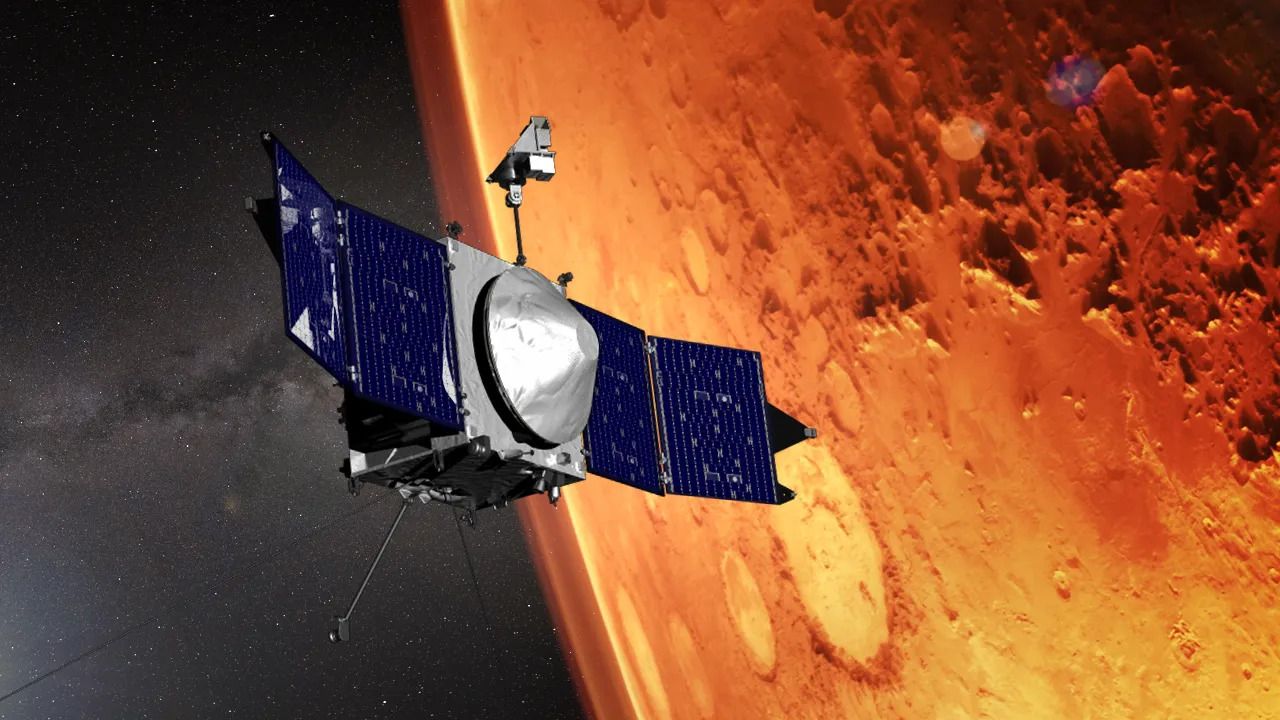
MAVEN (Mars Atmosphere and Volatile EvolutioN) is one of only three NASA missions currently in operation around Mars, and one of five spacecraft serving as a communications relay for the space agency's rover missions on the Martian surface.
During routine operations on Dec. 6, NASA's Deep Space Network (DSN) lost communications with MAVEN as it orbited behind the planet. This type of loss of signal (LOS) is anticipated by NASA's tracking systems, which usually reestablish connections with distant spacecraft after they are temporarily blocked by planetary bodies. As MAVEN was expected to emerge from Mars' far side, however, DSN failed to reacquire a signal, according to a Dec. 9 NASA update. "The spacecraft and operations teams are investigating the anomaly to address the situation," NASA wrote in the statement.
MAVEN launched on a ULA Atlas V rocket in Nov. 2013, equipped with instruments to measure the evolution of Mars' atmosphere and its interaction with solar winds. The orbiter arrived 10 months later, and has remained operational in Martian orbit for the last decade.
In addition to its scientific mission, MAVEN also serves as a critical link to the small handful of missions on the Martian surface. MAVEN works in tandem with NASA's Mars Reconnaissance Orbiter (MRO) and Odyssey, as well as the European Space Agency's Mars Express (MEX) and ExoMars Trace Gas Orbiter (TGO) to provide planet-wide communications relay coverage for missions like the NASA's Perseverance and Curiosity rovers.
Data from MAVEN indicated a nominal trajectory and normal operating status for the spacecraft's systems prior to its disappearance behind the Red Planet, according to NASA. Assuming the satellite's orbit remained unaffected by whatever caused the communications anomaly, NASA and DSN operators can continue attempts to ping the spacecraft along its predicted orbit as they work to determine a cause and subsequent solution.
NASA's statement indicated more information would be shared on MAVEN's status as it becomes available.