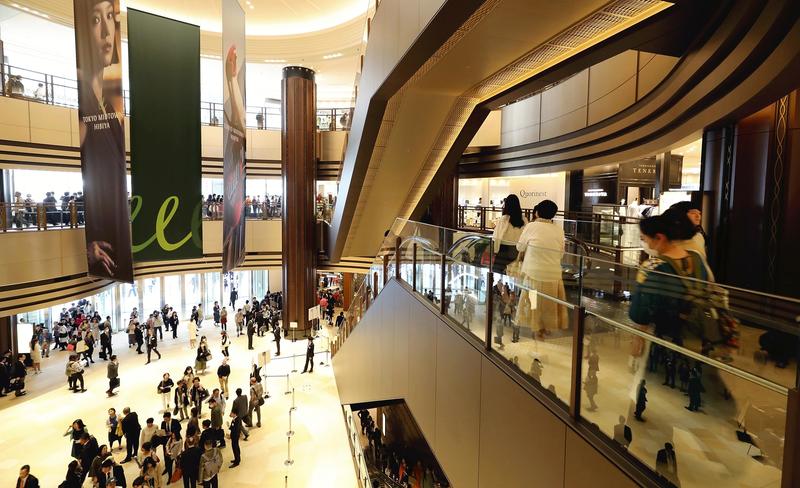
Tokyo's Hibiya district, which has a long history as a theater and cinema hub, is going through a major makeover with Thursday's opening of Toho Cinemas Hibiya as one of the capital's largest complexes of its kind.
Toho Cinemas Hibiya occupies parts of two buildings that are connected underground: the brand-new Tokyo Midtown Hibiya commercial complex and the older Toho Takarazuka Building. The cinema complex has 13 screens with a total of 2,800 seats. It includes the two screens that used to be Toho Cinemas Scalaza and Toho Cinemas Miyukiza in the Toho Takarazuka Building.
Toho Cinemas Hibiya's concept is to be a "movie palace." Its lobby, a glass-walled atrium, is one of the major features of the facility, from which visitors can enjoy the view of Hibiya Park and various other iconic landmarks in Tokyo. The cinema complex also sells high-quality drinks and food items.
"We offer visitors a space of extra quality, a step up from [what we've provided] up to this point," said Toho Cinemas Hibiya general manager Yoshiteru Fukui. "I believe this complex will boost the level of the nation's [film] theaters."
The 459-seat Screen 1 is dubbed a "premium theater" thanks to its three high-end features: luxury seats, an extra-large screen that meets the cinema's custom specifications, and a tailor-made sound system of a concert-hall quality. Other theaters in the complex feature sound systems designed specifically for their respective sizes.
"Cinema complexes are available in many places today, allowing us to enjoy films anywhere," said Yoshito Hiramatsu, marketing department manager of Toho Cinemas Ltd.
"We hope to help Hibiya, which was once known as a 'cinema town,' regain its momentum," he said about opening the latest facility.
The nearby Yurakucho district is the former home of Toho Cinemas Nichigeki, the chain's key complex that closed down in February. This place will be used as a rental hall and also house a facility offering various types of visual entertainment, with a planetarium and other technologies.
The film industry has a tradition of running the same titles simultaneously at various cinemas under certain distribution networks, each with its own flagship cinemas in Tokyo, such as Nichigeki. Its closure, therefore, has had a significant impact on the industry, said film journalist Hiroo Otaka. "It means Toho Co., the biggest movie supplier, ended the distribution network it had long maintained. That would trigger a major change in the way cinemas show films," he said.
Currently, cinema complexes have to cut short the schedules for certain titles or reduce the number of screenings per day if they fail to earn the expected box office revenue on the day they are released. This practice, however, sometimes narrows the range of choices for moviegoers who want to enjoy not just major titles, but also see an expanded variety of films, Otaka said.
"Cinema complexes have an important role to promote quality films, even when it goes against the market mechanism," the expert said. "I hope Toho Cinemas Hibiya will work as a model for [other facilities] nationwide, not just in terms of setup, but also in what it chooses to show."
3 areas eye joint promotion
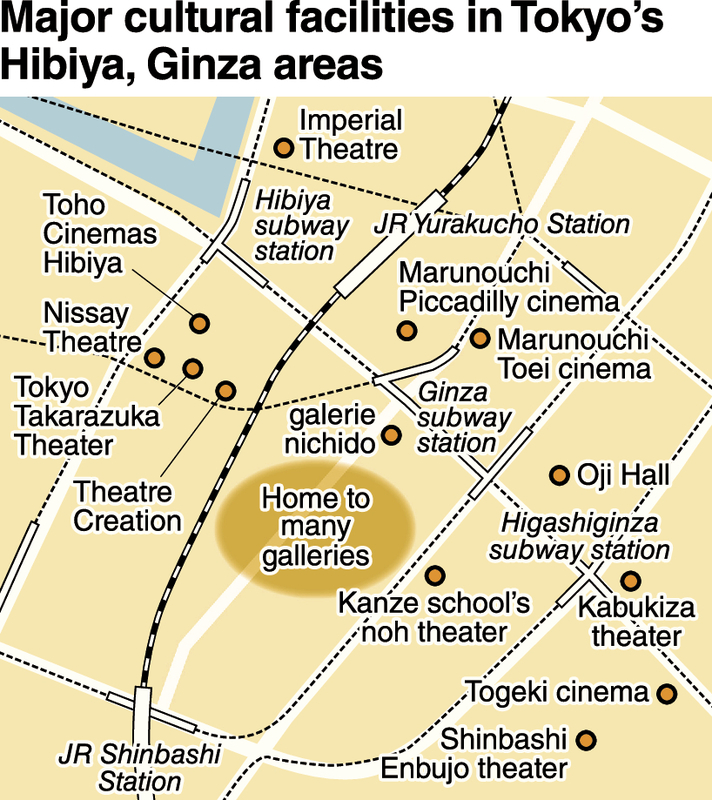
Hibiya, along with its neighboring Ginza and Tsukiji districts, is home to many facilities considered shrines for the respective fields of performing arts, such as the Kabukiza theater, the Kanze school's noh theater, the Tokyo Takarazuka Theater and the Imperial Theatre.
Moreover, the three areas have the long-running "galerie nichido" and many other art dealers and galleries, in addition to a number of established cinemas such as Marunouchi Piccadilly and Marunouchi Toei, as well as art house theaters. Also in operation here is Oji Hall, which is known for providing quality chamber music concerts.
Now, cultural facilities and other entities in Hibiya, Ginza and Tsukiji have been working on a joint project to better promote their locations as a hub for entertainment among visitors from Japan and abroad. Named "Tokyo Art & Live City," the project will kick off its first event on April 20.
"We should proudly show the world what a wide variety of art forms are centered here," said Nobuyoshi Otani, president of the Japan Association of Major Theaters, who also serves as head of the joint project's executive committee that was launched in January. "They are on par with New York's Broadway and London's West End."
Up to now, however, cultural faculties in Hibiya, Ginza and Tsukiji have not generally worked together, Otani said. Under the latest project, "We hope to have collaborations beyond the framework of forms of art so that we can promote our respective cultural programs to much wider audiences at home and abroad."
As one significant measure, Tokyo Art & Live City will upgrade the way information is provided on plays and other entertainment in multiple languages, targeting in particular foreign visitors prior to them visiting Japan.
The project will come with a website (www.artandlive.net) that goes up officially on April 20, and will offer information in Japanese and English during fiscal 2018, with the additions of Chinese, Korean and French in fiscal 2019.
The portal site will also offer links to others for hotel bookings and ticket sales.
From April 26 to May 20, Tokyo Midtown Hibiya will host "Hibiya Festival" as the first area-wide performing arts event. As an example of collaborations beyond the framework of entertainment forms, a tour is planned for May 25 that will combine Azuma Odori -- an annual dance show by geisha in Tokyo's Shinbashi district -- and Ginza Art Night, an event that features visits to area galleries. Applications for the tour, for which non-Japanese participants will be given a priority, can be made via the Tokyo Art & Live City website.
Read more from The Japan News at https://japannews.yomiuri.co.jp/