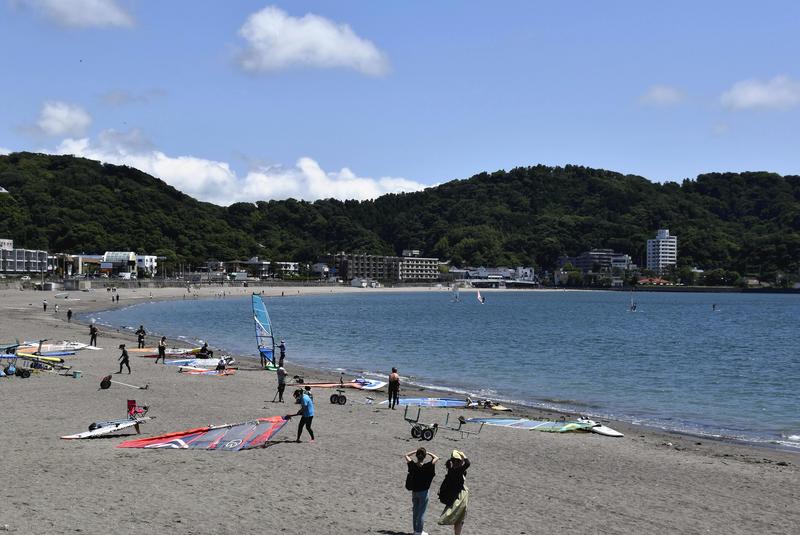
Most local governments in the Kanto region have decided not to open public swimming beaches in their areas this summer, citing a need to prevent infections of the new coronavirus from spreading among sea bathers.
In the three coastal prefectures of the Kanto region alone -- Kanagawa, Chiba and Ibaraki -- 79 out of the about 100 seaside swimming areas will be closed to the public this summer.
However, as the entry of people to beaches cannot be easily controlled, concerns are being voiced that they will become "lawless areas" with more water accidents and uncollected litter. Thus, local governments will still need to carry out some patrol activities in these areas.
Seaside swimming will be closed to the public at all beaches in Kanagawa and Ibaraki prefectures, 25 and 18 beaches, respectively, and at 36 out of 59 beaches in Chiba Prefecture.
The Kanagawa prefectural government had informed the local governments of seaside municipalities that if they open their swimming areas to the general public this summer, they must implement thorough anti-infection measures such as restricting beach hut use to a reservation-only basis and enforcing social distancing by placing markers on the beach. Daunted by such rigorous requirements, local governments threw in the towel on opening their beaches to the public one after another. The Chiba and Ibaraki prefectural governments both concluded that it would be difficult to take relevant measures sufficiently, as people would get close to each other while swimming and in beach huts.
There is also an expected difficulty in securing enough college students to serve as lifeguards. This has much to do with many universities having been closed for a prolonged period, a shorter-than-usual summer recess period and the extended period for job-hunting activities by senior students amid the coronavirus outbreak.
The city of Choshi, Chiba Prefecture, which has three public swimming beaches, managed to secure 10 to 12 college students a day for lifeguard duties last summer. But this year, it has neither been able to conduct lifesaving drills nor secure a sufficient number of students due to uncertainties over the period of their summer recesses.
Even if the swimming beaches are closed, there is a high likelihood that people will come to the seaside anyway to enjoy wining and dining.
Zushi, Kanagawa Prefecture, has an ordinance forbidding people to have barbecues or play music on its beaches. Both are banned on the assumption that the beaches are made open to the public. For this reason, the city government plans to create a new ordinance on manners, encompassing the whole beachfront, while also mobilizing guards. The city government in nearby Kamakura also plans to station guards on the beach, saying, "Although it will create a financial burden, we cannot leave it to chance."
The city government of Kashima, Ibaraki Prefecture will install signboards along the roads leading to the beaches, notifying people of the closure of the public swimming beach, while reinforcing its seaside patrols in cooperation with the local police.
Beaches without lifeguards and manned aid stations have a higher risk of water accidents. Toshinori Ishikawa, professor at Chuo University Research and Development Initiative and an expert on coastal engineering, pointed out, "The fact that safety management is not sufficient [on such beaches] should be made widely known via local governments' web sites and the like."
On the other hand, in Chiba Prefecture, the city governments of Kamogawa and Minamiboso, in a bid to open their public swimming beaches, are making haste in securing manpower for lifeguard duty and other functions. Both cities had earlier been poised to give up opening their beaches this season but have changed their position in response to strong requests from local tourism organizations.
Yoichi Horie, 52, chairman of the Minamiboso City Tourism Association and a proprietor of a ryokan Japanese inn, said: "We were hit by the coronavirus pandemic just when we were about to see a recovery in the number of visitors following the typhoon damage last autumn. Without public swimming beaches being open during the busiest time of the year, a dire situation will continue for us."
Read more from The Japan News at https://japannews.yomiuri.co.jp/