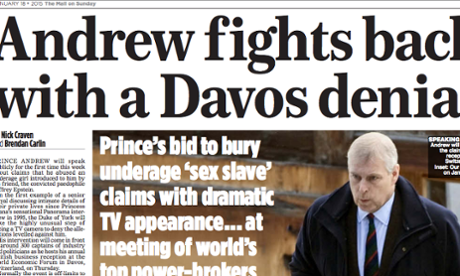
It is assumed that Prince Andrew is going to speak in front of TV cameras this week about the claims by a woman that he had sex with her when she was under the age of consent.
The Mail on Sunday was the first to report it. The Times, although noting that Buckingham Palace described the report as speculation, appeared to accept it as fact in an article headlined Prince due to speak publicly about sex allegations.
Others, such as the Daily Telegraph, the Guardian (here) and the Daily Mail (here) also run similar articles suggesting he will address the “sex slave” subject at his annual Davos party.
We must wait until Thursday to see whether he does indeed take such an unprecedented step. Meanwhile, some papers overlooked the import Mail of Sunday’s major revelation about Andrew’s party, that it is being funded by two big British businesses: Diageo and KPMG. (The Sunday Times’s Prufrock column also mentioned that fascinating factual detail).
In recent weeks, since the latest crop of stories about Prince Andrew’s relationship with the convicted sex offender, Jeffrey Epstein, first broke, I have noted another intriguing phenomenon.
The Telegraph and Mail titles, all four of which would be regarded - and regard themselves - as supporters of monarchy in general and Queen Elizabeth in particular, have published much of the critical material about the prince.
After yesterday’s full page in the Mail on Sunday, there was a full page in today’s Daily Mail. But the really interesting piece was in yesterday’s Sunday Telegraph because it dealt not with sex allegations, but the extraordinary matter of the jet-setting prince’s mysterious finances.
The global odyssey of Air Miles Andy explored the Duke of York’s globe-trotting schedule in 2014. It told of him visiting 15 countries on working visits “almost four times as many as the Duke of Cambridge and six more than any other member of the Royal family”.
It wondered how he afforded it, given that he “has no income of his own and has to rely on the patronage of the Queen, who in turn derives her wealth from land and property income controlled by the Treasury”.
But there is a cost to the taxpayer because he is always travels with police bodyguards at all times, whose travel costs are funded by the public purse.
The Sunday Telegraph article cited one critic, a Labour MP Paul Flynn, who described the prince as “totally unaccountable” and revealed that “at least one of the duke’s visits was not listed in the court circular, the official gazette of royal engagements.”
The paper discovered he had been to Bahrain last April from studying a list of official gifts to members of the royal family. It continued:
“During some of the trips the Duke, a fanatical golfer, had several days without any official engagements, suggesting he was combining work and leisure on the same trips.
He has been criticised in the past for tagging on golf breaks to official visits funded by the taxpayer.
Following a visit to Saudi Arabia from November 16 to 20, the Duke carried out an engagement in the United Arab Emirates with his daughter Princess Beatrice on November 24, suggesting he had several days off in the Gulf in between”.
Of the 15 countries visited by the Duke in 2014, seven were official visits on behalf of the government and six more were described by Buckingham Palace as “working visits” paid for from private funds. The visit to Bahrain in April and a visit to the UAE were said to be “private” visits.
It may be understandable that the sex allegations are getting most attention with big headlines, but the prince’s ability to travel the world, and the consequent on-cost to the taxpayer of protecting him is surely a reason for even wider newspaper attention.
Similarly, should not editors question the wisdom of Diageo and KPMG in funding the prince’s Davos party?
Do these companies’ public relations departments really think there is a benefit in being seen to underwrite a prince who has been unwise enough to consort with a man after he had served 13 months in jail on sex offences?