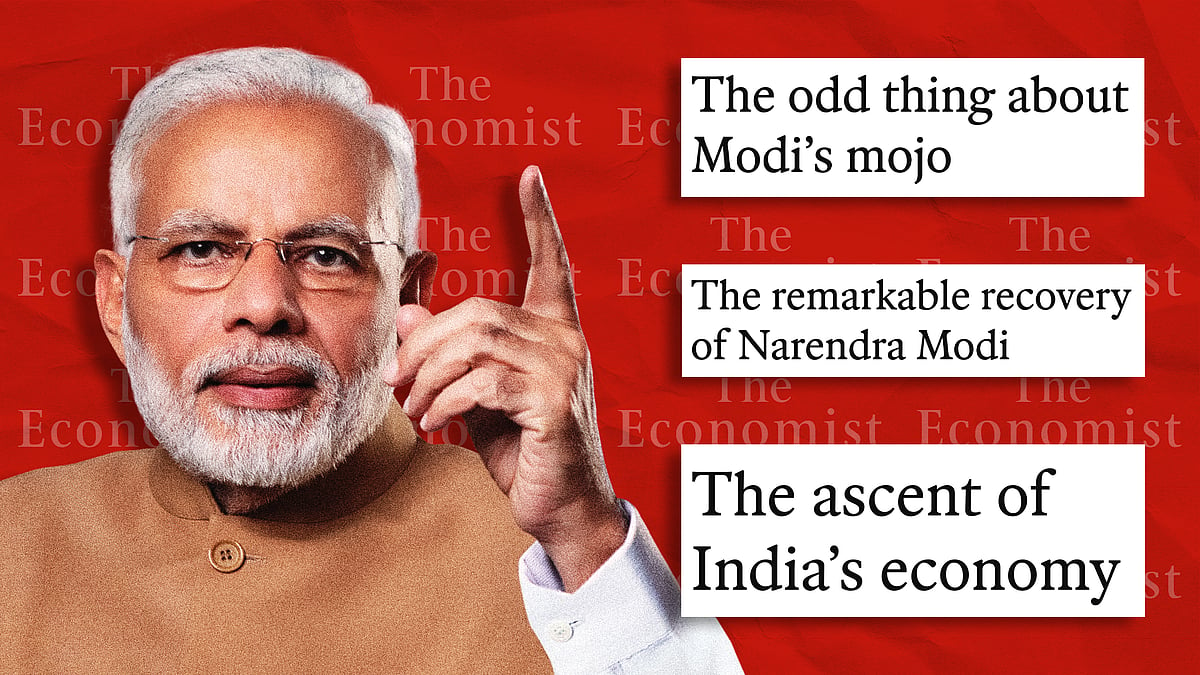
For an outlet that prides itself on cool detachment, The Economist has lately sounded unusually starry-eyed about India.
In three pieces last month — in the Asia, Finance and Economics, and Leaders sections — the house journal of market liberalism declared that Narendra Modi has bounced back, reforms are “rigorous”, inflation is tamed, and the economy is “outperforming expectations”. Prime Minister Narendra Modi is portrayed less as a polarising strongman than as a seasoned statesman quietly engineering a historic turnaround.
The Economist had earlier usually been more cautious about Modi while lauding his focus on “growth”. Read all about it here.
In a piece headlined “The remarkable recovery of Narendra Modi” that was published in the Asia section on January 21, the outlet wrote that the Modi government has “rediscovered its zeal”.
“Sixteen months ago Narendra Modi looked chastened. Having just lost his majority in a national election, the chest-thumping Indian leader was forced to lean on regional parties. His coalition showed little appetite for difficult reform. Some commentators pronounced it ‘Peak Modi’. Would-be successors began to plot. Today things look rather different.”
Considering the BJP’s electoral performance in 2024, the Economist said the party was “quick to identify lessons”. It said the government has “taken action to improve food supply and distribution”, has “refrained from launching many new temperature-raising initiatives”, and Modi has not gone down the path to introduce a uniform civil code.
“Instead, he has focused his movement on the idea of making India strong,” it said, referring to India’s conflict with Pakistan, and how “most Indians approve of the way he has stood up to Mr Trump”. “And he has used pressure from abroad as a pretext for reform. Freeing up labour and reducing the cost of power are urgent, he argues, if Indian manufacturers are to compete. So, too, is reducing trade barriers,” it stated.
The Economist also pointed out Rahul Gandhi’s voter fraud allegations, noting that it “is true that the government has undermined the independence of India’s electoral commission, and that election-watchers have reported some irregularities”. “Yet Mr Gandhi has not presented evidence of widespread fraud, nor have analysts found a smoking gun.”
“Mr Modi’s dominance is not guaranteed. States including Kerala, Tamil Nadu and West Bengal go to the polls this spring. Those contests will be trickier than the one in Bihar. Although inflation has abated, anger about a lack of jobs has not. Protests have flared over conditions for gig workers. A stronger opposition would help hold the government to account. But for now Mr Modi is ascendant.”
In another piece in the Finance and Economy section on January 22, the outlet pointed out that a “combination of three things – luck, macroeconomic policy and structural reform – is reason for optimism, in both the short and long term”. It noted that the Indian economy is “showing remarkable promise” given the “headwinds it faces”.
The Economist said that in the year to the third quarter, “gdp grew by 8.2%, much faster than expected. The government has raised its forecast for the 2026 fiscal year (ending on March 31st), which will feed into the budget on February 1st, from a range of 6.3-6.8% to 7.4%. That is the sort of pace that India needs to meet Mr Modi’s 2047 target. Meanwhile, inflation is down to 1.3%.”
Notably, Indian growth statistics have long come with asterisks the size of footnotes. The GDP deflator magic, wholesale-price distortions, base effects, and the persistent puzzle of weak private investment and jobless growth rarely made it into the celebratory narrative of the article. As did the fact that India has often looked statistically muscular and socially anemic at the same time. Additionally, the quality of India’s macroeconomic data has become suspect with institutions like the International Monetary Fund.
The caveats appeared – from soft capex to weak investment – but the prose largely returned to faith.
“The longer term looks even more promising, thanks to a vigorous reform effort aimed at problems that have bedevilled the economy for decades. A long-mooted cut in the number of labour codes, from 29 to four, was enacted in November. A cap of 74% on foreign direct investment in the insurance industry has been lifted. Nuclear power has been opened up to the private sector. Financial-market regulation has been overhauled. The states have also pursued reforms,” the article stated.
In another piece headlined “the odd thing about Modi’s mojo”, the outlet noted: “Yet as America grows increasingly protectionist and erratic, India’s reformist turn deserves praise. Mr Modi could have responded to his setback at the ballot box, or to Mr Trump’s tariffs, in a much less constructive manner. Indians seem to have recognised that building a whizzier economy is the best way to gain global clout. Mr Modi should double down on economic pragmatism, and keep his divisive impulses in check.”
In a piece last week, the outlet said Indian agriculture “should be the next target of Narendra Modi’s reform drive”, referring to “distorted incentives produced by a web of subsidies, from cheap power and fertiliser to government-backed price guarantees for certain crops”, and batting for deregulation.
After the Trump-Modi phone call, the Economist published another piece on the “good news”.
Though it noted that the details of the US-India deal remain unclear, including India’s stance on Russian oil. “Signs point towards it buying less. Fewer Russian tankers have been arriving in Indian ports, and India’s oil minister, Hardeep Singh Puri, hinted last week that the country might tilt more towards purchases from Venezuela. A tougher nut to crack may be Mr Trump’s claim that India will reduce its tariff and non-tariff barriers on American goods to zero. That is unlikely. Agriculture has long been a sticking point: India restricts gm crops, and feeding practices in America’s dairy industry include animal by-products.”
At Newslaundry, we believe in holding power to account. Our journalism is truly in the public interest – funded by our subscribers, not by ad revenue from corporations and governments. You can help. Click here and join the tribe that pays to keep news free.
Newslaundry is a reader-supported, ad-free, independent news outlet based out of New Delhi. Support their journalism, here.